
Business Architecture for Data and Analytics: AI Transformation Blueprint
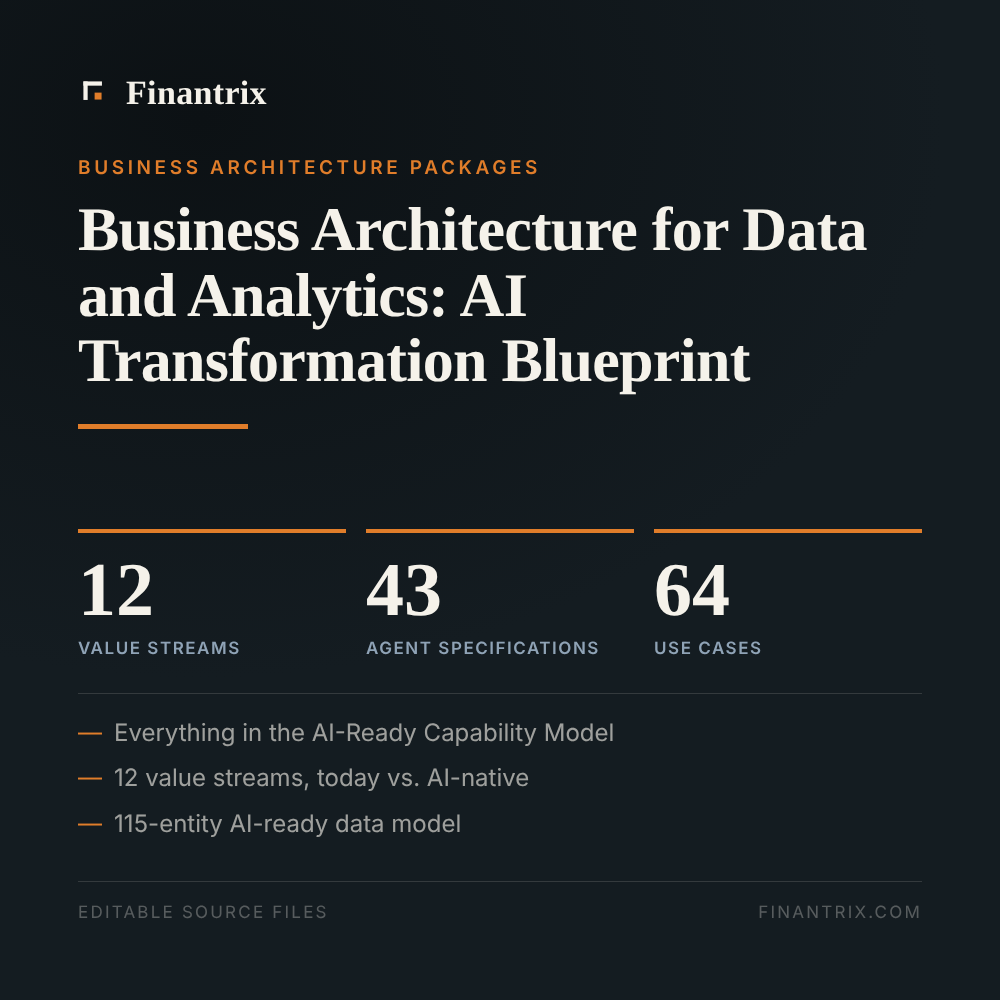
Data and analytics architecture with 12 value streams, a 115-entity data model, 43 agent specification starters, 64 use cases and 45 controls.
About This Business Architecture Package
Data and analytics business architecture is the starting point this blueprint gives teams at banks, insurers, asset and wealth managers and payments firms planning AI across their data function. The content is cross-industry. It covers capabilities, value streams, a business data model of 16 subject areas, and the AI layer on top: 43 agent specification starters, 64 use cases, 45 controls and responsible AI principles, an operating model with a RACI, and a three-wave roadmap. A leadership presentation template helps take the plan to the people who fund it.
What it isInside the Business Architecture for Data and Analytics
The blueprint is the capability model plus everything an AI program in the data function has to design after it has chosen where to start. The capability layer is the same as the AI-Ready Edition: 8 L1, 48 L2 and 192 L3 capabilities, an AI profile for every L2, ratings for every L3, the prioritization model, the heatmap and the readiness assessment. The blueprint builds the remaining layers on those IDs, so an agent, a use case and a control all trace back to the capability they serve.
Twelve data and analytics value streams, with 60 stages, show how the work flows from request to outcome, each stage described as it runs today and as it would run AI-native, with the human checkpoint named. The business data model has 16 subject areas, 115 entities, 743 attributes and 388 relationships, with sensitivity and data-quality requirements, which is the information an agent would read or write. The 43 agent specification starters give each agent its tool permissions, guardrails and escalation path.
Above that sit the decisions that make AI governable: 64 use cases written as structured business cases, 45 controls and responsible AI principles tied to the risk tiers, an operating model with governance bodies, a RACI, an agent lifecycle, role impacts and new roles, and a roadmap in three waves. The leadership presentation template turns the result into something an executive committee can approve.
The Problem Behind It
Choosing where AI fits is the first decision, not the last. Once a data function knows which capabilities to start with, it still has to say how the work will run, what data the agents can touch, who approves what, which controls apply and what order the changes go in. Most programs answer those questions one project at a time, which produces agents with inconsistent permissions and controls written after the fact.
In data and analytics the cost of that is specific. An agent that proposes corrections to data of record, drafts a lineage record or answers a business question from a governed dataset sits on top of the information every other function depends on. The blueprint designs those agents against one data model, one set of controls and one operating model, so the second and tenth agent follow the same rules as the first.
The deliverablesWhat's Inside
- Everything in the AI-Ready Capability Model edition: 8 L1, 48 L2 and 192 L3 data and analytics capabilities, with definitions to L3 and 193 KPIs at L2, an AI profile for every L2, AI ratings for every L3, prioritization, the AI heatmap and a 40-question readiness assessment
- 12 data and analytics value streams, 60 stages with their steps, each described today and AI-native, with the human checkpoint at every stage, plus 13 standard value streams
- An AI-ready business data model: 16 subject areas, 115 entities, 743 attributes and 388 relationships, with sensitivity and data-quality requirements
- 43 agent specification starters with tool permissions, guardrails and escalation paths
- 64 use cases as structured business cases
- 45 controls and responsible AI principles, tied to risk tiers
- An operating model: governance bodies, a RACI, an agent lifecycle, role impacts and new roles
- A three-wave roadmap
- A Welcome document, a leadership presentation template to adapt, the capability map deck, standalone documents for the capability definitions, KPIs, data model, agent specifications, use cases and AI governance, a value streams deck, the Excel workbook, the implementation guide
- Bonus files: a data and analytics glossary, data and analytics roles and how AI changes them, data and analytics operating model archetypes, a data and analytics transformation overview and framework, A Practical Guide to Business Architecture, a capability modeling overview, an AI-ready capability profile template, capability relationship mapping templates, a framework-to-enablement deck, a capabilities to microservices and AI agents mapping example, and a business architecture leader role guide
- Free corrections, and new versions free for 180 days
Every file names your organization and carries your license ID. Ratings describe a typical large enterprise and are a starting point for your own.
Putting it to workUse Cases
Redesigning a value stream for AI. Take a value stream behind one of your top-ranked capabilities and compare its today and AI-native stages. The human checkpoint at each stage tells you where an agent stops and a Data Owner or Steward decides.
Specifying and approving data agents. Start from the agent specification starters to write the agents your team plans to build or buy. Each one already states tool permissions, guardrails and escalation, so architecture and risk reviewers can approve a design rather than a demo.
Building the AI use case portfolio. The 64 use cases are written as structured business cases tied to capabilities and risk tiers. Select and adapt them to fill a portfolio, and drop the ones that do not fit, instead of collecting proposals from each team in different formats.
Setting up AI governance for the data function. Adopt the controls and responsible AI principles, matched to the risk tiers, as the baseline your governance body reviews against. A new agent then inherits the controls for its tier instead of negotiating them.
Designing the data operating model. Use the governance bodies, the RACI, the agent lifecycle and the role impacts to decide who owns agents, who approves changes to them and which roles change as AI takes on preparation work.
Funding the program. Adapt the leadership presentation template and the three-wave roadmap to show an executive committee what each wave delivers, what it depends on and what stays under human decision.
Who It Is For
Chief Data Officer. Owns the roadmap and the case for funding, and uses the operating model to set who is accountable for each agent and dataset.
Enterprise and business architects. Keep capabilities, value streams, data entities, agents and controls linked by ID, and use the model as the reference for solution designs.
Data governance and AI risk leads. Apply the controls and principles by risk tier, review agent specifications and confirm that every decision about data of record stays with a named person.
Data and AI engineering leads. Build from the agent specification starters and the business data model, so permissions and data access are designed before code is written.
Transformation and program managers. Run delivery against the three-wave roadmap and track what each wave changes in the value streams and KPIs.
The economicsThe Alternatives
An AI transformation design for data and analytics touches every layer of the architecture, so the choice of where to start shapes most of the program's early months.
- Building it from a blank slate. Teams model the capabilities, map the value streams, design a data model, write agent specifications, draft use cases, define controls and agree an operating model, each through its own workshops and review cycles. Keeping all of those layers consistent with each other is a job in itself, and it usually falls behind.
- Hiring consultants to build it. Consultants can run the workstreams in parallel, but they still have to elicit the generic structure before they reach what is particular to you, and the cross-references between layers are only as good as the last review.
- Starting from this model. Every layer arrives drafted and linked: capabilities to value stream stages, data entities, agents, use cases and controls, with the links validated before release. Workshops start by deciding what to change, and the first complete draft exists on day one.
Outside help earns its cost on what is particular to your organization: fitting the operating model to your structure, adjusting risk tiers to your own appetite, and deciding which use cases deserve funding. Drafting a generic agent specification or data entity is not where that judgment is needed.
Getting Started
- Read the Welcome document and the implementation guide, then rank the capabilities with the prioritization model as the AI-Ready Edition does.
- For the top-ranked capabilities, open the value streams they appear in and review the AI-native stages and human checkpoints with the people who run them.
- Select the use cases and agent specification starters that serve those stages and adapt them to your systems and data.
- Adopt the controls for each risk tier and set up the governance bodies and RACI from the operating model.
- Adjust the three-wave roadmap and the leadership presentation template, and take them to the people who fund the program.
Read the Public Sample
The sample follows one thread through the package, data quality issue resolution, and is 0.82% of the content. From the Data Quality Issue Resolution (DA-6.3) AI profile:
- Work patterns: Analysis & insight, Rules-based decision, Coordination & orchestration
- Target AI mode: Augment
- Human oversight: Human-in-the-loop
- AI fit / Value / Feasibility / Data readiness: 3 / 5 / 3 / 2 (1–5)
- Risk tier: High
- Roadmap wave: Wave 2
- AI opportunity: Log quality issues from checks, consumer reports and stewards in one record, merge duplicates and propose severity and an owner from the critical data elements and reports affected
- What stays human: The Data Owner approves every correction of data of record, at its source and in its copies, on the evidence the Data Steward prepares, after hearing the Data Quality Lead
Upgrade Credit
Bought the AI-Ready Capability Model edition in the last 90 days? The full price you paid counts toward this Blueprint. Email support@finantrix.com with your order number for a one-time checkout code.
Read before you buyFrequently Asked Questions
What is the difference between the two editions?
The AI-Ready Capability Model covers the capability map, an AI profile for every L2 capability, prioritization, the heatmap and the readiness assessment. The AI Transformation Blueprint adds value streams redesigned for AI, the business data model, agent specifications, use cases, responsible AI principles and controls, the operating model and the roadmap, a leadership presentation template, and bonus files on roles, operating model archetypes and transformation.
Can I upgrade from the Capability Model to the Blueprint later?
Yes. The full price you paid for the Capability Model counts toward the Blueprint if you upgrade within 90 days. Email support@finantrix.com with your order number for a one-time checkout code.
What happens after 180 days?
Your license to use the files does not end. Corrections are free for as long as you use the files. New versions released within 180 days of purchase are free: we email you a new download link when one is released. There is no renewal after that: you can buy a new version at 25% off its price.
Can I load the content into our own AI tools?
Yes, within the license. The Enterprise license allows internal tools, including your own assistants and agents. Neither license allows training, fine-tuning or prompting AI systems for third parties.
Does the package cover AI laws and regulations?
No, by design. It is business architecture: capabilities, value streams, data and the AI layer describe what data and analytics does and how AI fits, and they hold whichever laws apply where you operate. The risk tiers, principles and controls are durable practices your compliance team maps to your own jurisdictions.
Why not just ask ChatGPT or another AI assistant?
For orientation, an AI assistant does well: it can sketch a data value stream or suggest agents for data quality work in a minute. What it cannot give you is a design that holds together. Each answer is generated fresh, the agents it proposes have no permissions or guardrails unless you write them, and nothing links an agent to the data it reads or the control that governs it. This blueprint is for decisions that must stand up to review: stable IDs across capabilities, value streams, data entities, agents, use cases and controls, with every cross-reference checked before release, rated AI profiles, risk tiers, 45 controls and a scoring model you weight yourself.
| A generic AI-generated list | This package | |
|---|---|---|
| Structure | A plausible list that changes between runs | A fixed model with stable IDs: 8 L1, 48 L2 and 192 L3 capabilities, defined to L3 |
| Cross-references | Not checked | Every link between capabilities, value stream stages, data entities, agents, use cases and controls is validated before release |
| Where AI fits | Suggestions you have to verify yourself | An AI profile for every L2 capability: AI mode, human oversight, opportunities, what stays human, data, KPIs, prerequisites and risks |
| Risk | Generic cautions | A risk tier for every capability, agent and use case, 45 controls and responsible AI principles, with every decision about a person kept with a named human |
| Agents | Ideas, without permissions or guardrails unless you write them | 43 agent specification starters with tool permissions, guardrails and escalation paths |
| Scoring | No model to score against | A prioritization model with your own ratings and weights, and a 40-question readiness assessment |
| Durability | Shifts with each prompt and model version | Capabilities that describe what data and analytics does, independent of any tool, vendor or law, with free corrections and 180 days of free new versions |
What's Included
+ 14 more files included
At a Glance
- Everything in the AI-Ready Capability Model
- 12 value streams, today vs. AI-native
- 115-entity AI-ready data model
- 43 agent specifications with guardrails
- 64 use cases
- 45 controls · responsible AI principles
- Operating model + three-wave roadmap
- New versions free for 180 days
Enterprise License
Consultancy License
All sales are final. We do not offer refunds, returns or exchanges.
Delivered instantly on payment. EU and UK consumers: starting the download ends the 14-day right of withdrawal.
Prices exclude tax. Any sales tax, VAT or GST due in your country is added at checkout.
Sign up for Finantrix Insights for periodic updates of new and notable.
Protected by reCAPTCHA. No spam. Unsubscribe anytime.
The Finantrix Store sells reusable business-architecture reference deliverables — capability models, data models, and value-stream maps — built for financial-services strategy and technology teams.
Browse the full Store →Before You Buy
The questions worth settling first. Still unsure? Email us before purchasing — sales are final.
What exactly do I receive?
The files listed under "What's Included" on the product page, and nothing beyond them. Most products are editable PowerPoint, Excel, and Word documents; some are supplied as archives containing those files. Delivery is immediate — a download link is issued as soon as payment completes.
Are the files editable, or locked?
Editable. They are working documents in their native formats, not locked PDFs or images, because the point of the product is that you customize it. A few reference guides are supplied as PDF where editing them would serve no purpose.
How long is my download link valid?
Links stay active for 7 days after purchase and allow up to 3 downloads. Save the files somewhere durable when you receive them. If a link expires or you run out of downloads, email support@finantrix.com and we will issue a new one — that is a support request, not a repurchase.
What is the difference between the Enterprise and Consultancy licenses?
An Enterprise License covers use anywhere within a single organization — your colleagues can all work from the material. A Consultancy License covers use across multiple client engagements, which the Enterprise License does not permit. If you advise more than one organization, the Consultancy License is the one you need. Full terms are at /legal/digital-products-terms.
Do I get a receipt and proof of license?
Yes, both, automatically. Your order confirmation email links to a purchase receipt and a license certificate, and normally carries them as PDF attachments as well. Unlike the download link, those documents do not expire and opening them does not use up one of your 3 downloads — they are there for expense claims, accounting, and procurement reviews that arrive long after the files do. Finantrix collects no sales tax or VAT, so the receipt shows the tax line as not applicable rather than as a computed amount.
Can I get a refund?
As a rule, no. These are digital products delivered immediately and in full, so sales are final — we do not offer returns, refunds or exchanges once a purchase completes. If you buy as a consumer in the EU or UK, you have a 14-day right of withdrawal that ends when you ask us to start the download, which is what you confirm at checkout. Where Stripe is the merchant of record for your purchase, Stripe operates its own refund process and may decide a request itself. All of this is why every product page carries a detailed manifest and an honest note on fit: we would rather you decide correctly before buying than be disappointed afterwards. If you are unsure whether a product suits your situation, email support@finantrix.com before purchasing and we will tell you.
How much customization should I expect to do?
A meaningful amount, and that is by design. These are generic, sector-level artifacts intended as a substantial head start rather than a finished deliverable for your organization. Each product page includes an honest note on fit setting out, deliverable by deliverable, what is complete and what you will need to supply.
Is implementation help or support included?
No. The purchase covers the files only — it does not include customization, implementation assistance, training, or consulting. Our consulting team is available separately on a paid basis if you want deeper help; contact us to discuss scope.
Do you offer a preview or sample before purchase?
Not as a downloadable sample. The product page is the preview: it lists every file, states the capability counts and levels of decomposition, and sets out where the artifact stops. If something specific would settle your decision, email support@finantrix.com and ask.
Can I share the files with colleagues or clients?
Colleagues within your organization, yes, under the Enterprise License. Clients, no — that requires a Consultancy License. Redistribution, resale, or publishing the material publicly is not permitted under either license.
How current is the content?
The artifacts describe business structure — capabilities, value streams, information entities — which changes far more slowly than technology or regulation. Where a product includes market-facing material such as vendor profiles, the product page says so and advises verifying currency before relying on it for a decision.
Related Frameworks
Business Architecture Packages
Business Architecture for AI Management: AI Transformation Blueprint
From $3295Business Architecture Packages
Business Architecture for Banking and Payments: AI Transformation Blueprint
From $4995Business Architecture Packages
Business Architecture for Cybersecurity: AI Transformation Blueprint
From $3295Business Architecture Packages