
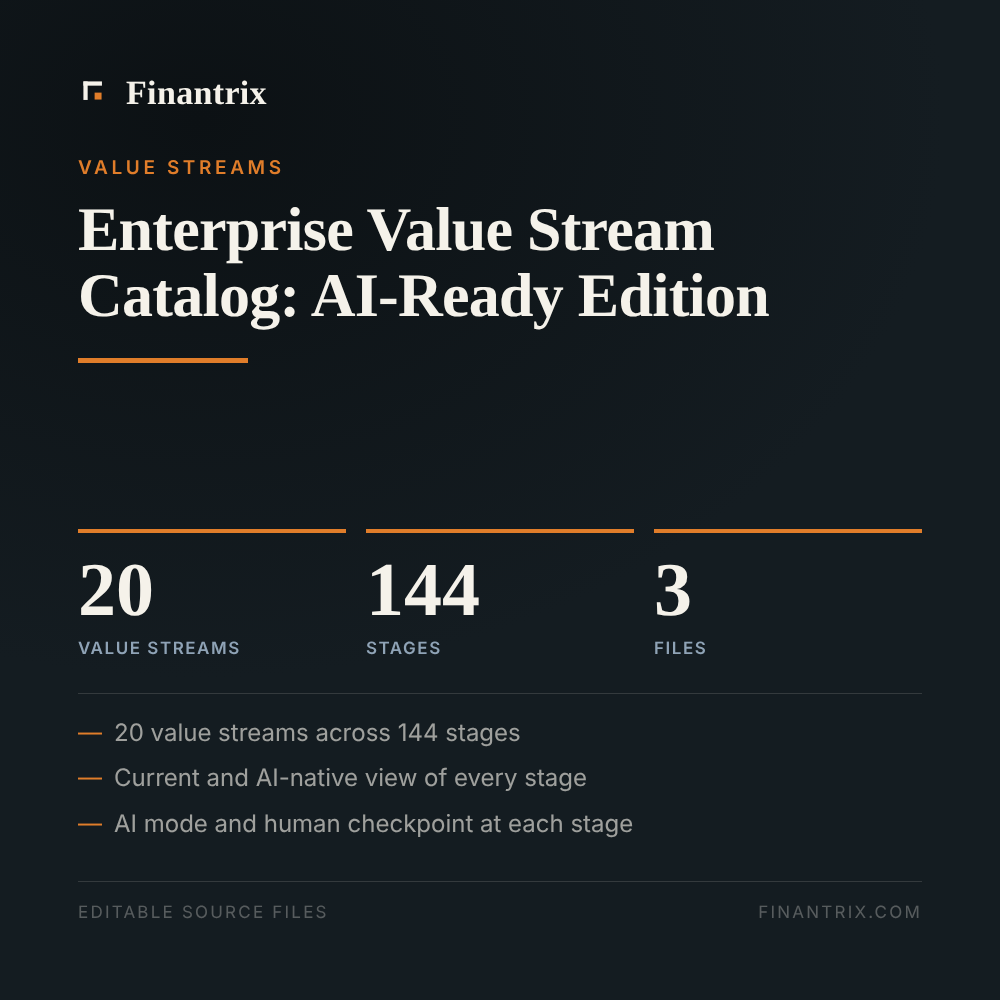
Enterprise Value Stream Catalog: AI-Ready Edition
A catalog of 20 enterprise value streams and 144 stages, each stage shown today and AI-native, with its AI mode and human checkpoint
About This Value Stream Collection
Enterprise Value Stream Catalog: AI-Ready Edition catalogs the end-to-end work of the enterprise for architects and transformation leads in financial services firms: 20 value streams in 144 stages, each running across functions from a trigger to a result. Every stage is set out twice, as it runs today and as it could run AI-native, with the target AI mode, the agents involved and the checkpoint where a person decides. The catalog is taken from Enterprise Business Architecture Package: AI Transformation Blueprint and sold on its own.
The Catalog
Each entry names the stream, its number of stages and the outcome it delivers.
- Strategy to Execution (7 stages). Outcome: The board, the executives and every business area work from one agreed strategy, funded plan and set of targets, and see early whether the enterprise is delivering them.
- Idea to Market (8 stages). Outcome: Customers get new and changed offerings that meet a tested need, and the enterprise launches only offerings it can sell, deliver and support at a set price and on set terms.
- Market to Customer (7 stages). Outcome: Sales teams receive qualified, consented leads with their context and self-service buyers reach a first purchase, while marketing spend goes to the campaigns and channels that produce results.
- Opportunity to Order (6 stages). Outcome: Buyers receive a solution, price and contract that fit their needs, and the enterprise books complete orders, within approved pricing and authority, that delivery and billing can act on without rework.
- Order to Cash (6 stages). Outcome: Customers receive what they ordered and accurate bills they can pay easily, and the enterprise collects its cash sooner and records revenue and receivables correctly.
- Onboard to Renew (6 stages). Outcome: Customers reach the outcome they bought and keep getting value from it, and the enterprise keeps and grows the revenue from each relationship.
- Issue to Resolution (7 stages). Outcome: Customers get their question answered, their problem fixed or their complaint decided fairly in the channel they chose, and the enterprise removes the causes so fewer customers need to contact it.
- Forecast to Produce (7 stages). Outcome: Sales, operations and finance work to one agreed plan, and customers can be promised orders against goods that have been produced, inspected and released to stock at a known cost.
- Order to Deliver (7 stages). Outcome: Customers receive the goods they ordered complete, on the promised date, with the documents they need and installed where agreed, and the enterprise bills on proof of delivery and recovers value from returns.
- Procure to Pay (8 stages). Outcome: Budget holders get the goods and services they need from qualified, contracted suppliers on terms within authority, and suppliers are paid correctly and on time with every payment checked before it leaves.
- Hire to Retire (7 stages). Outcome: Business units get the people their plans need, and each employee gets a correct, fair and supported working life from offer to exit, with pay right and access matching the role at every point.
- Record to Report (8 stages). Outcome: Management, the board, investors and lenders receive accurate, assured financial results and tax filings on schedule, with every figure traceable to the ledger.
- Acquire to Retire (7 stages). Outcome: Operations and employees get the physical, technology and real estate assets they need, kept reliable and accounted for, and finance gets an asset base whose cost and value it can trust from acquisition to disposal.
- Request to Fulfill (5 stages). Outcome: Employees and managers get the internal technology, human resources, workplace and shared services they ask for through one catalog and within agreed service levels, and service owners see what each service costs and how well it performs.
- Risk to Assurance (8 stages). Outcome: The board, executives and outside stakeholders get confidence that the enterprise's risks are known, within appetite and controlled, and that it meets its obligations, on one evidenced picture of risk, control and assurance.
- Disruption to Recovery (8 stages). Outcome: Employees and others on site stay safe and customers stay served through a disruption, critical business services return within the recovery objectives the business set, and losses are recovered.
- Data to Decision (8 stages). Outcome: Decision owners across the enterprise get answers built on governed, quality-checked data and see whether their decisions improved the result, and each question leaves reusable data products and official metrics behind.
- AI Idea to AI in Operation (8 stages). Outcome: Business areas get models and agents that deliver their intended value within an approved risk tier, with people prepared to use and oversee them, and each is retired when it no longer earns its place.
- Deal to Integration (8 stages). Outcome: The enterprise's owners get the value expected from acquisitions, divestitures, joint ventures and alliances, and the businesses and people involved get a planned integration or separation.
- Commitment to Disclosure (8 stages). Outcome: Investors, customers and communities get sustainability disclosures they can rely on, and the enterprise gets targets built into its operations, sourcing and design and measured on checked data.
In the Download
Three files carry the same catalog: a deck for presenting, a workbook for analysis and a guide for reading.
- Stream and stage detail: steps, stakeholders, entry and exit criteria, and the capabilities that enable each stage
- At each stage: current pain points, the AI-native design, agents, target AI mode, human checkpoint and KPIs
- Value Streams deck (PowerPoint), with each stream as a flow and then one stage at a time
- Workbook (Excel), with the streams and stages in sheets to filter and extend
- Guide (Word), covering the AI mode, human oversight, risk tier and work pattern scales, each stream in prose, and the license
- Corrections free of charge, and new versions free for 180 days after purchase
Your organization's name and license ID are printed in every file.
Who It Is For
Process owners redesigning work that crosses functions, transformation leads planning from a future-state view, and architects linking value streams to capabilities.
With the Other Editions
The Enterprise Capability Matrix: AI-Ready Edition defines the capabilities each stage names, and Enterprise Business Architecture Package: AI Transformation Blueprint specifies the agents and adds the data model, use cases, controls, operating model and roadmap. The Enterprise Business Information Model is sold on its own as well.
Target AI modes reflect a typical large enterprise; treat them as a first draft of your own.
What's Included
At a Glance
- 20 value streams across 144 stages
- Current and AI-native view of every stage
- AI mode and human checkpoint at each stage
- PowerPoint, Excel and Word
- New versions free for 180 days
Enterprise License
Consultancy License
All sales are final. We do not offer refunds, returns or exchanges.
Delivered instantly on payment. EU and UK consumers: starting the download ends the 14-day right of withdrawal.
Prices exclude tax. Any sales tax, VAT or GST due in your country is added at checkout.
Sign up for Finantrix Insights for periodic updates of new and notable.
Protected by reCAPTCHA. No spam. Unsubscribe anytime.
The Finantrix Store sells reusable business-architecture reference deliverables — capability models, data models, and value-stream maps — built for financial-services strategy and technology teams.
Browse the full Store →Before You Buy
The questions worth settling first. Still unsure? Email us before purchasing — sales are final.
What exactly do I receive?
The files listed under "What's Included" on the product page, and nothing beyond them. Most products are editable PowerPoint, Excel, and Word documents; some are supplied as archives containing those files. Delivery is immediate — a download link is issued as soon as payment completes.
Are the files editable, or locked?
Editable. They are working documents in their native formats, not locked PDFs or images, because the point of the product is that you customize it. A few reference guides are supplied as PDF where editing them would serve no purpose.
How long is my download link valid?
Links stay active for 7 days after purchase and allow up to 3 downloads. Save the files somewhere durable when you receive them. If a link expires or you run out of downloads, email support@finantrix.com and we will issue a new one — that is a support request, not a repurchase.
What is the difference between the Enterprise and Consultancy licenses?
An Enterprise License covers use anywhere within a single organization — your colleagues can all work from the material. A Consultancy License covers use across multiple client engagements, which the Enterprise License does not permit. If you advise more than one organization, the Consultancy License is the one you need. Full terms are at /legal/digital-products-terms.
Do I get a receipt and proof of license?
Yes, both, automatically. Your order confirmation email links to a purchase receipt and a license certificate, and normally carries them as PDF attachments as well. Unlike the download link, those documents do not expire and opening them does not use up one of your 3 downloads — they are there for expense claims, accounting, and procurement reviews that arrive long after the files do. Finantrix collects no sales tax or VAT, so the receipt shows the tax line as not applicable rather than as a computed amount.
Can I get a refund?
As a rule, no. These are digital products delivered immediately and in full, so sales are final — we do not offer returns, refunds or exchanges once a purchase completes. If you buy as a consumer in the EU or UK, you have a 14-day right of withdrawal that ends when you ask us to start the download, which is what you confirm at checkout. Where Stripe is the merchant of record for your purchase, Stripe operates its own refund process and may decide a request itself. All of this is why every product page carries a detailed manifest and an honest note on fit: we would rather you decide correctly before buying than be disappointed afterwards. If you are unsure whether a product suits your situation, email support@finantrix.com before purchasing and we will tell you.
How much customization should I expect to do?
A meaningful amount, and that is by design. These are generic, sector-level artifacts intended as a substantial head start rather than a finished deliverable for your organization. Each product page includes an honest note on fit setting out, deliverable by deliverable, what is complete and what you will need to supply.
Is implementation help or support included?
No. The purchase covers the files only — it does not include customization, implementation assistance, training, or consulting. Our consulting team is available separately on a paid basis if you want deeper help; contact us to discuss scope.
Do you offer a preview or sample before purchase?
Not as a downloadable sample. The product page is the preview: it lists every file, states the capability counts and levels of decomposition, and sets out where the artifact stops. If something specific would settle your decision, email support@finantrix.com and ask.
Can I share the files with colleagues or clients?
Colleagues within your organization, yes, under the Enterprise License. Clients, no — that requires a Consultancy License. Redistribution, resale, or publishing the material publicly is not permitted under either license.
How current is the content?
The artifacts describe business structure — capabilities, value streams, information entities — which changes far more slowly than technology or regulation. Where a product includes market-facing material such as vendor profiles, the product page says so and advises verifying currency before relying on it for a decision.
Related Frameworks
Business Architecture Packages
Enterprise Business Architecture Package: AI Transformation Blueprint
From $9995Capability Models
Enterprise Capability Matrix: AI-Ready Edition
From $4995Business Information Model
Enterprise Business Information Model: AI-Ready Edition
From $495Value Streams