
Sustainability Business Information Model: AI-Ready Edition
The sustainability information model for AI: 14 subject areas, 100 entities and 674 key attributes, each with sensitivity and AI use
About This Business Information Model
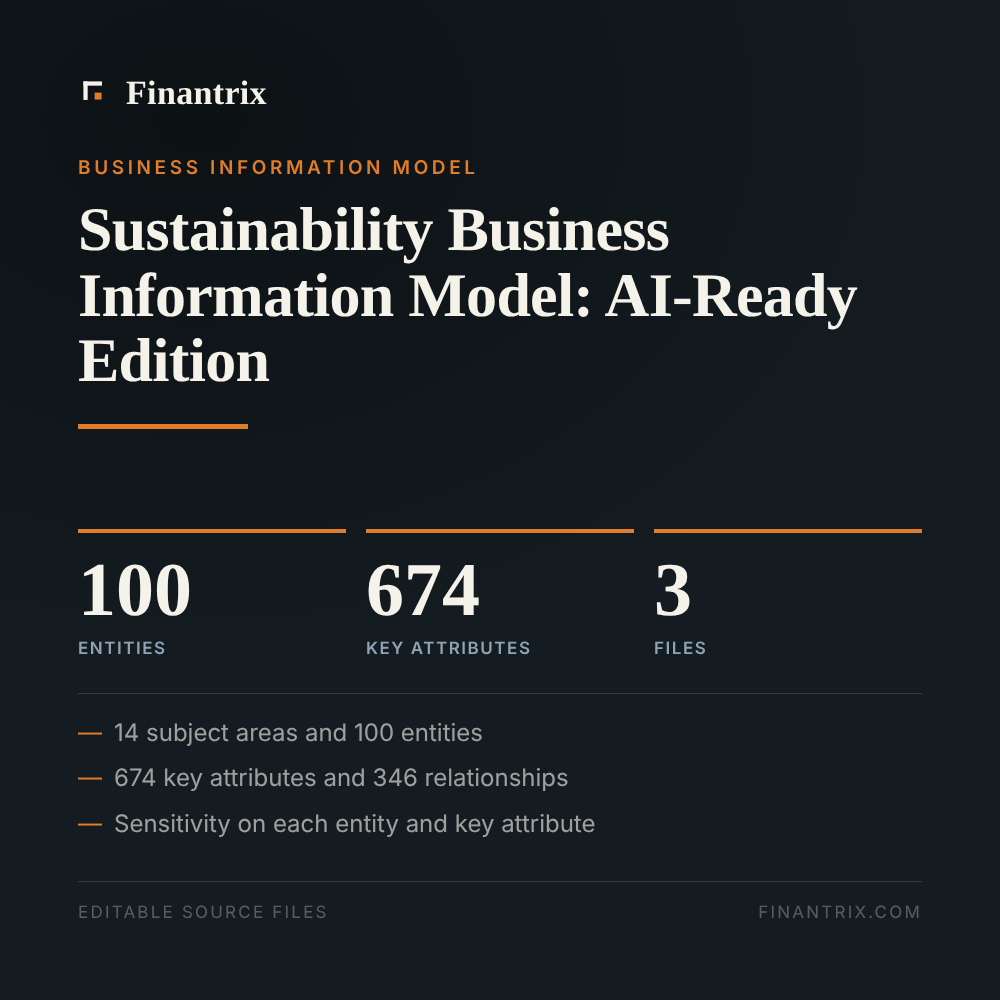
Sustainability Business Information Model: AI-Ready Edition sets out the information the sustainability function works with, so architects and transformation leads in financial services firms can see what an AI agent would read and how carefully it must be handled: 14 subject areas, 100 entities, 674 key attributes and 346 relationships. Every entity and key attribute has a sensitivity class, the AI uses it serves and the data-quality requirements an agent relies on. It is the information model inside Sustainability Business Architecture Package: AI Transformation Blueprint, sold separately.
Subject Areas
14 subject areas group the 100 entities.
- Sustainability Strategy, Materiality & Finance (8 entities). Scope: The direction and funding of sustainability: the ambition, the roadmap initiatives that deliver it, the topics judged material and how they were assessed, the program budget, and the sustainability inputs to Finance's decisions (the internal carbon price proposal, capital appraisal effects and financing support).
- Targets, Governance & Policy (6 entities). Scope: What the organization commits to and how it is governed: targets with their baselines and every change to them, the objectives cascaded to business units and sites, the bodies that oversee sustainability, and the policies and public commitments.
- Emissions Inventory (8 entities). Scope: The records behind the emissions inventory: the operating sites and inventory boundary, the emission sources, the activity data, the emission factors and calculation methods approved for reported figures, each calculation and the inventory for a reporting period.
- Emissions Reduction & Energy (6 entities). Scope: How emissions and energy use come down: the decarbonization pathway, reduction opportunities and the projects admitted to the reduction program, energy use by site, energy efficiency measures and renewable energy agreements.
- Climate Risk & Adaptation (5 entities). Scope: Climate risk and adaptation: the hazards sites and suppliers are exposed to, transition risks and opportunities, the plausible climate futures the organization chose to test against, the modeled results and the adaptation actions that follow.
- Carbon Credits (5 entities). Scope: Carbon credits from policy to retirement: the credit policy, the projects considered, their quality assessments, purchases and retirements.
- Water, Waste, Nature & Environmental Impact (11 entities). Scope: Water, waste, nature and environmental impact: water risk and use, wastewater discharges, waste streams and where waste goes, nature impact and dependency assessments, habitat actions, land clearing checks on sourced materials, environmental assessments of projects, site environmental plans and significant incident reviews.
- Products & Circularity (7 entities). Scope: Products and circularity: the products in scope, the product and packaging sustainability criteria, the footprint method and released footprints, substances of concern, end-of-life plans and circular offers such as repair, resale and take-back.
- Suppliers & Sourcing Requirements (9 entities). Scope: What suppliers are asked to meet and how they are assessed: supplier conduct expectations, category criteria, material origin records, risk ratings, data requests, assessments, corrective actions and referrals to Supply Chain.
- Human Rights & Concerns (5 entities). Scope: Human rights in the value chain: salient risks, impact assessments, concerns raised by value chain workers and community members, their resolution and the remedy for people harmed.
- Stakeholders & Communities (8 entities). Scope: Stakeholders and communities: stakeholder groups and dialogue, information requests and questionnaires, sustainability partnerships, the communities around sites, community investment programs, grants and social impact evaluations.
- Sustainability Data & Assurance (9 entities). Scope: The governance of sustainability data: measure definitions, data source owners, measure values with their basis, estimation rules, data quality issues, data controls designed with Finance, evidence records, assurance engagements and their findings.
- Disclosures & Claims (6 entities). Scope: Disclosures and claims: the disclosures the organization makes, the content items in each, restatements of reported figures, environmental and social claims, the evidence reviews behind them and their corrections.
- AI & Digital Labor Governance (7 entities). Scope: The governance of sustainability's AI: the AI systems and agents in use, their action logs, the decisions they supported, validation records, human reviews and the authority limits each agent works within.
In the Download
Three files carry the same model: the full model in Word, a workbook for analysis and a guide.
- For each of the 100 entities: definition, typical system of record, sensitivity class, AI uses and data-quality requirements
- 674 key attributes rated for sensitivity and AI relevance, and 346 relationships with cardinality
- The capabilities that need each entity and the agents that read it, by name and ID
- Business Data Model (Word), every subject area and entity in full
- Workbook (Excel), with subject areas, entities, attributes and relationships to filter and extend
- Guide (Word), covering the scales, the data foundation and the license
- Corrections free of charge, and new versions free for 180 days after purchase
Your organization's name and license ID are printed in every file.
Who It Is For
Data owners and stewards, data architects, and the AI and analytics engineers who decide what an agent may read, how sensitive it is and what quality it needs first; and architects connecting capabilities to data.
With the Other Editions
The capabilities listed under each entity are defined in the Sustainability Capability Matrix: AI-Ready Edition. Sustainability Business Architecture Package: AI Transformation Blueprint contains this model, specifies the agents and adds the value streams, use cases, controls, operating model and roadmap. The Sustainability Value Stream Catalog is sold on its own as well.
What's Included
At a Glance
- 14 subject areas and 100 entities
- 674 key attributes and 346 relationships
- Sensitivity on each entity and key attribute
- AI uses and data-quality requirements
- Linked to capabilities and agents by ID
- Word and Excel
- New versions free for 180 days
Enterprise License
Consultancy License
All sales are final. We do not offer refunds, returns or exchanges.
Delivered instantly on payment. EU and UK consumers: starting the download ends the 14-day right of withdrawal.
Prices exclude tax. Any sales tax, VAT or GST due in your country is added at checkout.
Sign up for Finantrix Insights for periodic updates of new and notable.
Protected by reCAPTCHA. No spam. Unsubscribe anytime.
The Finantrix Store sells reusable business-architecture reference deliverables — capability models, data models, and value-stream maps — built for financial-services strategy and technology teams.
Browse the full Store →Before You Buy
The questions worth settling first. Still unsure? Email us before purchasing — sales are final.
What exactly do I receive?
The files listed under "What's Included" on the product page, and nothing beyond them. Most products are editable PowerPoint, Excel, and Word documents; some are supplied as archives containing those files. Delivery is immediate — a download link is issued as soon as payment completes.
Are the files editable, or locked?
Editable. They are working documents in their native formats, not locked PDFs or images, because the point of the product is that you customize it. A few reference guides are supplied as PDF where editing them would serve no purpose.
How long is my download link valid?
Links stay active for 7 days after purchase and allow up to 3 downloads. Save the files somewhere durable when you receive them. If a link expires or you run out of downloads, email support@finantrix.com and we will issue a new one — that is a support request, not a repurchase.
What is the difference between the Enterprise and Consultancy licenses?
An Enterprise License covers use anywhere within a single organization — your colleagues can all work from the material. A Consultancy License covers use across multiple client engagements, which the Enterprise License does not permit. If you advise more than one organization, the Consultancy License is the one you need. Full terms are at /legal/digital-products-terms.
Do I get a receipt and proof of license?
Yes, both, automatically. Your order confirmation email links to a purchase receipt and a license certificate, and normally carries them as PDF attachments as well. Unlike the download link, those documents do not expire and opening them does not use up one of your 3 downloads — they are there for expense claims, accounting, and procurement reviews that arrive long after the files do. Finantrix collects no sales tax or VAT, so the receipt shows the tax line as not applicable rather than as a computed amount.
Can I get a refund?
As a rule, no. These are digital products delivered immediately and in full, so sales are final — we do not offer returns, refunds or exchanges once a purchase completes. If you buy as a consumer in the EU or UK, you have a 14-day right of withdrawal that ends when you ask us to start the download, which is what you confirm at checkout. Where Stripe is the merchant of record for your purchase, Stripe operates its own refund process and may decide a request itself. All of this is why every product page carries a detailed manifest and an honest note on fit: we would rather you decide correctly before buying than be disappointed afterwards. If you are unsure whether a product suits your situation, email support@finantrix.com before purchasing and we will tell you.
How much customization should I expect to do?
A meaningful amount, and that is by design. These are generic, sector-level artifacts intended as a substantial head start rather than a finished deliverable for your organization. Each product page includes an honest note on fit setting out, deliverable by deliverable, what is complete and what you will need to supply.
Is implementation help or support included?
No. The purchase covers the files only — it does not include customization, implementation assistance, training, or consulting. Our consulting team is available separately on a paid basis if you want deeper help; contact us to discuss scope.
Do you offer a preview or sample before purchase?
Not as a downloadable sample. The product page is the preview: it lists every file, states the capability counts and levels of decomposition, and sets out where the artifact stops. If something specific would settle your decision, email support@finantrix.com and ask.
Can I share the files with colleagues or clients?
Colleagues within your organization, yes, under the Enterprise License. Clients, no — that requires a Consultancy License. Redistribution, resale, or publishing the material publicly is not permitted under either license.
How current is the content?
The artifacts describe business structure — capabilities, value streams, information entities — which changes far more slowly than technology or regulation. Where a product includes market-facing material such as vendor profiles, the product page says so and advises verifying currency before relying on it for a decision.
Related Frameworks
Business Architecture Packages
Sustainability Business Architecture Package: AI Transformation Blueprint
From $3295Capability Models
Sustainability Capability Matrix: AI-Ready Edition
From $1295Value Streams
Sustainability Value Stream Catalog: AI-Ready Edition
From $495Business Information Model