
Cybersecurity Capability Matrix: AI-Ready Edition
Cybersecurity capabilities to L3, identity and access management included, with 161 KPIs and an AI profile for each of 39 L2 capabilities.
About This Capability Model
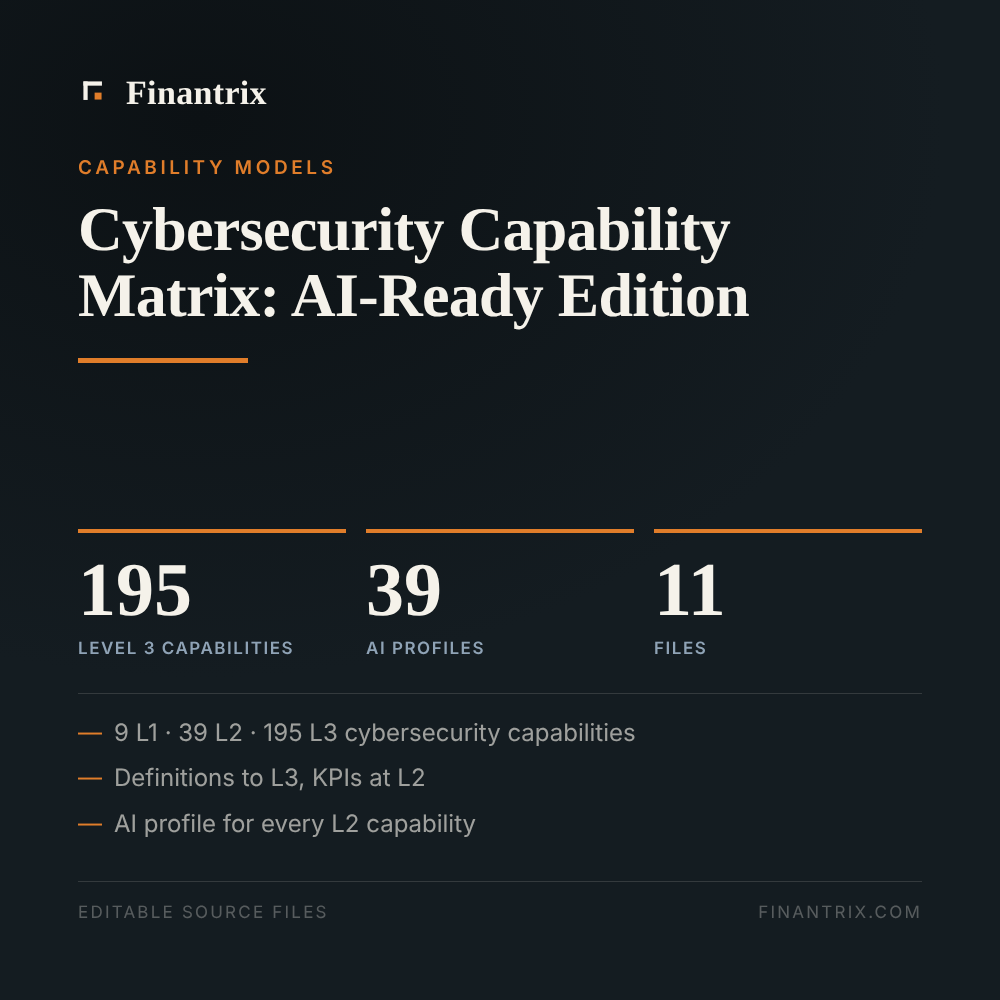
The Cybersecurity Capability Matrix describes security work in 9 Level 1 areas, 39 Level 2 capabilities and 195 Level 3 capabilities, each defined, with identity and access management as one of the areas. Security architecture teams at banks, insurers, asset and wealth managers and payments firms use it to set out what the function does in terms a board and a budget committee can follow. Each Level 2 capability has an AI profile stating where AI can take on work, how closely a person oversees it and how risky the use is. A scoring model ranks the 39 on your weights. The content is cross-industry.
What it isInside the Cybersecurity Capability Matrix
Security work is named here by its purpose, so a capability keeps its name when the product behind it is replaced. Detection, response, access and the rest of the function share one hierarchy, defined down to Level 3, with 161 KPIs at Level 2.
Privileged access management is CY-4.4 in every release. A security team can carry that ID into its risk register, its tool inventory and its project list, and a search across all three returns the same capability.
Every Level 2 capability has a profile listing the AI opportunity, the decisions a person keeps, the agents and data involved, prerequisites, risks and the effect on roles, with a target AI mode, an oversight level and a risk tier. Every Level 3 is rated for work pattern, mode, AI fit and risk tier. In the sample, CY-4.4 scores 4 for AI fit and 5 for value but 2 for data readiness, and it is rated High risk with a person in the loop. An agent may find accounts with elevated rights and propose an owner for each. The System Owner approves every grant.
The Problem Behind It
Boards of financial firms ask their security leaders what the function covers and where the money goes. A list of teams and tools answers poorly. One tool can serve several capabilities, and some capabilities have no tool and no owner.
AI widens that gap. Detection products, ticketing systems and identity tools now include AI features, some of them enabled in a routine update, and each one can act on accounts, devices or alerts. The matrix lets security leadership decide per capability how far an agent may go without a person, and then hold every tool serving that capability to the same answer.
The deliverablesWhat the Download Contains
The matrix comes with its AI ratings and the files to rank and present them:
The model
- 9 L1, 39 L2 and 195 L3 cybersecurity capabilities, defined through L3, with 161 KPIs set at L2
AI and governance
- For each L2 capability, an AI profile covering opportunities, what stays human, agents, data, KPIs, AI measures, prerequisites, risks and workforce impact
- L3 capabilities rated for work pattern, target AI mode, AI fit and risk tier
- Risk-adjusted scoring and ranking of each L2 capability, driven by your own ratings and weights
- An AI heatmap across the entire model
- A weighted AI readiness assessment with 40 questions
Files and terms
- To begin, a Welcome document; then the capability map deck, standalone capability definitions and KPIs documents, the Excel workbook, the user guide
- Bonus files included: a cybersecurity glossary, A Practical Guide to Business Architecture, a capability modeling overview, an AI-ready capability profile template and capability relationship mapping templates
- Corrections free of charge, and new versions free for 180 days after purchase
Your organization's name and license ID are printed in every file. Ratings reflect a typical large enterprise; treat them as a first draft of your own.
Who It Is For
Chief information security officer. Reports the function to the board by capability and uses the ranking to choose where AI goes first.
Security architects. Map products and designs to capability IDs and check new proposals against the oversight levels.
Identity and access management lead. Uses the profiles for access capabilities to fix which grants and reviews stay with a named person.
Security operations lead. Compares AI features in detection and response products against the target mode for each capability.
Technology risk partners. Use the risk tiers as the baseline for reviewing AI in security work and track the KPIs the matrix assigns.
Putting it to workUse Cases
Reporting coverage to the board. Present the function as its 39 Level 2 capabilities with their KPIs and owners. Gaps and overlaps are visible on one page, and each investment request points at a capability ID.
Deciding which AI features to enable. When a security product offers a new AI feature, look up the capability it serves and read its target AI mode and oversight level. Switch the feature on only to the degree the profile and your own review allow.
Mapping the security tool estate. Place each security product against the Level 3 capabilities it supports. Several products on one capability point to consolidation, and a capability with none points to a gap.
Ranking security AI proposals. Score the Level 2 capabilities with your own ratings and weights. The heatmap shows where AI fit and value are high and the risk tier is acceptable.
Testing readiness before the first agents. Run the 40-question assessment with security operations, identity and technology risk. Low answers on data or skills show what to fix before an agent acts on the estate.
Scoping a managed security service. List the Level 3 capabilities a provider will run and those the firm keeps. The split shows which KPIs belong in the contract and which decisions stay in-house.
The economicsThe Alternatives
Security teams usually get a capability model in one of three ways, and each puts the effort in a different place.
- Building it from a blank slate. Architects collect the work of each security team, write definitions, settle overlaps between identity, operations and engineering, and take drafts through review. Rating every capability for AI and building a ranking come afterward, often as a second project.
- Hiring consultants to build it. A consulting team brings a method and can move fast, but its first weeks go to drafting the structure every security function shares. The model then has to be kept current by your own people.
- Starting from this model. The structure, KPIs, AI profiles, ratings, scoring model and assessment arrive cross-checked. Your workshops change ratings and remove what does not apply, and the first ranked list follows quickly.
Fitting the ratings to your estate and your appetite for risk is the judgment that needs experienced people, internal or external. The ratings in the files describe a typical large enterprise.
Getting Started
These steps take a security team from the files to an agreed first list:
- Read the Welcome document and the user guide.
- Walk the capability map deck with the security leadership team and mark what to rename, merge or drop.
- Adjust the AI ratings for your estate and set your weights in the Excel workbook.
- Run the readiness assessment with operations, identity and technology risk.
- Turn the top-ranked capabilities into proposals that name an owner, the oversight level and the KPIs to watch.
A Sample Profile
The sample is 0.76% of the package and traces one thread through it: privileged access management. The fields below come from the Privileged Access Management (CY-4.4) AI profile:
- AI mode: Augment
- Oversight level: Human-in-the-loop
- Risk rating: High
- Wave: Wave 2
- Fit, value, feasibility and data readiness scores: 4, 5, 3, 2 on a 1–5 scale
- Patterns of work: Coordination & orchestration, Analysis & insight, Rules-based decision
- What AI could do: Find accounts with elevated rights across systems, classify their power and propose an owner for each, flagging standing privileged accounts with no recent use
- What people decide: The System Owner approves every privileged access grant for a task, whether just-in-time elevation or release of a vaulted credential; the Access Request Agent prepares the request, carries out only what the System Owner approved and never decides a grant
Upgrading Later
Buy this edition now and, if you upgrade to the Cybersecurity Business Architecture Package: AI Transformation Blueprint within 90 days, its full price counts against the upgrade. Email your order number to support@finantrix.com for a one-time checkout code.
Read before you buyCommon Questions
Which edition fits my team?
Choose the AI-Ready Capability Model for the capability map, an AI profile for every L2 capability, prioritization, the heatmap and the readiness assessment. Choose the AI Transformation Blueprint for all of that plus value streams redesigned for AI, the business data model, agent specifications, use cases, responsible AI principles and controls, the operating model and the roadmap, a leadership presentation template, and bonus files on roles, operating model archetypes and transformation.
Can our internal AI tools use the content?
Yes, inside your organization. The Enterprise license covers internal tools, including assistants and agents you run yourselves. No license permits using the content to train, fine-tune or prompt AI systems on behalf of third parties.
Does it address AI laws and regulations?
No. The content is business architecture by intent: capabilities, value streams, data and the AI layer describe what cybersecurity does and where AI fits, which holds under whatever laws apply to you. The risk tiers, principles and controls are lasting practices for your compliance team to map to the jurisdictions you operate in.
What happens when the 180 days end?
The license continues with no end date, and corrections stay free for as long as you use the files. New versions released within 180 days of purchase are free, and we email a download link for each. After that nothing renews, and new versions are offered at 25% off.
Can I move from the Capability Model to the full blueprint?
Yes. If you upgrade within 90 days, the full price paid for the Capability Model is credited. Email your order number to support@finantrix.com for a one-time checkout code.
Could an AI assistant write this instead?
An AI assistant can list what a security function does, and for orientation the list is fine. It will differ on the next run, and it will suggest where AI helps without saying who approves an agent's actions or how risky each use is. A decision to let an agent touch accounts or devices has to hold up when audit asks why it was allowed. The matrix gives you stable IDs for 195 Level 3 capabilities, cross-references validated before release, a target AI mode, oversight level and risk tier for every Level 2 capability, and a scoring model weighted by you.
| From a chat assistant | In this package | |
|---|---|---|
| Model structure | A list that reads well and changes each time you ask | 9 L1, 39 L2 and 195 L3 capabilities with stable IDs, defined to L3 |
| Links | Unchecked | Links between capabilities, ratings and the readiness assessment validated before each release |
| AI fit | Suggestions left for you to verify | Each L2 capability with an AI profile: AI mode, human oversight, opportunities, what stays human, data, KPIs, prerequisites and risks |
| Risk and controls | General caveats | Risk tiers on every L2 capability, with each one that informs a decision about a person flagged |
| Prioritization | No model to score with | Prioritization on your own ratings and weights, plus a 40-question readiness assessment |
| Stability | Varies by prompt and model version | A description of what cybersecurity does, tied to no tool, vendor or law, with corrections free and new versions free for 180 days |
A Look Inside
Pages 1, 4 and 8 of 10 from Cybersecurity Capabilities Map.pptx, blurred on purpose: enough to judge the structure, depth and format, not the content you are paying for.


What's Included
+ 1 more files included
At a Glance
- 9 L1 · 39 L2 · 195 L3 cybersecurity capabilities
- Definitions to L3, KPIs at L2
- AI profile for every L2 capability
- Target AI mode, oversight and risk tier
- Prioritization with your own weights
- AI heatmap
- 40-question AI readiness assessment
- Excel, Word and PowerPoint
- New versions free for 180 days
Enterprise License
Consultancy License
All sales are final. We do not offer refunds, returns or exchanges.
Delivered instantly on payment. EU and UK consumers: starting the download ends the 14-day right of withdrawal.
Prices exclude tax. Any sales tax, VAT or GST due in your country is added at checkout.
Sign up for Finantrix Insights for periodic updates of new and notable.
Protected by reCAPTCHA. No spam. Unsubscribe anytime.
The Finantrix Store sells reusable business-architecture reference deliverables — capability models, data models, and value-stream maps — built for financial-services strategy and technology teams.
Browse the full Store →Before You Buy
The questions worth settling first. Still unsure? Email us before purchasing — sales are final.
What exactly do I receive?
The files listed under "What's Included" on the product page, and nothing beyond them. Most products are editable PowerPoint, Excel, and Word documents; some are supplied as archives containing those files. Delivery is immediate — a download link is issued as soon as payment completes.
Are the files editable, or locked?
Editable. They are working documents in their native formats, not locked PDFs or images, because the point of the product is that you customize it. A few reference guides are supplied as PDF where editing them would serve no purpose.
How long is my download link valid?
Links stay active for 7 days after purchase and allow up to 3 downloads. Save the files somewhere durable when you receive them. If a link expires or you run out of downloads, email support@finantrix.com and we will issue a new one — that is a support request, not a repurchase.
What is the difference between the Enterprise and Consultancy licenses?
An Enterprise License covers use anywhere within a single organization — your colleagues can all work from the material. A Consultancy License covers use across multiple client engagements, which the Enterprise License does not permit. If you advise more than one organization, the Consultancy License is the one you need. Full terms are at /legal/digital-products-terms.
Do I get a receipt and proof of license?
Yes, both, automatically. Your order confirmation email links to a purchase receipt and a license certificate, and normally carries them as PDF attachments as well. Unlike the download link, those documents do not expire and opening them does not use up one of your 3 downloads — they are there for expense claims, accounting, and procurement reviews that arrive long after the files do. Finantrix collects no sales tax or VAT, so the receipt shows the tax line as not applicable rather than as a computed amount.
Can I get a refund?
As a rule, no. These are digital products delivered immediately and in full, so sales are final — we do not offer returns, refunds or exchanges once a purchase completes. If you buy as a consumer in the EU or UK, you have a 14-day right of withdrawal that ends when you ask us to start the download, which is what you confirm at checkout. Where Stripe is the merchant of record for your purchase, Stripe operates its own refund process and may decide a request itself. All of this is why every product page carries a detailed manifest and an honest note on fit: we would rather you decide correctly before buying than be disappointed afterwards. If you are unsure whether a product suits your situation, email support@finantrix.com before purchasing and we will tell you.
How much customization should I expect to do?
A meaningful amount, and that is by design. These are generic, sector-level artifacts intended as a substantial head start rather than a finished deliverable for your organization. Each product page includes an honest note on fit setting out, deliverable by deliverable, what is complete and what you will need to supply.
Is implementation help or support included?
No. The purchase covers the files only — it does not include customization, implementation assistance, training, or consulting. Our consulting team is available separately on a paid basis if you want deeper help; contact us to discuss scope.
Do you offer a preview or sample before purchase?
Not as a downloadable sample. The product page is the preview: it lists every file, states the capability counts and levels of decomposition, and sets out where the artifact stops. If something specific would settle your decision, email support@finantrix.com and ask.
Can I share the files with colleagues or clients?
Colleagues within your organization, yes, under the Enterprise License. Clients, no — that requires a Consultancy License. Redistribution, resale, or publishing the material publicly is not permitted under either license.
How current is the content?
The artifacts describe business structure — capabilities, value streams, information entities — which changes far more slowly than technology or regulation. Where a product includes market-facing material such as vendor profiles, the product page says so and advises verifying currency before relying on it for a decision.
Related Frameworks
Business Architecture Packages
Cybersecurity Business Architecture Package: AI Transformation Blueprint
From $3295Business Information Model
Cybersecurity Business Information Model: AI-Ready Edition
From $495Value Streams
Cybersecurity Value Stream Catalog: AI-Ready Edition
From $495Capability Models