
Investment and Wealth Management Capability Matrix: AI-Ready Edition
Investment and wealth management capabilities mapped to L3 across four segments, with an AI profile, target AI mode and risk tier for all 60 L2 capabilities.
About This Capability Model
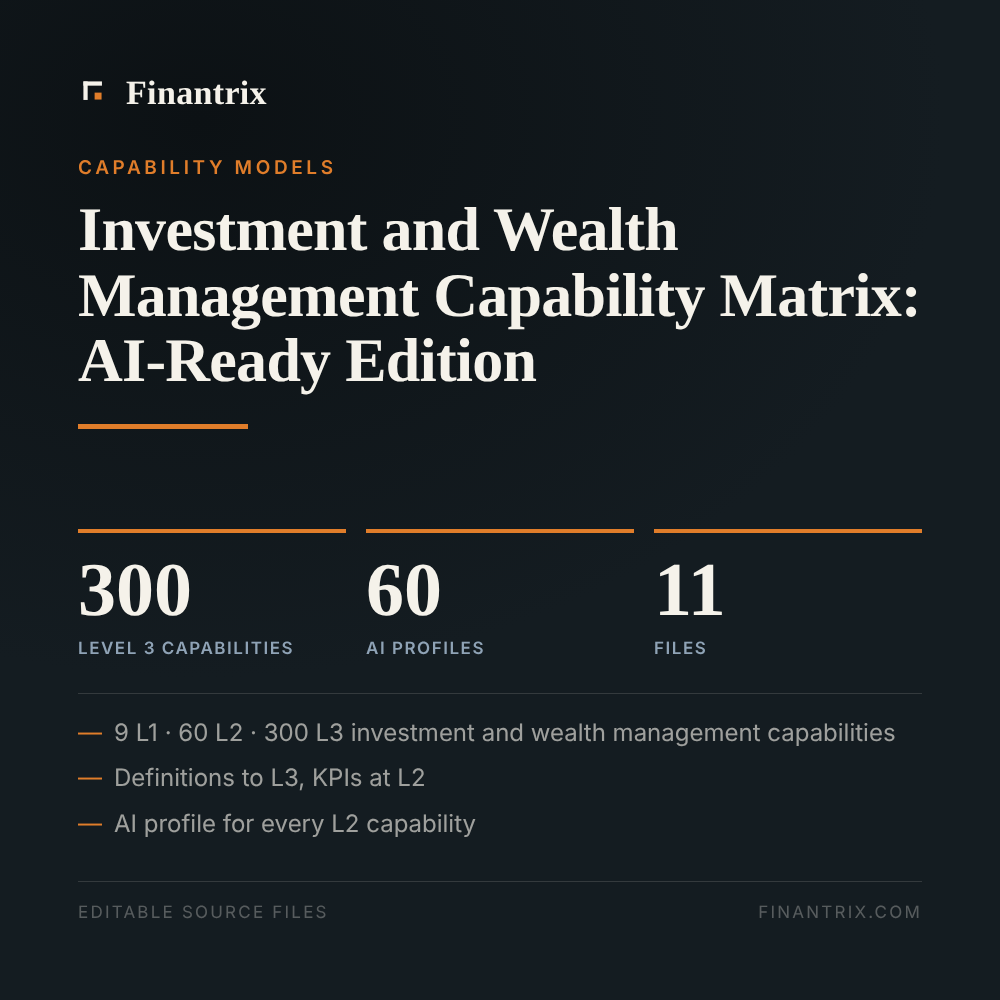
The Investment and Wealth Management Capability Matrix describes an asset manager, hedge fund, private equity firm or wealth business as 300 L3 capabilities under 60 L2 and 9 L1 capabilities, with an AI profile for every L2 and AI ratings for every L3. Shared work such as research, trading, investment operations, fund accounting, fees and investment risk sits beside four tagged segments, so a firm keeps the businesses it runs and filters out the rest. Architecture and transformation teams use it to describe the firm by its work rather than its systems, and to rank where AI belongs with a risk-adjusted score and weights they set. Every L3 is defined, and the L2 level carries 239 KPIs.
What it isInside the Investment and Wealth Management Capability Matrix
Each of the 9 L1 capabilities is a block of work an investment or wealth firm performs: managing products and funds, distribution, investor servicing and reporting, research and portfolio management, trading and operations, fund accounting and valuation, and investment risk and oversight. Two more belong to a single segment each, private equity deals and portfolio companies, and wealth advice and planning. Beneath them are 60 L2 and 300 L3 capabilities, each L3 with a definition and each L2 with its KPIs.
The Segment column carries the differences between businesses. Hedge fund work such as lockups, prime broker financing and performance fees is tagged Hedge Funds. Capital calls, the carried interest waterfall and portfolio company monitoring are tagged Private Equity. Exchange-traded fund operations and shareholder recordkeeping are tagged Asset Management, and account transfers, managed account programs and trusts are tagged Wealth Management. A firm that runs two of the four filters to the shared work plus those two.
The AI layer has two parts. Each L2 capability has a profile of opportunities, the work that stays human, KPIs and AI measures, prerequisites, risks and workforce impact. Each L3 is rated for work pattern, target AI mode, AI fit and risk tier, which feeds the heatmap and the ranking. In the trade settlement and reconciliation sample (IW-5.2), AI matches trades against broker confirmations and scores fail risk, while the Investment Operations Analyst owns every break and every correction.
The Problem Behind It
Investment firms tend to grow by adding businesses, and each new business arrives with its own order management, accounting and client systems. A firm with a fund range, a hedge fund and a private wealth arm can end up with three descriptions of trading, three of fees and three of client reporting. AI proposals then land in whichever business asked first, and nobody sees that the same reconciliation problem has been funded twice.
The matrix keeps one description of the shared work and a tagged description of what only one business does. Each capability states the AI mode it suits, the oversight it needs and the risk it carries, so a proposal to automate price checks in the fund business and one to draft client reviews in wealth are compared on the same terms. Capabilities where an error moves money, misstates a value or harms a client are marked for review first.
The deliverablesWhat the Download Contains
The Capability Model edition contains the matrix, its AI ratings and the files to use them:
The model
- 9 L1, 60 L2 and 300 L3 investment and wealth management capabilities, defined through L3, with 239 KPIs set at L2
AI and governance
- For each L2 capability, an AI profile covering opportunities, what stays human, KPIs, AI measures, prerequisites, risks and workforce impact
- L3 capabilities rated for work pattern, target AI mode, AI fit and risk tier
- Risk-adjusted scoring and ranking of each L2 capability, driven by your own ratings and weights
- An AI heatmap across the entire model
- A weighted AI readiness assessment with 40 questions
Files and terms
- To begin, a Welcome document; then the capability map deck, standalone capability definitions and KPIs documents, the Excel workbook, the user guide
- Bonus files included: an investment and wealth management glossary, A Practical Guide to Business Architecture, a capability modeling overview, an AI-ready capability profile template and capability relationship mapping templates
- Corrections free of charge, and new versions free for 180 days after purchase
Your organization's name and license ID are printed in every file. Ratings reflect a typical large enterprise; treat them as a first draft of your own.
Who It Is For
Enterprise architects in asset and wealth firms. Use the matrix as the reference for every business, mark the segments in scope, and attach systems and projects to L3 IDs.
Heads of investment operations. Compare the ratings for settlement, reconciliation and fund accounting, and agree where AI prepares the work and an analyst decides.
Chief investment officers and heads of trading. Confirm that order release and guideline breaches stay with named people, and adjust the research and portfolio management ratings to how their desks run.
Private equity deal teams and operating partners. Review the deal and portfolio company profiles and record who keeps investment, valuation and exit decisions.
Wealth and trust leaders. Check the advice, planning and trust profiles so that recommendations and discretionary distributions stay with the people accountable for them.
Putting it to workUse Cases
Choosing an AI pilot in operations. Rank the shared operations and fund accounting capabilities with your own weights. The trade settlement sample, rated Automate with human-on-the-loop oversight and a Moderate risk tier, shows what a high-fit candidate looks like in the profiles.
Separating firm-wide work from business-specific work. Filter by segment to show the executive committee which capabilities every business uses and which belong to one. Shared capabilities such as reconciliation and client reporting become firm-wide investments, and segment ones stay with their business.
Planning an outsourcing decision. Before moving fund accounting, shareholder recordkeeping or middle-office work to a service provider, mark the L3 capabilities that would move and those that stay. The KPIs at L2 become the measures written into the service agreement.
Reviewing advice and planning work. Read the wealth segment's profiles for planning, advice and suitability with the heads of advice. The work that stays human records which recommendations a person must make before any assistant is put in front of advisors or clients.
Comparing readiness across businesses. Run the 40-question readiness assessment once per business. Differences in the data and oversight scores show which business can act on its ranking now and which needs groundwork first.
Reporting KPIs by capability. Pick from the 239 KPIs the ones your operating committee already debates and attach each to its capability. A measure that moves then points to a piece of work and its owner.
The economicsThe Alternatives
A firm that wants a rated capability model has three options. They differ in how soon the team stops arguing about structure and starts deciding where AI belongs.
- Building it from a blank slate. Architects interview the fund, alternatives and wealth businesses, reconcile what each calls the same activity, and write definitions and KPIs before any AI rating begins. The model fits the firm in the end, after several rounds of review.
- Hiring consultants to build it. A consulting team brings its own structure and runs the interviews. A large part of the work is drafting what investment firms have in common, and the firm receives a model its staff must then learn.
- Starting from this model. The shared work, four segments, definitions, KPIs and AI ratings are ready on the first day. Workshops spend their time removing segments the firm does not run, correcting ratings for its desks and setting the weights for the ranking.
Outside specialists still help where knowledge of the firm matters: tailoring, facilitation and change planning. The price of this edition also counts toward the Blueprint edition if the firm upgrades within 90 days.
Getting Started
From the download to a ranked list of AI candidates:
- Read the Welcome document and the user guide to learn how the workbook is organized.
- Narrow the Segment column to the shared work and the businesses your firm runs.
- Go through the definitions and KPIs with investment, operations, fund accounting and client leaders, and note your differences.
- Change the AI ratings where your desks work differently and set the prioritization weights.
- Complete the readiness assessment and bring the heatmap and the top-ranked capabilities to the steering group.
A Sample Profile
The sample is 0.48% of the package and traces one thread through it: trade settlement and reconciliation. The fields below come from the Trade Settlement and Reconciliation (IW-5.2) AI profile:
- AI mode: Automate
- Oversight level: Human-on-the-loop
- Risk rating: Moderate
- Wave: Wave 1
- Fit, value, feasibility and data readiness scores: 4, 4, 4, 3 on a 1–5 scale
- Patterns of work: Transactional processing, Analysis & insight, Coordination & orchestration
- What AI could do: Match each trade with the broker's confirmation on trade date and explain every mismatch by field, with the likely correct value
- What people decide: The Investment Operations Analyst owns every mismatch, settlement exception and reconciliation break, and makes every correction to the organization's records; the Reconciliation Break Agent and the Settlement Fail Monitoring Agent gather evidence and alter nothing
Upgrading Later
Buy this edition now and, if you upgrade to the Business Architecture for Investment and Wealth Management: AI Transformation Blueprint within 90 days, its full price counts against the upgrade. Email your order number to support@finantrix.com for a one-time checkout code.
Read before you buyCommon Questions
Which edition fits my team?
Choose the AI-Ready Capability Model for the capability map, an AI profile for every L2 capability, prioritization, the heatmap and the readiness assessment. Choose the AI Transformation Blueprint for all of that plus value streams redesigned for AI, the business data model, agent specifications, use cases, responsible AI principles and controls, the operating model and the roadmap, a leadership presentation template, and bonus files on roles, operating model archetypes and transformation.
Can our internal AI tools use the content?
Yes, inside your organization. The Enterprise license covers internal tools, including assistants and agents you run yourselves. No license permits using the content to train, fine-tune or prompt AI systems on behalf of third parties.
Does it address AI laws and regulations?
No. The content is business architecture by intent: capabilities, value streams, data and the AI layer describe what an investment or wealth management firm does and where AI fits, which holds under whatever laws apply to you. The risk tiers, principles and controls are lasting practices for your compliance team to map to the jurisdictions you operate in.
What happens when the 180 days end?
The license continues with no end date, and corrections stay free for as long as you use the files. New versions released within 180 days of purchase are free, and we email a download link for each. After that nothing renews, and new versions are offered at 25% off.
Can I move from the Capability Model to the full blueprint?
Yes. If you upgrade within 90 days, the full price paid for the Capability Model is credited. Email your order number to support@finantrix.com for a one-time checkout code.
Could an AI assistant write this instead?
A chat assistant can list the capabilities of an asset manager or a private equity firm, and that is fine for getting oriented. When the list has to support funding decisions, the gaps matter. The matrix keeps stable IDs, checks its profiles, ratings and readiness assessment against each other before release, gives every L2 capability a risk tier, and tags segment work so a wealth business is not scored on hedge fund capabilities. A generated list varies between prompts and gives the investment or risk committee nothing to trace.
| From a chat assistant | In this package | |
|---|---|---|
| Model structure | A list that reads well and changes each time you ask | 9 L1, 60 L2 and 300 L3 capabilities with stable IDs, defined to L3 |
| Links | Unchecked | Links between capabilities, ratings and the readiness assessment validated before each release |
| AI fit | Suggestions left for you to verify | Each L2 capability with an AI profile: AI mode, human oversight, opportunities, what stays human, data, KPIs, prerequisites and risks |
| Risk and controls | General caveats | Risk tiers on every L2 capability, with each one that informs a decision about a person flagged |
| Prioritization | No model to score with | Prioritization on your own ratings and weights, plus a 40-question readiness assessment |
| Stability | Varies by prompt and model version | A description of what an investment or wealth management firm does, tied to no tool, vendor or law, with corrections free and new versions free for 180 days |
What's Included
+ 1 more files included
At a Glance
- 9 L1 · 60 L2 · 300 L3 investment and wealth management capabilities
- Definitions to L3, KPIs at L2
- AI profile for every L2 capability
- Target AI mode, oversight and risk tier
- Prioritization with your own weights
- AI heatmap
- 40-question AI readiness assessment
- Excel, Word and PowerPoint
- New versions free for 180 days
Enterprise License
Consultancy License
All sales are final. We do not offer refunds, returns or exchanges.
Delivered instantly on payment. EU and UK consumers: starting the download ends the 14-day right of withdrawal.
Prices exclude tax. Any sales tax, VAT or GST due in your country is added at checkout.
Sign up for Finantrix Insights for periodic updates of new and notable.
Protected by reCAPTCHA. No spam. Unsubscribe anytime.
The Finantrix Store sells reusable business-architecture reference deliverables — capability models, data models, and value-stream maps — built for financial-services strategy and technology teams.
Browse the full Store →Before You Buy
The questions worth settling first. Still unsure? Email us before purchasing — sales are final.
What exactly do I receive?
The files listed under "What's Included" on the product page, and nothing beyond them. Most products are editable PowerPoint, Excel, and Word documents; some are supplied as archives containing those files. Delivery is immediate — a download link is issued as soon as payment completes.
Are the files editable, or locked?
Editable. They are working documents in their native formats, not locked PDFs or images, because the point of the product is that you customize it. A few reference guides are supplied as PDF where editing them would serve no purpose.
How long is my download link valid?
Links stay active for 7 days after purchase and allow up to 3 downloads. Save the files somewhere durable when you receive them. If a link expires or you run out of downloads, email support@finantrix.com and we will issue a new one — that is a support request, not a repurchase.
What is the difference between the Enterprise and Consultancy licenses?
An Enterprise License covers use anywhere within a single organization — your colleagues can all work from the material. A Consultancy License covers use across multiple client engagements, which the Enterprise License does not permit. If you advise more than one organization, the Consultancy License is the one you need. Full terms are at /legal/digital-products-terms.
Do I get a receipt and proof of license?
Yes, both, automatically. Your order confirmation email links to a purchase receipt and a license certificate, and normally carries them as PDF attachments as well. Unlike the download link, those documents do not expire and opening them does not use up one of your 3 downloads — they are there for expense claims, accounting, and procurement reviews that arrive long after the files do. Finantrix collects no sales tax or VAT, so the receipt shows the tax line as not applicable rather than as a computed amount.
Can I get a refund?
As a rule, no. These are digital products delivered immediately and in full, so sales are final — we do not offer returns, refunds or exchanges once a purchase completes. If you buy as a consumer in the EU or UK, you have a 14-day right of withdrawal that ends when you ask us to start the download, which is what you confirm at checkout. Where Stripe is the merchant of record for your purchase, Stripe operates its own refund process and may decide a request itself. All of this is why every product page carries a detailed manifest and an honest note on fit: we would rather you decide correctly before buying than be disappointed afterwards. If you are unsure whether a product suits your situation, email support@finantrix.com before purchasing and we will tell you.
How much customization should I expect to do?
A meaningful amount, and that is by design. These are generic, sector-level artifacts intended as a substantial head start rather than a finished deliverable for your organization. Each product page includes an honest note on fit setting out, deliverable by deliverable, what is complete and what you will need to supply.
Is implementation help or support included?
No. The purchase covers the files only — it does not include customization, implementation assistance, training, or consulting. Our consulting team is available separately on a paid basis if you want deeper help; contact us to discuss scope.
Do you offer a preview or sample before purchase?
Not as a downloadable sample. The product page is the preview: it lists every file, states the capability counts and levels of decomposition, and sets out where the artifact stops. If something specific would settle your decision, email support@finantrix.com and ask.
Can I share the files with colleagues or clients?
Colleagues within your organization, yes, under the Enterprise License. Clients, no — that requires a Consultancy License. Redistribution, resale, or publishing the material publicly is not permitted under either license.
How current is the content?
The artifacts describe business structure — capabilities, value streams, information entities — which changes far more slowly than technology or regulation. Where a product includes market-facing material such as vendor profiles, the product page says so and advises verifying currency before relying on it for a decision.
Related Frameworks
Business Architecture Packages
Business Architecture for Investment and Wealth Management: AI Transformation Blueprint
From $4995Business Information Model
Wealth Management Business Information Model: AI-Ready Edition
From $495Value Streams
Wealth Management Value Stream Catalog: AI-Ready Edition
From $495Business Information Model