
Key Takeaways
- JPMorgan Chase & Co. reports the largest trading line of any US-listed company that presents one, $27.2 billion for its fiscal year 2025, according to its 10-K filed with the SEC.
- 5 companies report 94% of the trading revenue on the income statements of the 18 US-listed companies that present a trading line, according to SEC filings.
- Among the 5 largest, trading is the biggest share of net revenue at Goldman Sachs Group, 31%, and the smallest at Bank of America, 11%, according to their SEC filings.
- Each figure is the line as the company labels it on its own income statement; definitions differ between companies.
According to their annual reports filed with the SEC, 5 companies report 94% of the trading revenue on the income statements of US-listed companies: JPMorgan Chase & Co., Morgan Stanley, Goldman Sachs Group, Bank of America and Citigroup. Between them they report $86.0 billion of the $91.8 billion that the 18 listed companies presenting a trading line report, according to SEC filings. JPMorgan Chase & Co. reports the largest line, $27.2 billion according to its 10-K filed with the SEC, and labels it "Principal transactions".
Among the 5 largest, trading is the biggest share of net revenue at Goldman Sachs Group, 31%, and the smallest at Bank of America, 11%, according to their SEC filings. JPMorgan Chase & Co. reports the largest investment banking line among them, $9.6 billion, according to its SEC filing.
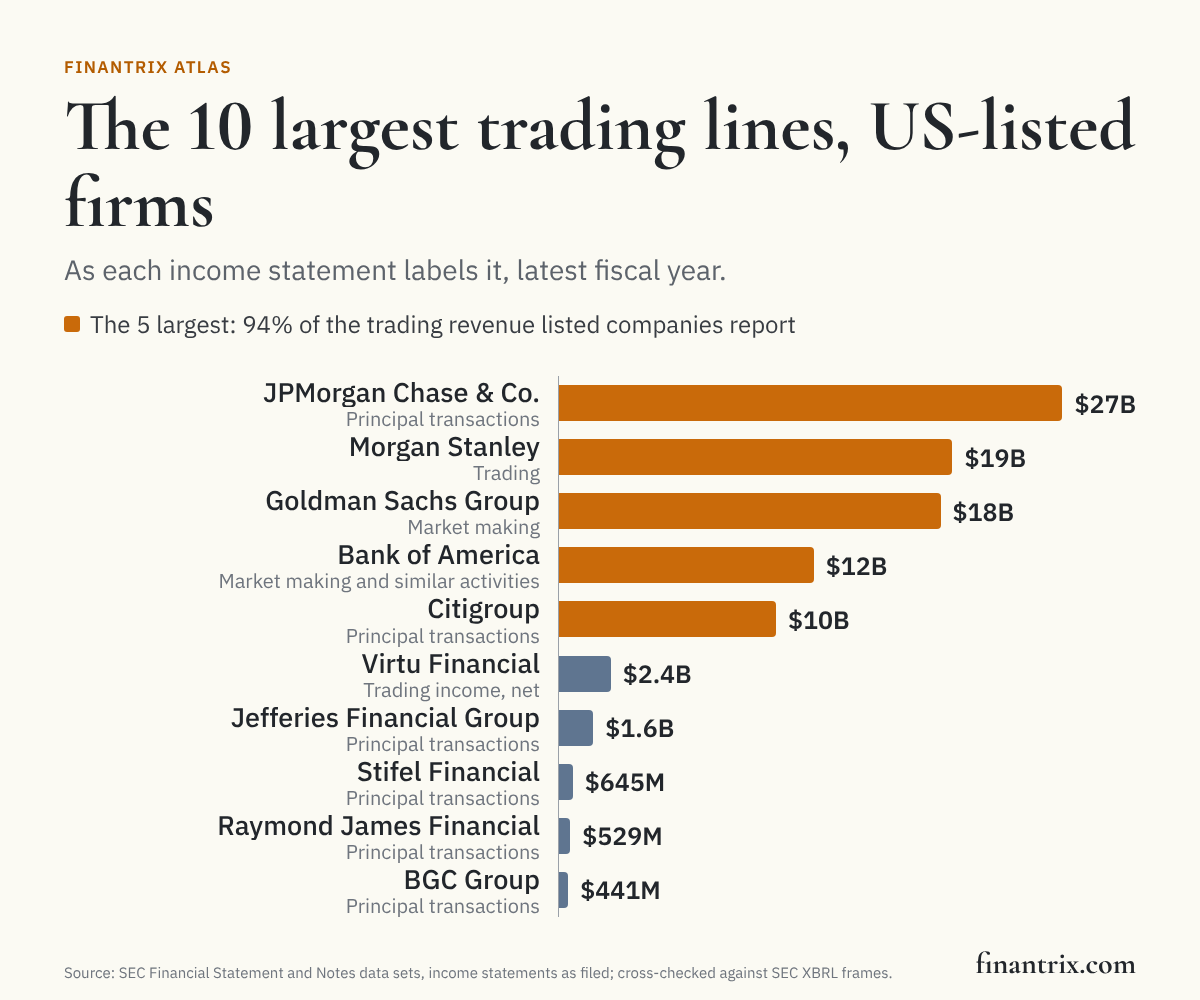
The 10 largest trading lines of US-listed companies
Each figure is the line as the company presents and labels it on its own income statement, for its latest fiscal year in a 10-K filed from October 1, 2025 to September 30, 2026. The investment banking line, where a company presents one, is advisory and underwriting fees together. Net revenue is the company's own total revenue line, net of interest expense where it reports one.
| Rank | Company | Ticker | Trading line, as labeled | Trading revenue | Investment banking line | Net revenue | Trading share of net revenue | Fiscal year end | Source |
|---|---|---|---|---|---|---|---|---|---|
| 1 | JPMorgan Chase & Co. | JPM | Principal transactions | $27.2 billion | $9.6 billion (Investment banking fees) | $182 billion | 14.9% | December 31, 2025 | SEC |
| 2 | Morgan Stanley | MS | Trading | $18.6 billion | $8.2 billion (Investment banking) | $70.6 billion | 26.3% | December 31, 2025 | SEC |
| 3 | Goldman Sachs Group Inc. | GS | Market making | $18.0 billion | $9.3 billion (Investment banking) | $58.3 billion | 30.9% | December 31, 2025 | SEC |
| 4 | Bank of America Corp. | BAC | Market making and similar activities | $12.0 billion | no line | $113 billion | 10.6% | December 31, 2025 | SEC |
| 5 | Citigroup Inc. | C | Principal transactions | $10.2 billion | no line | $85.2 billion | 12.0% | December 31, 2025 | SEC |
| 6 | Virtu Financial, Inc. | VIRT | Trading income, net | $2.4 billion | no line | $3.6 billion | 67.1% | December 31, 2025 | SEC |
| 7 | Jefferies Financial Group Inc. | JEF | Principal transactions | $1.6 billion | $3.8 billion (Investment banking) | $7.3 billion | 21.9% | November 30, 2025 | SEC |
| 8 | Stifel Financial Corp. | SF | Principal transactions | $645 million | $1.3 billion (Investment banking) | $5.5 billion | 11.7% | December 31, 2025 | SEC |
| 9 | Raymond James Financial Inc. | RJF | Principal transactions | $529 million | no line | $14.1 billion | 3.8% | September 30, 2025 | SEC |
| 10 | BGC Group, Inc. | BGC | Principal transactions | $441 million | no line | $2.9 billion | 15.0% | December 31, 2025 | SEC |
Download this table (CSV), free. The full dataset, every listed company that presents a trading line, with the concept each line is filed under and its accession number, is one email away.
What the lines are, and are not
The companies do not use one word. The labels in the table are their own: "principal transactions", "trading", "market making". Each defines its line in its own notes, so two equal figures need not measure the same activity. The table compares what each company chose to put on the face of its income statement, not a measure of each firm's markets business on one definition.
Bank of America and Citigroup present no separate investment banking line on the income statement, so the table shows none for them.
What this means for technology buyers
A trading line is the result of a front-to-back operation: pricing and risk on the trading desk, regulatory capital and reporting behind it, and clearing and settlement after the trade. These guides compare the systems a bank or dealer runs it on:
- Market risk management systems for investment banks: value at risk, stress testing and limits for trading books.
- Regulatory reporting platforms for investment banks: the capital and trading reports a dealer files.
- Equity trading platforms for broker-dealers: order handling and execution.
- Clearing and settlement systems for broker-dealers: the books a self-clearing firm keeps.
Mapping the business before the systems? The Investment Banking Capability Model sets out what a securities firm does, from origination to settlement.
More from Finantrix Atlas
- Top broker-dealer firms in the US by total assets
- Largest bank holding companies
- Registered swap dealers
- Largest futures commission merchants
How this list was built
The universe is every company listed on a US exchange whose latest 10-K in the SEC's monthly Financial Statement and Notes data sets, filed from October 1, 2025 to September 30, 2026, presents a trading line on its income statement. The data sets record which lines each statement presents, in what order and under what label, so the rule reads the statement as the company filed it:
- A trading line is a line filed under the standard concepts for trading gains and for principal transactions, or under the company's own concept named for market making. A statement that presents its revenue as members of one concept is read from that member; in the table, 1 of the companies present their trading line that way. Costs and expenses are never counted.
- An investment banking line is a line filed under the standard investment banking concept, or under the company's own concept named for it and labeled "Investment banking".
- Values are the fiscal-year figures the statement reports, at the consolidated level. Where a company presents two trading lines, they are added.
Each figure filed under a standard concept for a calendar fiscal year is checked against the SEC's XBRL frames, which the SEC builds separately from the same filings: 10 figures, every one equal. 2 listed companies present a trading line with a loss or no value for the year and are not ranked.
Limits
- Listed companies that present a trading line. A bank that reports trading within a broader line, a foreign bank's US dealer that is not listed, and private trading firms, which file no 10-K, are not here. The page is a comparison of reported lines, not a ranking of every markets business.
- Each company's own definition. Labels and contents differ, and part of a markets business's revenue can sit in other lines of the same statement. Read the trading share of net revenue as a share of the company's own lines.
- Fiscal years differ. 8 of the 10 in the table end their year in December; the table shows each company's year end. The data runs through 10-Ks filed by September 30, 2026.
- Advisory fees are not shown apart. Where companies report advisory and underwriting separately, each does so under its own product categories, so the investment banking line is the figure on one basis.
Cite this
Free to quote, cite and republish, including the chart, with credit to Finantrix Atlas and a link to this page.
5 companies report 94% of the trading revenue on the income statements of US-listed companies, according to a Finantrix Atlas analysis of 10-K filings with the SEC.
JPMorgan Chase & Co. reports $27.2 billion of trading revenue for 2025, the largest trading line of any US-listed company that presents one, according to Finantrix Atlas.
Suggested citation: Finantrix Atlas, "Notable US Banks and Dealers by Trading Revenue," 10-Ks filed October 1, 2025 to September 30, 2026, from SEC Financial Statement and Notes data sets. https://www.finantrix.com/articles/bank-dealer-trading-revenue
Embed the chart:
<a href="https://www.finantrix.com/articles/bank-dealer-trading-revenue"><img src="https://www.finantrix.com/atlas/bank-dealer-trading-revenue.png" alt="The largest trading lines of US-listed companies, from Finantrix Atlas"></a>
<p>Chart: <a href="https://www.finantrix.com/articles/bank-dealer-trading-revenue">Finantrix Atlas</a>, from SEC filings.</p>
Frequently asked questions
Q: Which US bank has the most trading revenue? A: JPMorgan Chase & Co. reports the largest trading line of any US-listed company that presents one, $27.2 billion for 2025, according to its 10-K filed with the SEC.
Q: How concentrated is trading revenue among US-listed companies? A: 5 companies report 94% of it, $86.0 billion of $91.8 billion, according to SEC filings.
Q: Which bank earns the largest share of its revenue from trading? A: Among the 5 largest, trading is the biggest share of net revenue at Goldman Sachs Group, 31%, and the smallest at Bank of America, 11%, according to their SEC filings.
Q: Which bank reports the most investment banking fees? A: JPMorgan Chase & Co. reports the largest investment banking line among them, $9.6 billion, according to its SEC filing. Some large banks present no separate investment banking line on their income statement.
Download the data
The 10 rows on this page (CSV), free. The full dataset has all 20 rows, as of September 30, 2026; we email you a link.
Frequently Asked Questions
Which US bank has the most trading revenue?
JPMorgan Chase & Co. reports the largest trading line of any US-listed company that presents one, $27.2 billion for 2025, according to its 10-K filed with the SEC.
How concentrated is trading revenue among US-listed companies?
5 companies report 94% of it, $86.0 billion of $91.8 billion, according to SEC filings.
Which bank earns the largest share of its revenue from trading?
Among the 5 largest, trading is the biggest share of net revenue at Goldman Sachs Group, 31%, and the smallest at Bank of America, 11%, according to their SEC filings.
Which bank reports the most investment banking fees?
JPMorgan Chase & Co. reports the largest investment banking line among them, $9.6 billion, according to its SEC filing. Some large banks present no separate investment banking line on their income statement.