
Key Takeaways
- JPMorgan Chase & Co. is the largest US bank holding company, with $5.02 trillion in consolidated assets on June 30, 2026, according to its SEC filing.
- The four largest hold $13.69 trillion between them, according to their SEC filings.
- 3 of the 50 report at least twice the assets of the FDIC-insured banks they own, Ameriprise Financial Inc., Goldman Sachs Group Inc. and Morgan Stanley, according to SEC and FDIC data.
- 7 of the 50 file no consolidated figure with the SEC and are ranked by their insured banks' assets from FDIC data, a lower bound.
JPMorgan Chase & Co. is the largest US bank holding company, with $5.02 trillion in consolidated assets on June 30, 2026, according to its SEC filing, and the four largest hold $13.69 trillion between them. A holding company is more than its bank: according to SEC and FDIC data, 3 of the 50 report at least twice the assets of the FDIC-insured banks they own, Ameriprise Financial Inc., Goldman Sachs Group Inc. and Morgan Stanley. The largest of them, Goldman Sachs Group Inc., reports $2.13 trillion to the SEC, against $759 billion in its insured bank by FDIC data, 2.8 times as much.
Consolidated assets are each company's own figure from its quarterly SEC filing. 7 of the 50, marked ‡, file no consolidated figure with the SEC, among them the US banks of Toronto-Dominion Bank. They are ranked by the assets of their FDIC-insured banks, a lower bound: the holding company may be larger and rank higher.
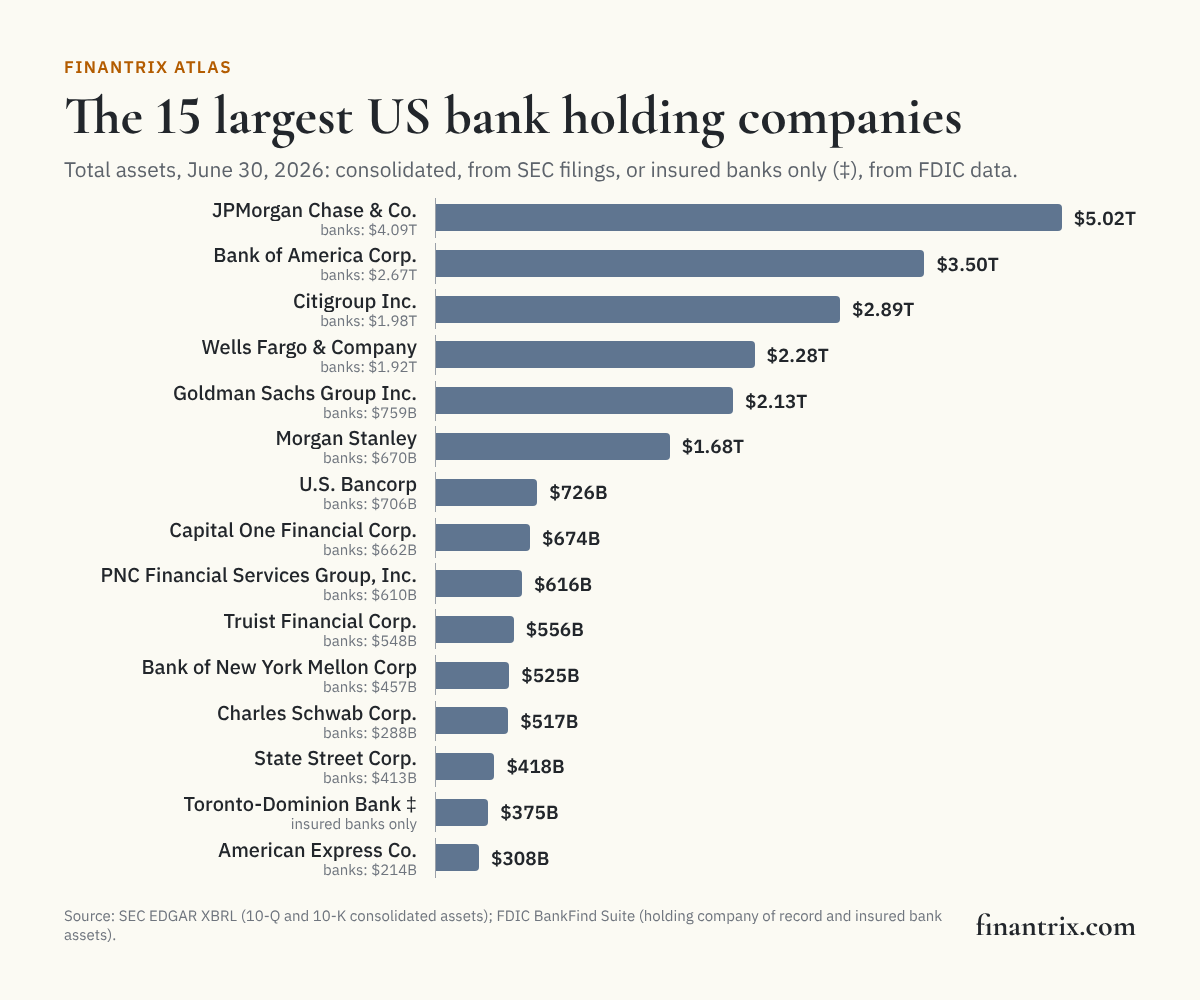
The 50 largest US bank holding companies
Ranked by total assets on June 30, 2026: consolidated assets from the holding company's SEC filing, or, for a holding company marked ‡, the assets of its FDIC-insured banks from FDIC data. The insured banks' assets are shown for every row, beside the consolidated figure, so the part of each company outside its banks can be read off.
| Rank | Holding company | Total assets | Basis | FDIC-insured banks held | Their assets | Largest insured bank | Source |
|---|---|---|---|---|---|---|---|
| 1 | JPMorgan Chase & Co. | $5.02 trillion | consolidated | 2 | $4.09 trillion | JPMorgan Chase Bank | SEC, FDIC |
| 2 | Bank of America Corp. | $3.50 trillion | consolidated | 2 | $2.67 trillion | Bank of America | SEC, FDIC |
| 3 | Citigroup Inc. | $2.89 trillion | consolidated | 1 | $1.98 trillion | Citibank | SEC, FDIC |
| 4 | Wells Fargo & Company | $2.28 trillion | consolidated | 3 | $1.92 trillion | Wells Fargo Bank | SEC, FDIC |
| 5 | Goldman Sachs Group Inc. | $2.13 trillion | consolidated | 1 | $759 billion | Goldman Sachs Bank USA | SEC, FDIC |
| 6 | Morgan Stanley | $1.68 trillion | consolidated | 2 | $670 billion | Morgan Stanley Bank | SEC, FDIC |
| 7 | U.S. Bancorp | $726 billion | consolidated | 1 | $706 billion | U.S. Bank | SEC, FDIC |
| 8 | Capital One Financial Corp. | $674 billion | consolidated | 1 | $662 billion | Capital One | SEC, FDIC |
| 9 | PNC Financial Services Group, Inc. | $616 billion | consolidated | 1 | $610 billion | PNC Bank | SEC, FDIC |
| 10 | Truist Financial Corp. | $556 billion | consolidated | 1 | $548 billion | Truist Bank | SEC, FDIC |
| 11 | Bank of New York Mellon Corp | $525 billion | consolidated | 4 | $457 billion | The Bank of New York Mellon | SEC, FDIC |
| 12 | Charles Schwab Corp. | $517 billion | consolidated | 3 | $288 billion | Charles Schwab Bank, SSB | SEC, FDIC |
| 13 | State Street Corp. | $418 billion | consolidated | 1 | $413 billion | State Street Bank and Trust Company | SEC, FDIC |
| 14 | Toronto-Dominion Bank ‡ | $375 billion | insured banks only | 2 | $375 billion | TD Bank | FDIC |
| 15 | American Express Co. | $308 billion | consolidated | 1 | $214 billion | American Express National Bank | SEC, FDIC |
| 16 | Fifth Third Bancorp | $300 billion | consolidated | 1 | $299 billion | Fifth Third Bank | SEC, FDIC |
| 17 | Huntington Bancshares Inc. | $284 billion | consolidated | 1 | $283 billion | The Huntington National Bank | SEC, FDIC |
| 18 | Bank of Montreal ‡ | $255 billion | insured banks only | 2 | $255 billion | BMO Bank | FDIC |
| 19 | First Citizens Bancshares Inc. | $237 billion | consolidated | 1 | $236 billion | First-Citizens Bank & Trust Company | SEC, FDIC |
| 20 | Citizens Financial Group Inc. | $234 billion | consolidated | 1 | $233 billion | Citizens Bank | SEC, FDIC |
| 21 | M&T Bank Corp. | $219 billion | consolidated | 2 | $220 billion | Manufacturers and Traders Trust Company | SEC, FDIC |
| 22 | Ally Financial Inc. | $200 billion | consolidated | 1 | $188 billion | Ally Bank | SEC, FDIC |
| 23 | Ameriprise Financial Inc. | $198 billion | consolidated | 1 | $25.5 billion | Ameriprise Bank, FSB | SEC, FDIC |
| 24 | KeyCorp | $191 billion | consolidated | 1 | $189 billion | KeyBank | SEC, FDIC |
| 25 | Northern Trust Corp. | $179 billion | consolidated | 1 | $179 billion | The Northern Trust Company | SEC, FDIC |
| 26 | HSBC Holdings ‡ | $173 billion | insured banks only | 2 | $173 billion | HSBC Bank USA | FDIC |
| 27 | Santander Holdings USA, Inc. | $165 billion | consolidated | 1 | $104 billion | Santander Bank | SEC, FDIC |
| 28 | Regions Financial Corp. | $161 billion | consolidated | 1 | $160 billion | Regions Bank | SEC, FDIC |
| 29 | Pinnacle Financial Partners, Inc. | $129 billion | consolidated | 1 | $129 billion | Pinnacle Bank | SEC, FDIC |
| 30 | UBS Group ‡ | $124 billion | insured banks only | 1 | $124 billion | UBS Bank USA | FDIC |
| 31 | Synchrony Financial | $122 billion | consolidated | 1 | $115 billion | Synchrony Bank | SEC, FDIC |
| 32 | Royal Bank of Canada ‡ | $109 billion | insured banks only | 2 | $109 billion | City National Bank | FDIC |
| 33 | United Services Automobile Association ‡ | $106 billion | insured banks only | 1 | $106 billion | USAA Federal Savings Bank | FDIC |
| 34 | Western Alliance Bancorporation | $98.7 billion | consolidated | 1 | $98.6 billion | Western Alliance Bank | SEC, FDIC |
| 35 | Raymond James Financial Inc. | $94.2 billion | consolidated | 2 | $69.9 billion | Raymond James Bank | SEC, FDIC |
| 36 | Webster Financial Corp. | $85.9 billion | consolidated | 1 | $85.9 billion | Webster Bank (closed since) | SEC, FDIC |
| 37 | East West Bancorp Inc. | $84.8 billion | consolidated | 1 | $84.3 billion | East West Bank | SEC, FDIC |
| 38 | First Horizon Corp. | $84.4 billion | consolidated | 1 | $84.1 billion | First Horizon Bank | SEC, FDIC |
| 39 | Popular, Inc. | $79.0 billion | consolidated | 2 | $78.4 billion | Banco Popular de Puerto Rico | SEC, FDIC |
| 40 | Wintrust Financial Corp. | $74.7 billion | consolidated | 16 | $74.8 billion | Wintrust Bank | SEC, FDIC |
| 41 | Old National Bancorp | $74.2 billion | consolidated | 1 | $73.9 billion | Old National Bank | SEC, FDIC |
| 42 | UMB Financial Corp. | $72.3 billion | consolidated | 1 | $71.9 billion | UMB Bank | SEC, FDIC |
| 43 | SouthState Bank Corp | $68.9 billion | consolidated | 1 | $68.8 billion | SouthState Bank | SEC, FDIC |
| 44 | Canadian Imperial Bank of Commerce ‡ | $66.9 billion | insured banks only | 2 | $66.9 billion | CIBC Bank USA | FDIC |
| 45 | Valley National Bancorp | $66.3 billion | consolidated | 1 | $66.2 billion | Valley National Bank | SEC, FDIC |
| 46 | Columbia Banking System, Inc. | $65.4 billion | consolidated | 1 | $65.4 billion | Columbia Bank | SEC, FDIC |
| 47 | SoFi Technologies, Inc. | $60.9 billion | consolidated | 1 | $56.8 billion | SoFi Bank | SEC, FDIC |
| 48 | Cullen/Frost Bankers, Inc. | $53.9 billion | consolidated | 1 | $54.0 billion | Frost Bank | SEC, FDIC |
| 49 | BOK Financial Corp. | $53.2 billion | consolidated | 1 | $53.0 billion | BOKF | SEC, FDIC |
| 50 | Associated Banc-Corp | $51.8 billion | consolidated | 1 | $51.8 billion | Associated Bank | SEC, FDIC |
Download this table (CSV), free. The full dataset, all 3,341 holding companies with their SEC and FDIC identifiers, is one email away.
‡ Files no consolidated report with the SEC for the quarter, under the name the FDIC records. The figure shown is its FDIC-insured banks' assets, a lower bound on what the holding company holds.
A bank marked "closed since" filed for this quarter and has since closed or merged into another bank; it is counted on the figures it filed.
Why a holding company can be much larger than its bank
A bank holding company owns one or more banks and may own other businesses as well. The bank's Call Report, which the FDIC publishes, covers only the bank. The holding company's financial statements, filed with the SEC, consolidate everything it controls.
For 31 of the 43 holding companies in the table that file with the SEC, the two figures are within 10% of each other, according to SEC and FDIC data: the bank is nearly the whole company. For Ameriprise Financial Inc., Goldman Sachs Group Inc. and Morgan Stanley, the holding company reports at least twice its insured banks' assets, according to SEC and FDIC data, so a ranking of banks alone would understate them.
What this means for technology buyers
A holding company reports for the whole group, consolidated from every legal entity it controls, not only for its bank. That puts the general ledger, the close and the regulatory reporting stack at the center of any change. These guides compare the options:
- Regulatory reporting platforms for Basel compliance: capital and liquidity reporting for a banking group.
- Financial close and consolidation software for banks: closing the books across legal entities.
- General ledger systems for financial services: the ledger every consolidated figure starts from.
- Data warehouse solutions for financial services: one store for the data a group reports from.
Mapping what a bank does before changing the systems behind it? The Retail Bank Business Capability Model sets out a bank's capabilities, one by one.
More from Finantrix Atlas
How this list was built
The universe is every top-tier holding company the FDIC records for an FDIC-insured bank or savings institution at June 30, 2026, 3,341 in all, including savings and loan holding companies. Each one's insured institutions are those the FDIC lists under it, with the total assets each filed in its Call Report, including banks that filed for the quarter and have closed since.
Consolidated total assets are the holding company's own figure for June 30, 2026, as tagged in its 10-Q or 10-K and published in the SEC's XBRL data. Where that data leaves a filing out, the figure is read from the filing itself, as for Citigroup Inc. in the table. Holding companies are matched to SEC filers by name, after the FDIC's abbreviations are spelled out, and 10 are matched by a recorded rule, each with its reason, such as two filers sharing one name. A foreign bank's US holding company is used where it files with the SEC and the Federal Reserve's Large Commercial Banks release names it as the bank's holding company.
Every match is checked: a holding company must report at least the assets of the insured banks it owns, give or take intercompany balances, or the build stops. Every holding company whose insured banks alone hold $10 billion or more is either matched or recorded as having no SEC filing, and the smallest figure in the table, $51.8 billion, is more than four times that. A holding company that was not read would need non-bank assets of three times its banks' to belong in the table.
The Federal Reserve's FR Y-9C reports, published through the FFIEC's National Information Center, are the regulatory measure of holding-company size, and they cover holding companies that do not file with the SEC. This page does not read them; it uses each company's SEC filing instead.
Limits
- ‡ rows are a lower bound. A holding company with no SEC filing is ranked by its insured banks' assets alone. Its consolidated assets may be larger, so it may belong higher in the table.
- The FDIC's top holder. For the US banks of a foreign bank, the FDIC records the foreign parent as the holding company, and its global balance sheet is not used. Only its FDIC-insured US banks are counted, unless its US holding company files with the SEC.
- Holding companies only. 682 insured institutions have no holding company and are left out, the largest being Zions Bancorporation, N.A., with $89.0 billion in assets, according to FDIC data.
- Total assets, not risk. SEC figures are total assets under US accounting standards, not risk-weighted assets, and total assets are one measure of size among several.
- One quarter. The date of the data is June 30, 2026. A merger can move a company up or down between filings.
Cite this
Free to quote, cite and republish, including the chart, with credit to Finantrix Atlas and a link to this page.
JPMorgan Chase & Co. is the largest US bank holding company, with $5.02 trillion in consolidated assets on June 30, 2026, according to a Finantrix Atlas analysis of SEC filings and FDIC data.
Goldman Sachs Group Inc. reports $2.13 trillion in consolidated assets, 2.8 times the $759 billion held by its FDIC-insured bank, according to Finantrix Atlas.
Suggested citation: Finantrix Atlas, "Largest US Bank Holding Companies," data as of June 30, 2026, from SEC filings and FDIC BankFind data. https://www.finantrix.com/articles/largest-bank-holding-companies
Embed the chart:
<a href="https://www.finantrix.com/articles/largest-bank-holding-companies"><img src="https://www.finantrix.com/atlas/largest-bank-holding-companies.png" alt="The largest US bank holding companies by total assets, from Finantrix Atlas"></a>
<p>Chart: <a href="https://www.finantrix.com/articles/largest-bank-holding-companies">Finantrix Atlas</a>, from SEC filings and FDIC data.</p>
Frequently asked questions
Q: What is the largest bank holding company in the US? A: JPMorgan Chase & Co., with $5.02 trillion in consolidated assets on June 30, 2026, according to its SEC filing. Its FDIC-insured banks hold $4.09 trillion, according to FDIC data.
Q: What is the difference between a bank and a bank holding company? A: A bank holding company owns one or more banks and may own other businesses as well, and its financial statements consolidate all of them. According to SEC and FDIC data, Goldman Sachs Group Inc. reports $2.13 trillion in assets while its insured bank holds $759 billion.
Q: How much do the largest bank holding companies hold? A: The four largest hold $13.69 trillion in consolidated assets between them, as of June 30, 2026, according to their SEC filings.
Q: How are foreign banks' US operations counted? A: The FDIC records the foreign parent as the holding company. This page counts only its FDIC-insured US banks, marked ‡, unless its US holding company files with the SEC and the Federal Reserve names it as the bank's holding company, as Santander Holdings USA, Inc. does.
Download the data
The 50 rows on this page (CSV), free. The full dataset has all 3,341 rows, as of June 30, 2026; we email you a link.
Frequently Asked Questions
What is the largest bank holding company in the US?
JPMorgan Chase & Co., with $5.02 trillion in consolidated assets on June 30, 2026, according to its SEC filing. Its FDIC-insured banks hold $4.09 trillion, according to FDIC data.
What is the difference between a bank and a bank holding company?
A bank holding company owns one or more banks and may own other businesses as well, and its financial statements consolidate all of them. According to SEC and FDIC data, Goldman Sachs Group Inc. reports $2.13 trillion in assets while its insured bank holds $759 billion.
How much do the largest bank holding companies hold?
The four largest hold $13.69 trillion in consolidated assets between them, as of June 30, 2026, according to their SEC filings.
How are foreign banks' US operations counted?
The FDIC records the foreign parent as the holding company. This page counts only its FDIC-insured US banks, marked ‡, unless its US holding company files with the SEC and the Federal Reserve names it as the bank's holding company, as Santander Holdings USA, Inc. does.