
Key Takeaways
- JPMorgan Chase Bank is the largest US bank, with $4.09 trillion in total assets, followed by Bank of America, Citibank and Wells Fargo Bank.
- Those four banks hold 40.2% of the assets of all 4,210 FDIC-insured institutions; the largest ten hold 54.2%.
- In FDIC data, 32 banks report more than $100 billion in assets, while 4,050 banks, 96% of the total, are under $10 billion.
- Every figure is a June 30, 2026 Call Report figure from the FDIC, and every bank on the list that the Federal Reserve also publishes matches its figure.
Four banks hold 40.2% of the assets of every FDIC-insured bank in the United States. They are JPMorgan Chase Bank, Bank of America, Citibank and Wells Fargo Bank. JPMorgan Chase Bank alone reports $4.09 trillion, more than the smallest 4,092 banks in the country put together.
This ranking covers all 4,210 FDIC-insured institutions that filed a Call Report for June 30, 2026, which together hold $26.45 trillion. Every figure is the one the bank reported to its regulators, and every bank on the list that the Federal Reserve also publishes was checked against its release of the same data.
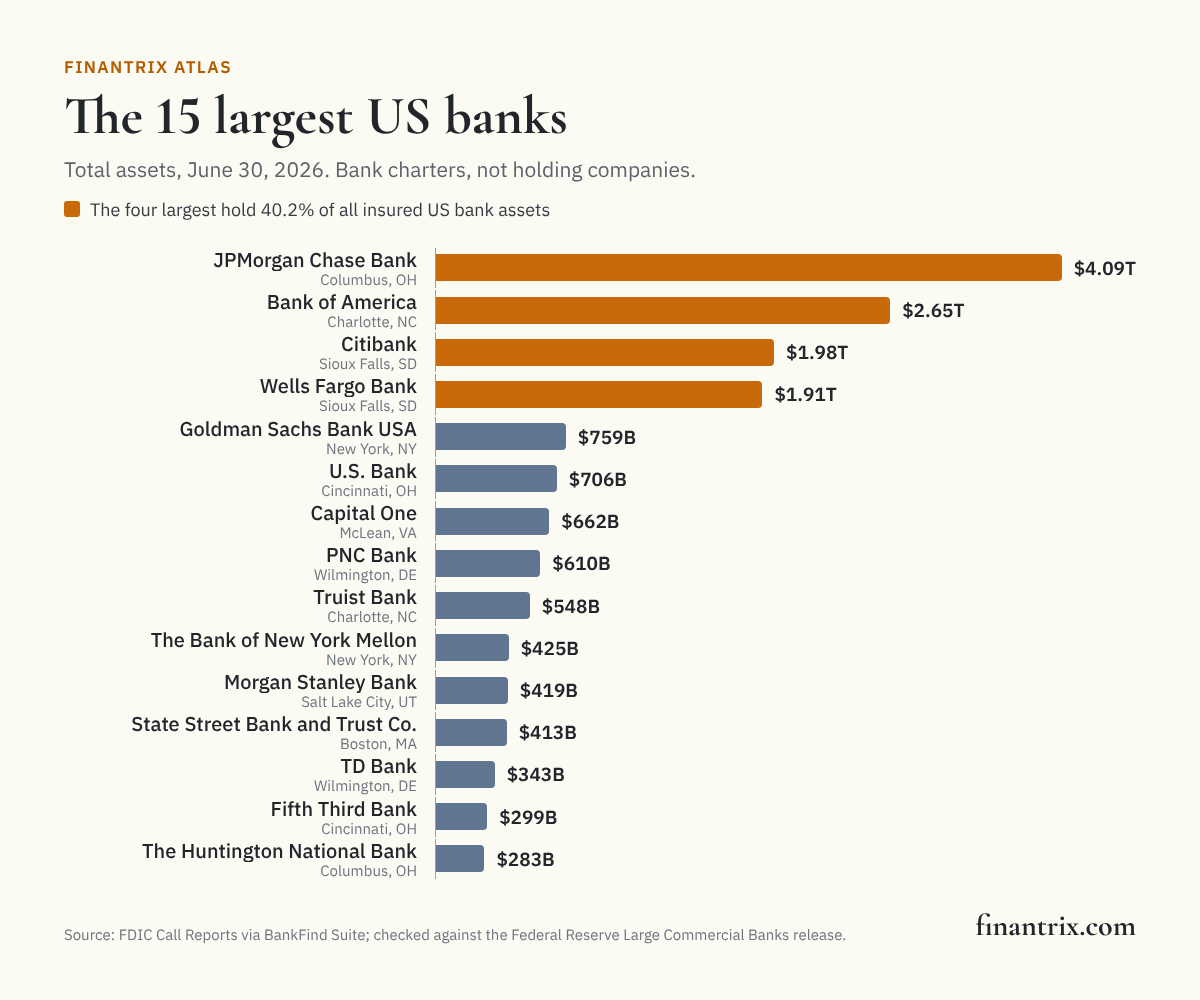
The 50 largest US banks
Ranked by total assets on June 30, 2026. Each row is one bank charter; a holding company that owns more than one charter appears once per charter.
| Rank | Bank | Headquarters | Total assets | Deposits | US offices | Source |
|---|---|---|---|---|---|---|
| 1 | JPMorgan Chase Bank | Columbus, OH | $4.09 trillion | $2.82 trillion | 5,176 | FDIC |
| 2 | Bank of America | Charlotte, NC | $2.65 trillion | $2.12 trillion | 3,598 | FDIC |
| 3 | Citibank | Sioux Falls, SD | $1.98 trillion | $1.55 trillion | 667 | FDIC |
| 4 | Wells Fargo Bank | Sioux Falls, SD | $1.91 trillion | $1.56 trillion | 4,161 | FDIC |
| 5 | Goldman Sachs Bank USA | New York, NY | $759 billion | $499 billion | 5 | FDIC |
| 6 | U.S. Bank | Cincinnati, OH | $706 billion | $542 billion | 2,097 | FDIC |
| 7 | Capital One | McLean, VA | $662 billion | $513 billion | 249 | FDIC |
| 8 | PNC Bank | Wilmington, DE | $610 billion | $458 billion | 2,413 | FDIC |
| 9 | Truist Bank | Charlotte, NC | $548 billion | $419 billion | 1,931 | FDIC |
| 10 | The Bank of New York Mellon | New York, NY | $425 billion | $373 billion | 13 | FDIC |
| 11 | Morgan Stanley Bank | Salt Lake City, UT | $419 billion | $279 billion | 1 | FDIC |
| 12 | State Street Bank and Trust Company | Boston, MA | $413 billion | $326 billion | 3 | FDIC |
| 13 | TD Bank | Wilmington, DE | $343 billion | $278 billion | 1,051 | FDIC |
| 14 | Fifth Third Bank | Cincinnati, OH | $299 billion | $241 billion | 1,508 | FDIC |
| 15 | The Huntington National Bank | Columbus, OH | $283 billion | $227 billion | 1,477 | FDIC |
| 16 | BMO Bank | Chicago, IL | $255 billion | $194 billion | 988 | FDIC |
| 17 | Charles Schwab Bank, SSB † | Westlake, TX | $251 billion | $225 billion | 1 | FDIC |
| 18 | Morgan Stanley Private Bank | Purchase, NY | $250 billion | $212 billion | 1 | FDIC |
| 19 | First-Citizens Bank & Trust Company | Raleigh, NC | $236 billion | $174 billion | 518 | FDIC |
| 20 | Citizens Bank | Providence, RI | $233 billion | $189 billion | 977 | FDIC |
| 21 | Manufacturers and Traders Trust Company | Buffalo, NY | $219 billion | $172 billion | 960 | FDIC |
| 22 | American Express National Bank | Sandy, UT | $214 billion | $172 billion | 1 | FDIC |
| 23 | KeyBank | Cleveland, OH | $189 billion | $158 billion | 952 | FDIC |
| 24 | Ally Bank | Sandy, UT | $188 billion | $157 billion | 1 | FDIC |
| 25 | The Northern Trust Company | Chicago, IL | $179 billion | $148 billion | 65 | FDIC |
| 26 | HSBC Bank USA | Tysons, VA | $173 billion | $141 billion | 22 | FDIC |
| 27 | Regions Bank | Birmingham, AL | $160 billion | $132 billion | 1,256 | FDIC |
| 28 | Pinnacle Bank | Nashville, TN | $129 billion | $102 billion | 429 | FDIC |
| 29 | UBS Bank USA | Salt Lake City, UT | $124 billion | $109 billion | 1 | FDIC |
| 30 | Synchrony Bank † | Draper, UT | $115 billion | $86.0 billion | 1 | FDIC |
| 31 | USAA Federal Savings Bank † | Phoenix, AZ | $106 billion | $92.0 billion | 2 | FDIC |
| 32 | Santander Bank | Wilmington, DE | $104 billion | $84.4 billion | 368 | FDIC |
| 33 | City National Bank | Los Angeles, CA | $99.1 billion | $81.5 billion | 71 | FDIC |
| 34 | Western Alliance Bank | Phoenix, AZ | $98.6 billion | $82.3 billion | 38 | FDIC |
| 35 | Zions Bancorporation | Salt Lake City, UT | $89.0 billion | $76.6 billion | 413 | FDIC |
| 36 | Flagstar Bank | Hicksville, NY | $87.7 billion | $67.5 billion | 345 | FDIC |
| 37 | East West Bank | Pasadena, CA | $84.3 billion | $70.3 billion | 97 | FDIC |
| 38 | First Horizon Bank | Memphis, TN | $84.1 billion | $68.8 billion | 416 | FDIC |
| 39 | Old National Bank | Evansville, IN | $73.9 billion | $57.0 billion | 361 | FDIC |
| 40 | UMB Bank | Kansas City, MO | $71.9 billion | $60.2 billion | 207 | FDIC |
| 41 | SouthState Bank | Winter Haven, FL | $68.8 billion | $56.4 billion | 374 | FDIC |
| 42 | CIBC Bank USA | Chicago, IL | $66.5 billion | $51.5 billion | 13 | FDIC |
| 43 | Valley National Bank | Passaic, NJ | $66.2 billion | $54.3 billion | 232 | FDIC |
| 44 | Columbia Bank | Roseburg, OR | $65.4 billion | $52.2 billion | 369 | FDIC |
| 45 | Banco Popular de Puerto Rico † | San Juan, PR | $63.3 billion | $58.7 billion | 1 | FDIC |
| 46 | SoFi Bank | Cottonwood Heights, UT | $56.8 billion | $46.8 billion | 4 | FDIC |
| 47 | Frost Bank | San Antonio, TX | $54.0 billion | $43.7 billion | 222 | FDIC |
| 48 | BOKF | Tulsa, OK | $53.0 billion | $40.0 billion | 115 | FDIC |
| 49 | Associated Bank | Green Bay, WI | $51.8 billion | $40.1 billion | 218 | FDIC |
| 50 | First National Bank of Pennsylvania | Greenville, PA | $50.8 billion | $39.1 billion | 361 | FDIC |
Download this table (CSV), free. The full dataset, every insured bank with its identifiers, is one email away.
† Not in the Federal Reserve's Large Commercial Banks release, because it is a savings institution or is based in a US territory. These rows are checked against the FDIC alone.
How concentrated US banking is
- The largest bank holds 15.5% of all insured bank assets.
- The largest four hold 40.2%, and the largest ten hold 54.2%.
- The 50 banks in the table hold 77.5%. The smallest of them, First National Bank of Pennsylvania, reports $50.8 billion.
- According to the FDIC, 32 banks report more than $100 billion in total assets.
- 4,050 banks, 96% of the total, are under $10 billion. Between them they hold 13.3% of insured bank assets.
Most US banks are small, and most US bank assets are in a handful of very large ones. Both facts matter to anyone selling to banks: most potential buyers are community banks, while most of the assets, and the largest budgets, sit at the top of this table.
What size changes about buying technology
A bank's size shapes how it buys systems as much as which systems it buys. The largest banks tend to run large internal engineering teams and negotiate bespoke terms; community banks more often buy hosted or managed services, and lean on their core provider's ecosystem for everything around it. Regional banks sit between the two: often large enough to need enterprise-grade systems, without the engineering depth of the very largest.
If you are evaluating vendors for a bank, these guides compare them side by side:
- Cloud-based core banking systems: what a move off a legacy core involves, and who can take it on.
- Mobile banking apps for regional banks: digital channel platforms for banks between community and money-center scale.
- Real-time payments platforms: the instant payment rails and the platforms that connect a bank to them.
- Banking-as-a-Service platforms for traditional banks: for banks that want to offer their charter to fintech partners.
Planning the change before choosing the vendor? The Retail Bank Business Capability Model maps what a bank does, and the Retail Banking Business Architecture Toolkit packages the model with value streams and an information model for a transformation program.
More from Finantrix Atlas
- Largest community banks in the US
- Largest credit unions in the US
- US bank mergers of the past year
- Largest bank trust departments
- Largest custodian banks, ranked by assets under custody
How this list was built
The universe is every active institution in the FDIC's BankFind Suite that reported for June 30, 2026, ranked by total assets as filed in its Call Report. Total assets and deposits are consolidated, so they include foreign offices; the office count is US offices only.
The Federal Reserve Board publishes the same quarter's figures for insured commercial banks in its Large Commercial Banks release. Each of the 46 commercial banks in the table appears there with the same consolidated assets, to the million dollars the Federal Reserve publishes, and in the same order. The 4 marked rows are outside that release. A list that disagreed with the Federal Reserve would not be published.
Limits
- Banks, not bank holding companies. A group that owns several charters, or a large nonbank business, is larger than any single row. 1 holding companies own more than one charter in this table.
- One quarter. Totals move from quarter to quarter, and a merger can reorder the list between filings. The date of the data is June 30, 2026.
- Assets are not size in every sense. A bank with a large trading or custody business can rank above a bank with far more branches and customers. Deposits and offices are shown so the difference is visible.
- Insured US institutions only. US branches of foreign banks and uninsured trust companies are outside the FDIC's insured universe and are not ranked.
Cite this
Free to quote, cite and republish, including the chart, with credit to Finantrix Atlas and a link to this page.
Four banks hold 40.2% of the assets of all FDIC-insured US banks, and JPMorgan Chase Bank alone holds more than the smallest 4,092 banks combined, according to a Finantrix Atlas analysis of June 30, 2026 Call Reports filed with the FDIC.
4,050 of the 4,210 insured US banks have less than $10 billion in assets, yet together they hold 13.3% of bank assets, according to Finantrix Atlas.
Suggested citation: Finantrix Atlas, "Largest Banks in the US by Total Assets," data as of June 30, 2026, from FDIC Call Reports. https://www.finantrix.com/articles/largest-banks-in-the-us
Embed the chart:
<a href="https://www.finantrix.com/articles/largest-banks-in-the-us"><img src="https://www.finantrix.com/atlas/largest-banks-in-the-us.png" alt="The largest US banks by total assets, from Finantrix Atlas"></a>
<p>Chart: <a href="https://www.finantrix.com/articles/largest-banks-in-the-us">Finantrix Atlas</a>, from FDIC Call Reports.</p>
Frequently asked questions
Q: What is the largest bank in the US? A: JPMorgan Chase Bank, with $4.09 trillion in total assets on June 30, 2026, according to its Call Report filed with the FDIC.
Q: How many banks are there in the US? A: 4,210 FDIC-insured institutions filed a Call Report for June 30, 2026, holding $26.45 trillion in total assets between them.
Q: How much of US banking do the biggest banks control? A: The four largest banks hold 40.2% of insured bank assets, and the ten largest hold 54.2%.
Q: How many US banks have more than $100 billion in assets? A: 32, according to FDIC data as of June 30, 2026.
Q: Why does this list differ from lists of the largest bank holding companies? A: It ranks individual bank charters, which is how the FDIC and the Federal Reserve report them. A holding company's total also includes its other charters and nonbank subsidiaries.
Download the data
The 50 rows on this page (CSV), free. The full dataset has all 4,210 rows, as of June 30, 2026; we email you a link.
Frequently Asked Questions
What is the largest bank in the US?
JPMorgan Chase Bank, with $4.09 trillion in total assets on June 30, 2026, according to its Call Report filed with the FDIC.
How many banks are there in the US?
4,210 FDIC-insured institutions filed a Call Report for June 30, 2026, holding $26.45 trillion in total assets between them.
How much of US banking do the biggest banks control?
The four largest banks hold 40.2% of insured bank assets, and the ten largest hold 54.2%.
How many US banks have more than $100 billion in assets?
32, according to FDIC data as of June 30, 2026.
Why does this list differ from lists of the largest bank holding companies?
It ranks individual bank charters, which is how the FDIC and the Federal Reserve report them. A holding company's total also includes its other charters and nonbank subsidiaries.