
Key Takeaways
- 3,785 of the 4,210 FDIC-insured banks, 90%, are community banks, and together they hold 10.4% of insured bank assets.
- The largest community bank is Customers Bank, with $26.5 billion in total assets; the median community bank holds $345 million.
- The FDIC's definition is not a size cutoff: 15 community banks have more than $10 billion in assets, while 280 banks under $10 billion are not community banks.
- Every figure is a June 30, 2026 Call Report figure from the FDIC, and every bank on the list that the Federal Reserve also publishes matches its figure.
90% of FDIC-insured US banks are community banks, and together they hold 10.4% of the country's bank assets. That is 3,785 of 4,210 banks, holding $2.74 trillion between them. The largest, Customers Bank of Malvern, PA, reports $26.5 billion; the median community bank holds $345 million.
This ranking uses the FDIC's own community-bank designation for June 30, 2026, and every figure is the one the bank reported in its Call Report.
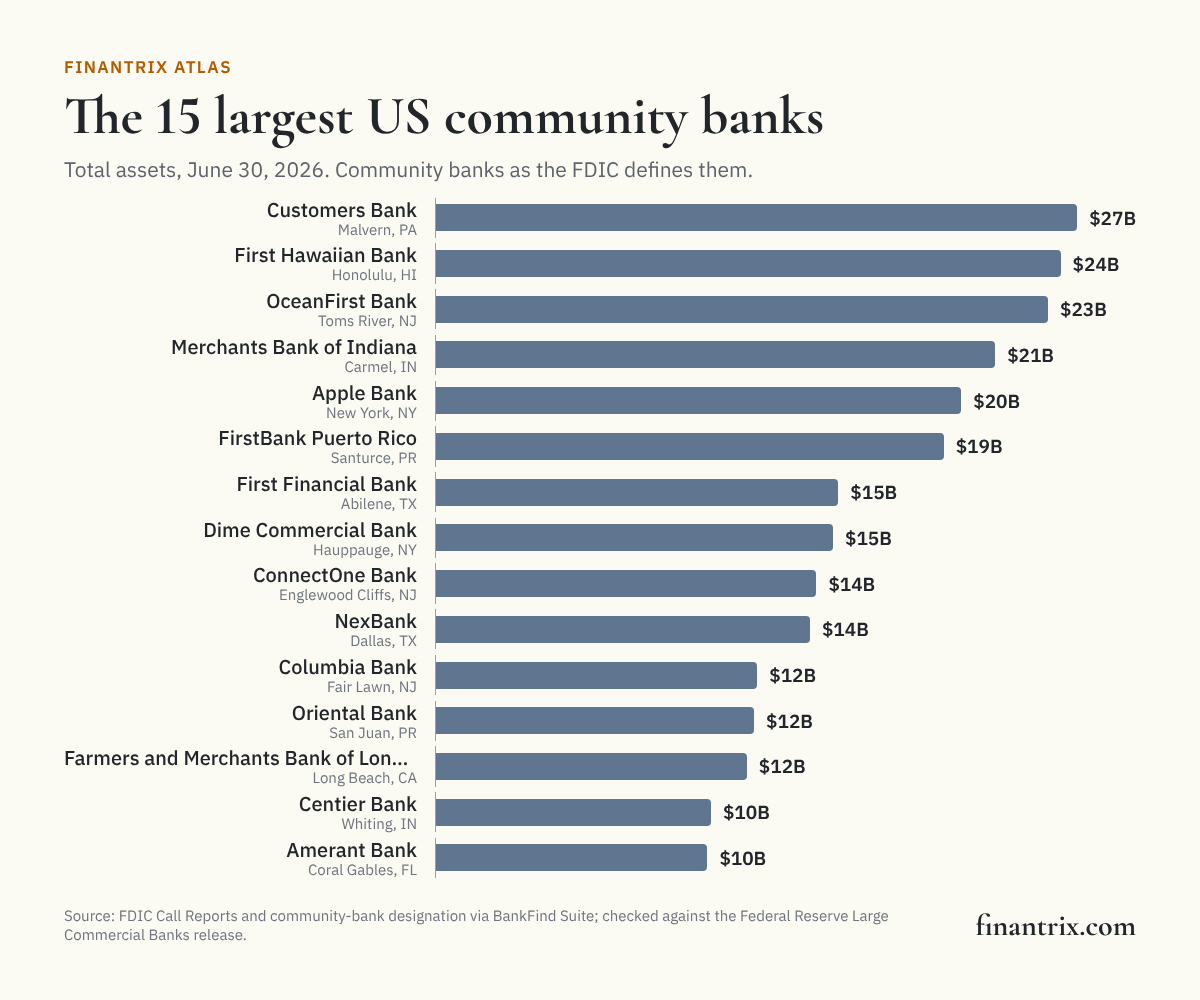
The 50 largest US community banks
Ranked by total assets on June 30, 2026. Each row is one bank charter.
| Rank | Bank | Headquarters | Total assets | Deposits | US offices | Source |
|---|---|---|---|---|---|---|
| 1 | Customers Bank | Malvern, PA | $26.5 billion | $21.9 billion | 7 | FDIC |
| 2 | First Hawaiian Bank | Honolulu, HI | $23.6 billion | $20.2 billion | 45 | FDIC |
| 3 | OceanFirst Bank | Toms River, NJ | $23.2 billion | $18.0 billion | 72 | FDIC |
| 4 | Merchants Bank of Indiana | Carmel, IN | $21.2 billion | $14.3 billion | 8 | FDIC |
| 5 | Apple Bank † | New York, NY | $19.9 billion | $16.1 billion | 79 | FDIC |
| 6 | FirstBank Puerto Rico † | Santurce, PR | $19.2 billion | $16.9 billion | 11 | FDIC |
| 7 | First Financial Bank | Abilene, TX | $15.2 billion | $13.3 billion | 83 | FDIC |
| 8 | Dime Commercial Bank | Hauppauge, NY | $15.0 billion | $12.7 billion | 64 | FDIC |
| 9 | ConnectOne Bank | Englewood Cliffs, NJ | $14.4 billion | $11.8 billion | 57 | FDIC |
| 10 | NexBank | Dallas, TX | $14.2 billion | $11.0 billion | 2 | FDIC |
| 11 | Columbia Bank † | Fair Lawn, NJ | $12.2 billion | $9.6 billion | 69 | FDIC |
| 12 | Oriental Bank † | San Juan, PR | $12.0 billion | $10.0 billion | 1 | FDIC |
| 13 | Farmers and Merchants Bank of Long Beach | Long Beach, CA | $11.8 billion | $8.8 billion | 27 | FDIC |
| 14 | Centier Bank | Whiting, IN | $10.4 billion | $8.8 billion | 63 | FDIC |
| 15 | Amerant Bank | Coral Gables, FL | $10.3 billion | $8.4 billion | 24 | FDIC |
| 16 | Byline Bank | Chicago, IL | $9.9 billion | $7.9 billion | 55 | FDIC |
| 17 | Capitol Federal Savings Bank † | Topeka, KS | $9.7 billion | $6.9 billion | 46 | FDIC |
| 18 | EagleBank | Bethesda, MD | $9.6 billion | $8.2 billion | 14 | FDIC |
| 19 | Union Bank and Trust Company | Lincoln, NE | $9.2 billion | $7.5 billion | 37 | FDIC |
| 20 | American Savings Bank | Honolulu, HI | $9.0 billion | $8.2 billion | 35 | FDIC |
| 21 | Metropolitan Commercial Bank | New York, NY | $8.9 billion | $7.8 billion | 11 | FDIC |
| 22 | First American Bank | Elk Grove Village, IL | $8.6 billion | $5.6 billion | 58 | FDIC |
| 23 | First Security Bank | Searcy, AR | $8.6 billion | $6.8 billion | 81 | FDIC |
| 24 | Forbright Bank | Potomac, MD | $8.5 billion | $7.3 billion | 4 | FDIC |
| 25 | Peapack Private Bank & Trust | Bedminster, NJ | $8.0 billion | $7.1 billion | 19 | FDIC |
| 26 | Stockman Bank of Montana | Miles City, MT | $7.7 billion | $6.2 billion | 47 | FDIC |
| 27 | Bangor Savings Bank † | Bangor, ME | $7.7 billion | $5.7 billion | 72 | FDIC |
| 28 | Kearny Bank † | Kearny, NJ | $7.7 billion | $5.7 billion | 40 | FDIC |
| 29 | Ocean Bank | Miami, FL | $7.6 billion | $6.2 billion | 25 | FDIC |
| 30 | Ridgewood Savings Bank † | Ridgewood, NY | $7.5 billion | $6.0 billion | 38 | FDIC |
| 31 | Central Pacific Bank | Honolulu, HI | $7.5 billion | $6.7 billion | 27 | FDIC |
| 32 | Needham Bank † | Needham, MA | $7.4 billion | $6.3 billion | 21 | FDIC |
| 33 | Lake City Bank | Warsaw, IN | $7.2 billion | $6.3 billion | 57 | FDIC |
| 34 | Johnson Bank | Racine, WI | $7.1 billion | $5.6 billion | 32 | FDIC |
| 35 | The Camden National Bank | Camden, ME | $6.9 billion | $5.6 billion | 74 | FDIC |
| 36 | Old Second National Bank | Aurora, IL | $6.9 billion | $5.5 billion | 57 | FDIC |
| 37 | Heartland Bank and Trust Company | Bloomington, IL | $6.7 billion | $5.8 billion | 87 | FDIC |
| 38 | Alpine Bank | Glenwood Springs, CO | $6.7 billion | $5.9 billion | 47 | FDIC |
| 39 | Midland States Bank | Effingham, IL | $6.7 billion | $5.7 billion | 60 | FDIC |
| 40 | SMBC MANUBANK | Los Angeles, CA | $6.6 billion | $5.6 billion | 8 | FDIC |
| 41 | The Washington Trust Company, of Westerly | Westerly, RI | $6.6 billion | $5.4 billion | 30 | FDIC |
| 42 | Choice Financial Group | Fargo, ND | $6.4 billion | $5.1 billion | 18 | FDIC |
| 43 | Five Star Bank | Rochester, NY | $6.3 billion | $5.3 billion | 48 | FDIC |
| 44 | Shore United Bank | Easton, MD | $6.1 billion | $5.4 billion | 40 | FDIC |
| 45 | CFG Bank | Lutherville, MD | $6.1 billion | $5.1 billion | 3 | FDIC |
| 46 | River City Bank | Sacramento, CA | $6.0 billion | $5.4 billion | 9 | FDIC |
| 47 | Wilson Bank and Trust | Lebanon, TN | $6.0 billion | $5.3 billion | 32 | FDIC |
| 48 | Fremont Bank | Fremont, CA | $6.0 billion | $5.3 billion | 23 | FDIC |
| 49 | Bank First | Manitowoc, WI | $5.9 billion | $5.0 billion | 38 | FDIC |
| 50 | Emigrant Bank | Miami, FL | $5.7 billion | $4.2 billion | 7 | FDIC |
Download this table (CSV), free. The full dataset, every community bank with its identifiers, is one email away.
† Not in the Federal Reserve's Large Commercial Banks release, because it is a savings institution or is based in a US territory. These rows are checked against the FDIC alone.
What makes a bank a community bank
The FDIC defines a community bank by what it does and where, not by size alone. It leaves out banks with no loans or no core deposits, banks with large foreign operations, and specialty institutions such as credit-card banks. Below a size threshold that it raises over time, the remaining banks count. Above it, a bank must also keep a high share of its balance sheet in loans and core deposits, and a limited, local office network.
That is why a simple size cutoff gives a different list:
- According to the FDIC, 15 community banks have more than $10 billion in total assets.
- At the same time, 280 banks with less than $10 billion are not community banks.
Texas is home to more community banks than any other state, with 312.
What this means for technology buyers
Community banks are most of the banks in the country and a minority of its assets. Most run their core systems through a provider rather than in-house, so a technology decision is usually also a decision about that provider's ecosystem. These guides compare the options side by side:
- Cloud-based core banking systems: what a move off a legacy core involves, and who can take it on.
- Mobile banking apps for regional banks: digital channel platforms for banks below money-center scale.
- Deposit management platforms: for banks competing to keep and grow core deposits.
- Commercial loan origination systems: the lending side of a community bank's franchise.
Planning the change before choosing the vendor? The Retail Bank Business Capability Model maps what a bank does, and the Bank Value Streams show how that work flows to a customer.
More from Finantrix Atlas
- Largest banks in the US, ranked by total assets
- Largest custodian banks, ranked by assets under custody
- Largest registered investment advisers, ranked by assets
How this list was built
The universe is every active institution in the FDIC's BankFind Suite that reported for June 30, 2026 and that the FDIC designates a community bank. Banks are ranked by total assets as filed in their Call Reports; assets and deposits are consolidated, and the office count is US offices only.
The Federal Reserve Board publishes the same quarter's figures for insured commercial banks in its Large Commercial Banks release. Each of the 41 banks in the table that it covers appears there with the same consolidated assets, to the million dollars the Federal Reserve publishes. The 9 marked rows are outside that release.
Limits
- The designation is the FDIC's. A bank's status can change from one year to the next as its business or size changes, and other definitions, including a simple asset cutoff, give a different list.
- Banks, not holding companies. A holding company that owns several charters appears once per charter.
- One quarter. The date of the data is June 30, 2026. A merger can move a bank in or out of the list between filings.
- Assets are one measure of size. Deposits and offices are shown so a bank with a large balance sheet and few branches can be told apart from one with a wide network.
Cite this
Free to quote, cite and republish, including the chart, with credit to Finantrix Atlas and a link to this page.
Community banks make up 90% of FDIC-insured US banks but hold 10.4% of bank assets, according to a Finantrix Atlas analysis of June 30, 2026 FDIC data.
The largest US community bank, Customers Bank, reports $26.5 billion in total assets, according to Finantrix Atlas.
Suggested citation: Finantrix Atlas, "Largest Community Banks in the US," data as of June 30, 2026, from FDIC Call Reports. https://www.finantrix.com/articles/largest-community-banks
Embed the chart:
<a href="https://www.finantrix.com/articles/largest-community-banks"><img src="https://www.finantrix.com/atlas/largest-community-banks.png" alt="The largest US community banks by total assets, from Finantrix Atlas"></a>
<p>Chart: <a href="https://www.finantrix.com/articles/largest-community-banks">Finantrix Atlas</a>, from FDIC Call Reports.</p>
Frequently asked questions
Q: What is the largest community bank in the US? A: Customers Bank, with $26.5 billion in total assets on June 30, 2026, among banks the FDIC designates as community banks.
Q: How many community banks are there in the US? A: 3,785, according to the FDIC's designation for June 30, 2026. That is 90% of all FDIC-insured banks.
Q: Is a community bank any bank under $10 billion? A: No. The FDIC defines community banks by their lending, deposits and office network as well as their size. According to the FDIC, 15 community banks are larger than $10 billion, and 280 smaller banks are not community banks.
Q: How much of US banking do community banks hold? A: 10.4% of the assets of FDIC-insured banks, or $2.74 trillion, as of June 30, 2026.
Download the data
The 50 rows on this page (CSV), free. The full dataset has all 3,785 rows, as of June 30, 2026; we email you a link.
Frequently Asked Questions
What is the largest community bank in the US?
Customers Bank, with $26.5 billion in total assets on June 30, 2026, among banks the FDIC designates as community banks.
How many community banks are there in the US?
3,785, according to the FDIC's designation for June 30, 2026. That is 90% of all FDIC-insured banks.
Is a community bank any bank under $10 billion?
No. The FDIC defines community banks by their lending, deposits and office network as well as their size. According to the FDIC, 15 community banks are larger than $10 billion, and 280 smaller banks are not community banks.
How much of US banking do community banks hold?
10.4% of the assets of FDIC-insured banks, or $2.74 trillion, as of June 30, 2026.