
Key Takeaways
- According to the FDIC's Summary of Deposits for June 30, 2026, Bank of America holds the most deposits in 9 states and the District of Columbia, more places than any other bank.
- In 30 of the 50 states and the District of Columbia, the leading bank's main office is in another state.
- The leader's share runs from 69.6% in Delaware to 6.9% in Kansas.
- Each state's total matches the FDIC's own sum, and each bank's offices add up to the domestic deposits in its Call Report, apart from 3 FDIC certificates the method names.
Bank of America holds the most deposits in 9 states and the District of Columbia, more places than any other bank, according to the FDIC's Summary of Deposits for June 30, 2026. Next is JPMorgan Chase Bank, with 6. In 30 of the 50 states and the District of Columbia, the bank holding the most deposits has its main office in another state.
The table below gives every state's leading bank, the deposits it holds there and its share, with the next two banks. Find a state by its name; the states are in alphabetical order.
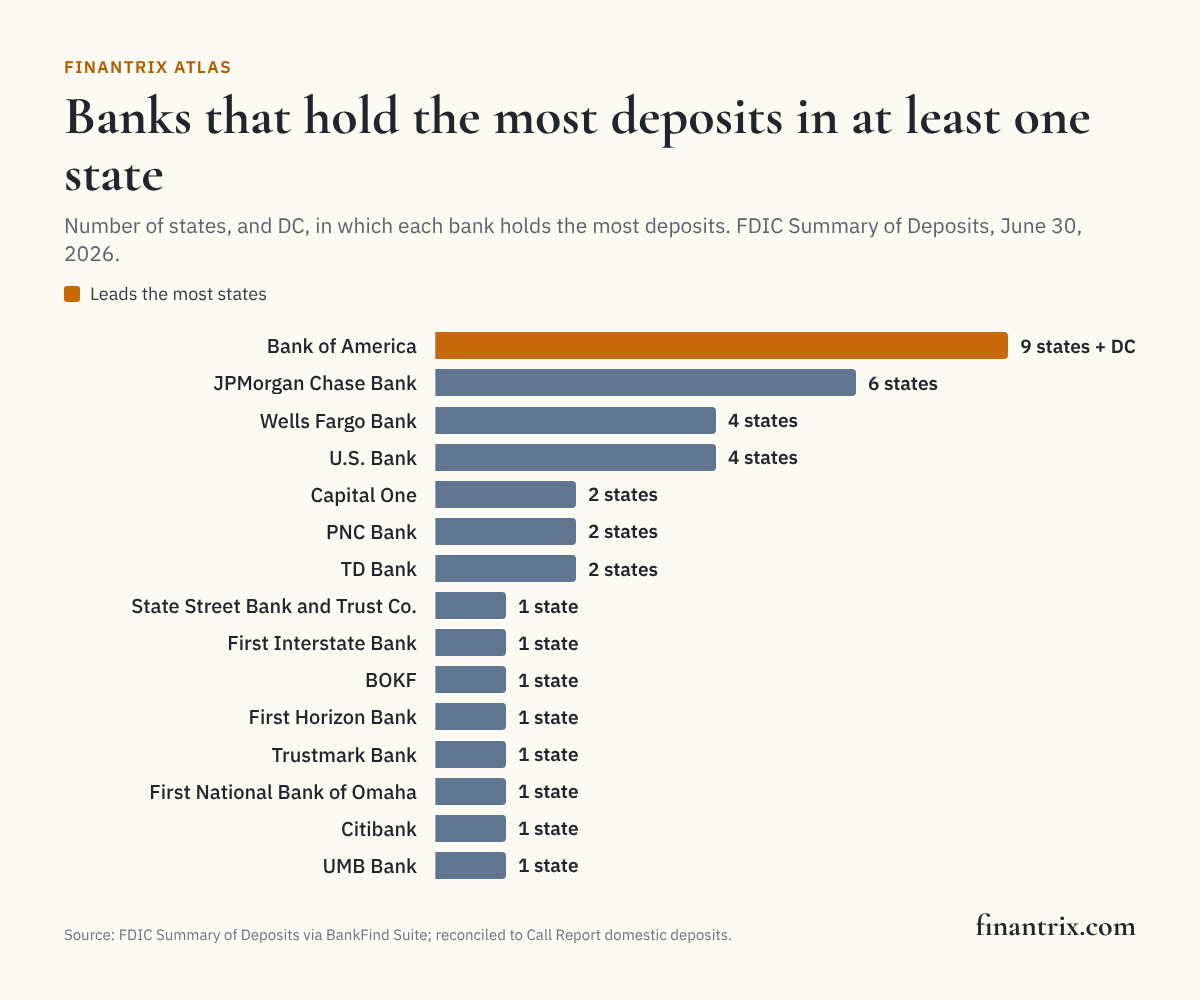
The bank with the most deposits in each state
Deposits held at the bank's offices in the state on June 30, 2026, as each bank reported them to the FDIC. Each row is one bank charter.
| State | Deposits in state | Banks | Leading bank | Its deposits there | Share | Second | Third | Top three | Source |
|---|---|---|---|---|---|---|---|---|---|
| Alabama | $144 billion | 131 | Regions Bank | $30.7 billion | 21.3% | PNC Bank (7.7%) | Wells Fargo Bank (6.8%) | 35.8% | FDIC |
| Alaska | $16.6 billion | 7 | Wells Fargo Bank * | $7.1 billion | 42.9% | First National Bank Alaska (22.3%) | Northrim Bank (17.7%) | 82.9% | FDIC |
| Arizona | $232 billion | 59 | Western Alliance Bank | $52.4 billion | 22.6% | JPMorgan Chase Bank (21.6%) | Wells Fargo Bank (17.0%) | 61.2% | FDIC |
| Arkansas | $108 billion | 108 | Arvest Bank | $14.4 billion | 13.3% | Bank OZK (10.7%) | Simmons Bank (7.4%) | 31.4% | FDIC |
| California | $1.87 trillion | 171 | Bank of America * | $453 billion | 24.2% | Wells Fargo Bank (16.3%) | JPMorgan Chase Bank (15.9%) | 56.4% | FDIC |
| Colorado | $185 billion | 124 | Wells Fargo Bank * | $34.2 billion | 18.5% | JPMorgan Chase Bank (12.8%) | PNC Bank (11.3%) | 42.6% | FDIC |
| Connecticut | $182 billion | 49 | Webster Bank | $42.7 billion | 23.5% | Bank of America (23.1%) | Manufacturers and Traders Trust Company (10.5%) | 57.1% | FDIC |
| Delaware | $556 billion | 36 | Capital One * | $387 billion | 69.6% | TD Bank (10.7%) | Barclays Bank Delaware (6.3%) | 86.7% | FDIC |
| District of Columbia | $55.9 billion | 34 | Bank of America * | $14.8 billion | 26.5% | Wells Fargo Bank (19.1%) | PNC Bank (13.5%) | 59.2% | FDIC |
| Florida | $877 billion | 192 | Bank of America * | $170 billion | 19.4% | Wells Fargo Bank (10.3%) | JPMorgan Chase Bank (9.0%) | 38.8% | FDIC |
| Georgia | $366 billion | 179 | Truist Bank * | $68.7 billion | 18.8% | Bank of America (15.3%) | Wells Fargo Bank (12.6%) | 46.6% | FDIC |
| Hawaii | $57.1 billion | 13 | Bank of Hawaii | $19.6 billion | 34.3% | First Hawaiian Bank (31.2%) | American Savings Bank (14.4%) | 79.9% | FDIC |
| Idaho | $41.8 billion | 31 | Wells Fargo Bank * | $7.0 billion | 16.6% | U.S. Bank (16.4%) | Glacier Bank (7.4%) | 40.4% | FDIC |
| Illinois | $736 billion | 383 | JPMorgan Chase Bank * | $129 billion | 17.5% | BMO Bank (14.5%) | CIBC Bank USA (6.7%) | 38.7% | FDIC |
| Indiana | $220 billion | 131 | JPMorgan Chase Bank * | $27.0 billion | 12.3% | PNC Bank (7.6%) | Old National Bank (6.6%) | 26.5% | FDIC |
| Iowa | $132 billion | 261 | Principal Bank | $9.3 billion | 7.0% | U.S. Bank (6.0%) | Wells Fargo Bank (6.0%) | 19.0% | FDIC |
| Kansas | $105 billion | 233 | Bank of America * | $7.3 billion | 6.9% | Capitol Federal Savings Bank (6.4%) | Intrust Bank (5.3%) | 18.7% | FDIC |
| Kentucky | $124 billion | 152 | PNC Bank * | $11.6 billion | 9.3% | JPMorgan Chase Bank (8.5%) | Fifth Third Bank (6.7%) | 24.6% | FDIC |
| Louisiana | $138 billion | 118 | JPMorgan Chase Bank * | $23.2 billion | 16.9% | Hancock Whitney Bank (12.4%) | Capital One (12.1%) | 41.3% | FDIC |
| Maine | $45.8 billion | 29 | Bangor Savings Bank | $5.3 billion | 11.7% | TD Bank (11.0%) | The Camden National Bank (10.1%) | 32.7% | FDIC |
| Maryland | $204 billion | 71 | Bank of America * | $45.1 billion | 22.2% | Manufacturers and Traders Trust Company (13.2%) | Truist Bank (11.4%) | 46.7% | FDIC |
| Massachusetts | $645 billion | 120 | State Street Bank and Trust Company | $242 billion | 37.5% | Bank of America (15.6%) | Citizens Bank (9.2%) | 62.3% | FDIC |
| Michigan | $303 billion | 98 | JPMorgan Chase Bank * | $64.4 billion | 21.3% | Fifth Third Bank (18.6%) | The Huntington National Bank (12.5%) | 52.4% | FDIC |
| Minnesota | $320 billion | 279 | U.S. Bank * | $107 billion | 33.3% | Wells Fargo Bank (18.1%) | Ameriprise Bank, FSB (7.5%) | 58.9% | FDIC |
| Mississippi | $83.1 billion | 81 | Trustmark Bank | $10.7 billion | 12.9% | The Huntington National Bank (12.2%) | Renasant Bank (11.0%) | 36.2% | FDIC |
| Missouri | $280 billion | 253 | UMB Bank | $36.3 billion | 13.0% | U.S. Bank (8.6%) | Bank of America (7.3%) | 28.9% | FDIC |
| Montana | $38.9 billion | 48 | Glacier Bank | $8.3 billion | 21.4% | Stockman Bank of Montana (16.0%) | First Interstate Bank (15.7%) | 53.0% | FDIC |
| Nebraska | $95.1 billion | 161 | First National Bank of Omaha | $17.5 billion | 18.4% | Pinnacle Bank (8.0%) | Union Bank and Trust Company (7.5%) | 33.9% | FDIC |
| Nevada | $117 billion | 49 | Bank of America * | $23.2 billion | 19.9% | Wells Fargo Bank (19.9%) | Toyota Financial Savings Bank (12.3%) | 52.0% | FDIC |
| New Hampshire | $49.0 billion | 44 | TD Bank * | $10.7 billion | 21.9% | Citizens Bank (18.2%) | Bank of America (11.1%) | 51.1% | FDIC |
| New Jersey | $450 billion | 104 | Bank of America * | $73.4 billion | 16.3% | TD Bank (12.8%) | PNC Bank (9.4%) | 38.5% | FDIC |
| New Mexico | $46.4 billion | 55 | Wells Fargo Bank * | $9.3 billion | 20.1% | Bank of America (13.4%) | BOKF (5.7%) | 39.2% | FDIC |
| New York | $2.77 trillion | 180 | JPMorgan Chase Bank * | $970 billion | 35.0% | Goldman Sachs Bank USA (10.1%) | The Bank of New York Mellon (9.2%) | 54.3% | FDIC |
| North Carolina | $696 billion | 86 | Bank of America | $305 billion | 43.8% | Truist Bank (16.9%) | First-Citizens Bank & Trust Company (13.4%) | 74.1% | FDIC |
| North Dakota | $42.9 billion | 70 | First International Bank & Trust | $4.3 billion | 10.1% | Bell Bank (8.1%) | Gate City Bank (7.8%) | 25.9% | FDIC |
| Ohio | $579 billion | 185 | U.S. Bank | $104 billion | 17.9% | The Huntington National Bank (16.9%) | KeyBank (12.9%) | 47.6% | FDIC |
| Oklahoma | $149 billion | 194 | BOKF | $20.3 billion | 13.6% | MidFirst Bank (10.9%) | BancFirst (7.5%) | 31.9% | FDIC |
| Oregon | $106 billion | 34 | U.S. Bank * | $22.2 billion | 21.0% | Columbia Bank (18.3%) | Bank of America (13.1%) | 52.5% | FDIC |
| Pennsylvania | $566 billion | 148 | PNC Bank * | $140 billion | 24.7% | Wells Fargo Bank (6.9%) | Citizens Bank (6.2%) | 37.8% | FDIC |
| Rhode Island | $45.2 billion | 17 | Citizens Bank | $16.2 billion | 35.7% | Bank of America (21.7%) | The Washington Trust Company, of Westerly (11.6%) | 69.1% | FDIC |
| South Carolina | $134 billion | 75 | Bank of America * | $19.9 billion | 14.9% | Wells Fargo Bank (13.8%) | Truist Bank (10.6%) | 39.2% | FDIC |
| South Dakota | $1.15 trillion | 82 | Citibank | $638 billion | 55.2% | Wells Fargo Bank (40.3%) | The Bancorp Bank (0.6%) | 96.2% | FDIC |
| Tennessee | $252 billion | 165 | First Horizon Bank | $34.1 billion | 13.6% | Pinnacle Bank (12.8%) | Bank of America (9.5%) | 35.9% | FDIC |
| Texas | $1.59 trillion | 447 | JPMorgan Chase Bank * | $308 billion | 19.4% | Charles Schwab Bank, SSB (14.2%) | Bank of America (12.6%) | 46.2% | FDIC |
| Utah | $1.23 trillion | 65 | Morgan Stanley Bank | $269 billion | 21.9% | Goldman Sachs Bank USA (15.8%) | American Express National Bank (14.0%) | 51.7% | FDIC |
| Vermont | $19.0 billion | 25 | TD Bank * | $3.8 billion | 20.2% | Manufacturers and Traders Trust Company (19.2%) | Community Bank (7.9%) | 47.3% | FDIC |
| Virginia | $319 billion | 105 | Capital One | $54.5 billion | 17.1% | Truist Bank (15.6%) | Bank of America (14.7%) | 47.3% | FDIC |
| Washington | $209 billion | 63 | Bank of America * | $41.5 billion | 19.8% | JPMorgan Chase Bank (14.5%) | U.S. Bank (11.1%) | 45.4% | FDIC |
| West Virginia | $48.1 billion | 65 | United Bank * | $7.0 billion | 14.5% | Truist Bank (12.5%) | WesBanco Bank, Inc. (8.7%) | 35.8% | FDIC |
| Wisconsin | $207 billion | 185 | U.S. Bank * | $33.8 billion | 16.3% | Associated Bank (13.1%) | BMO Bank (10.6%) | 40.1% | FDIC |
| Wyoming | $22.1 billion | 45 | First Interstate Bank * | $2.8 billion | 12.6% | Wells Fargo Bank (10.5%) | Glacier Bank (6.4%) | 29.5% | FDIC |
* The bank's main office is in another state.
Download this table (CSV), free. The full dataset, every bank's deposits in every state with FDIC certificates to join on, is one email away.
Territories and freely associated states
The Summary of Deposits also covers 7 places outside the states, holding $96.1 billion between them. They are listed here rather than in the table above.
| Place | Status | Deposits | Banks | Leading bank | Share | Second | Source |
|---|---|---|---|---|---|---|---|
| Puerto Rico | US territory | $85.5 billion | 6 | Banco Popular de Puerto Rico | 66.4% | FirstBank Puerto Rico (15.8%) | FDIC |
| Guam | US territory | $4.7 billion | 4 | First Hawaiian Bank | 41.6% | Bank of Guam (36.1%) | FDIC |
| US Virgin Islands | US territory | $3.6 billion | 5 | Banco Popular de Puerto Rico | 39.2% | FirstBank Puerto Rico (31.9%) | FDIC |
| Northern Mariana Islands | US territory | $968 million | 4 | Bank of Guam | 39.6% | First Hawaiian Bank (38.9%) | FDIC |
| Palau | Freely associated state | $593 million | 3 | Bank of Hawaii | 49.4% | Bank of Guam (46.8%) | FDIC |
| Federated States of Micronesia | Freely associated state | $510 million | 2 | Bank of Guam | 51.9% | Bank of the Federated States of Micronesia (48.1%) | FDIC |
| Marshall Islands | Freely associated state | $238 million | 1 | Bank of Guam | 100.0% | none | FDIC |
How concentrated each state is
- Most concentrated: in Delaware, Capital One holds 69.6% of the deposits in the state, according to FDIC data.
- Least concentrated: in Kansas, the leader, Bank of America, holds 6.9%, among 233 banks with offices there.
- Closest race: in Nevada, Bank of America leads Wells Fargo Bank by $19 million, or 0.02% of the state's deposits.
- Leaders: 28 different banks lead at least one of the 50 states and the District of Columbia.
Grouping every charter a holding company owns would change the leader in 1 of them: Nevada, where Wells Fargo & Company's banks together hold 25.8%.
Where deposits are counted
The Summary of Deposits assigns every deposit to one office of the bank that holds it. The FDIC's reporting instructions ask banks to assign deposits "in a manner consistent with their existing internal record-keeping practices", and allow certain classes of deposits to be assigned to a single office "for reasons of convenience or efficiency". A bank can therefore assign deposits it gathers across the country to a single office in one state. A state's total measures the deposits booked there, which is not the same as the deposits of the people who live there.
What this means for technology buyers
In 30 of the 50 states and the District of Columbia, a local bank's largest competitor for deposits is run from another state. A bank competing with the state leader competes on its deposit offer and its digital channels, and on the core that runs both. These guides compare the systems involved:
- Mobile banking apps for regional banks: digital channel platforms for banks below money-center scale.
- Deposit management platforms: for banks competing to keep and grow core deposits.
- Cloud-based core banking systems: what a move off a legacy core involves, and who can take it on.
- Financial BI and dashboarding for bank executives: tracking deposit share and growth market by market.
Mapping the business before choosing the vendor? The Retail Bank Business Capability Model maps what a bank does, and the Bank Value Streams show how that work reaches a customer.
More from Finantrix Atlas
- Largest banks in the US, ranked by total assets
- Largest community banks in the US
- US bank mergers: every deal in the past year
How this list was built
The universe is every office of every FDIC-insured institution in the FDIC's Summary of Deposits for June 30, 2026: 75,545 offices in the 50 states and the District of Columbia, belonging to 4,249 institutions in all. It includes 10 offices that are FDIC-insured branches of foreign banks. For each state, a bank's deposits are the sum of the deposits assigned to its offices there, and banks are ranked by that sum. Each row is one charter, identified by its FDIC certificate.
Two reconciliations run before the page is written:
- Each state's total equals the sum BankFind computes itself for the same survey and field.
- Every insured institution that filed a Call Report for June 30, 2026, 4,247 in all, is in the Summary of Deposits; the 66 filers that are not are uninsured. Each bank's offices add up to the domestic deposits in its Call Report, except 3 FDIC certificates whose offices differ by $999 million in all, 0.01% of the deposits counted: State Bank Northwest and Bank of China. For a bank with offices outside the states, the Call Report figure matches one of three sums, depending on where the bank is based and how it files: its offices in the states, its offices outside the freely associated states, or all of its offices. The check accepts the closest of the three, and only an exact match counts. No state's leader would change if the remaining gaps went the other way.
Limits
- Deposits only. The ranking measures deposits held in the state, not lending, assets or customers, and a bank that lends heavily in a state can hold few deposits there.
- Booked, not sourced. Deposits are counted where each bank assigns them, under the FDIC's reporting instructions, so a state's total and its leader reflect where deposits are booked.
- Charters, not companies. A holding company with two banks in one state appears twice; the note under the concentration figures says where that changes a leader.
- Insured offices only. Credit unions, which hold deposits too, are not in the Summary of Deposits and are not ranked here.
- One date. The survey is taken once a year, as of June 30, 2026. A merger or a branch sale since then is not reflected.
Cite this
Free to quote, cite and republish, including the chart, with credit to Finantrix Atlas and a link to this page.
Bank of America holds more deposits than any other bank in 9 states and the District of Columbia, according to a Finantrix Atlas analysis of the FDIC's Summary of Deposits for June 30, 2026.
The leading bank's share of a state's deposits ranges from 69.6% in Delaware to 6.9% in Kansas, according to Finantrix Atlas, from FDIC data.
Suggested citation: Finantrix Atlas, "Largest Banks in Each State by Deposits," data as of June 30, 2026, from the FDIC Summary of Deposits. https://www.finantrix.com/articles/banks-by-state
Embed the chart:
<a href="https://www.finantrix.com/articles/banks-by-state"><img src="https://www.finantrix.com/atlas/banks-by-state.png" alt="The banks that hold the most deposits in each state, from Finantrix Atlas"></a>
<p>Chart: <a href="https://www.finantrix.com/articles/banks-by-state">Finantrix Atlas</a>, from the FDIC Summary of Deposits.</p>
Frequently asked questions
Q: Which bank is the largest in the most states? A: Measured by deposits held in each state, Bank of America, which leads in 9 states and the District of Columbia, according to the FDIC's Summary of Deposits for June 30, 2026.
Q: Which state's deposits are most concentrated in one bank? A: Delaware, where Capital One holds 69.6% of the deposits booked in the state, according to FDIC data for June 30, 2026.
Q: Where does this data come from? A: The FDIC's Summary of Deposits, an annual survey of the deposits held at every office of every FDIC-insured institution as of June 30. This page uses the survey for June 30, 2026.
Q: Does a state's deposit total show where depositors live? A: No. The Summary of Deposits counts deposits at the office each bank assigns them to, and the FDIC's reporting instructions allow some classes of deposits to be assigned to a single office, so deposits gathered across the country can be booked in one state.
Download the data
The 58 rows on this page (CSV), free. The full dataset has all 6,065 rows, as of June 30, 2026; we email you a link.
Frequently Asked Questions
Which bank is the largest in the most states?
Measured by deposits held in each state, Bank of America, which leads in 9 states and the District of Columbia, according to the FDIC's Summary of Deposits for June 30, 2026.
Which state's deposits are most concentrated in one bank?
Delaware, where Capital One holds 69.6% of the deposits booked in the state, according to FDIC data for June 30, 2026.
Where does this data come from?
The FDIC's Summary of Deposits, an annual survey of the deposits held at every office of every FDIC-insured institution as of June 30. This page uses the survey for June 30, 2026.
Does a state's deposit total show where depositors live?
No. The Summary of Deposits counts deposits at the office each bank assigns them to, and the FDIC's reporting instructions allow some classes of deposits to be assigned to a single office, so deposits gathered across the country can be booked in one state.