
Key Takeaways
- State Street is custodian to more US registered fund series than any other bank, 4,532, or 36.4% of series with a bank custodian.
- 73% of those series use State Street, BNY or U.S. Bank.
- The series in State Street's custody have $15.45 trillion in combined average net assets, according to Form N-CEN.
- Counted from every fund's latest annual Form N-CEN, filed October 6, 2025 to September 29, 2026.
73% of US registered fund series (mutual funds, ETFs, closed-end and interval funds) with a bank custodian keep their assets at one of three banks: State Street, BNY and U.S. Bank. State Street alone is custodian to 4,532 series, 36.4% of them, whose average net assets come to $15.45 trillion.
Every fund registered with the SEC files Form N-CEN once a year and names its custodians. This count covers all 13,195 fund series in the SEC's data at their latest report, filed October 6, 2025 to September 29, 2026; 94% of them name a bank custodian.
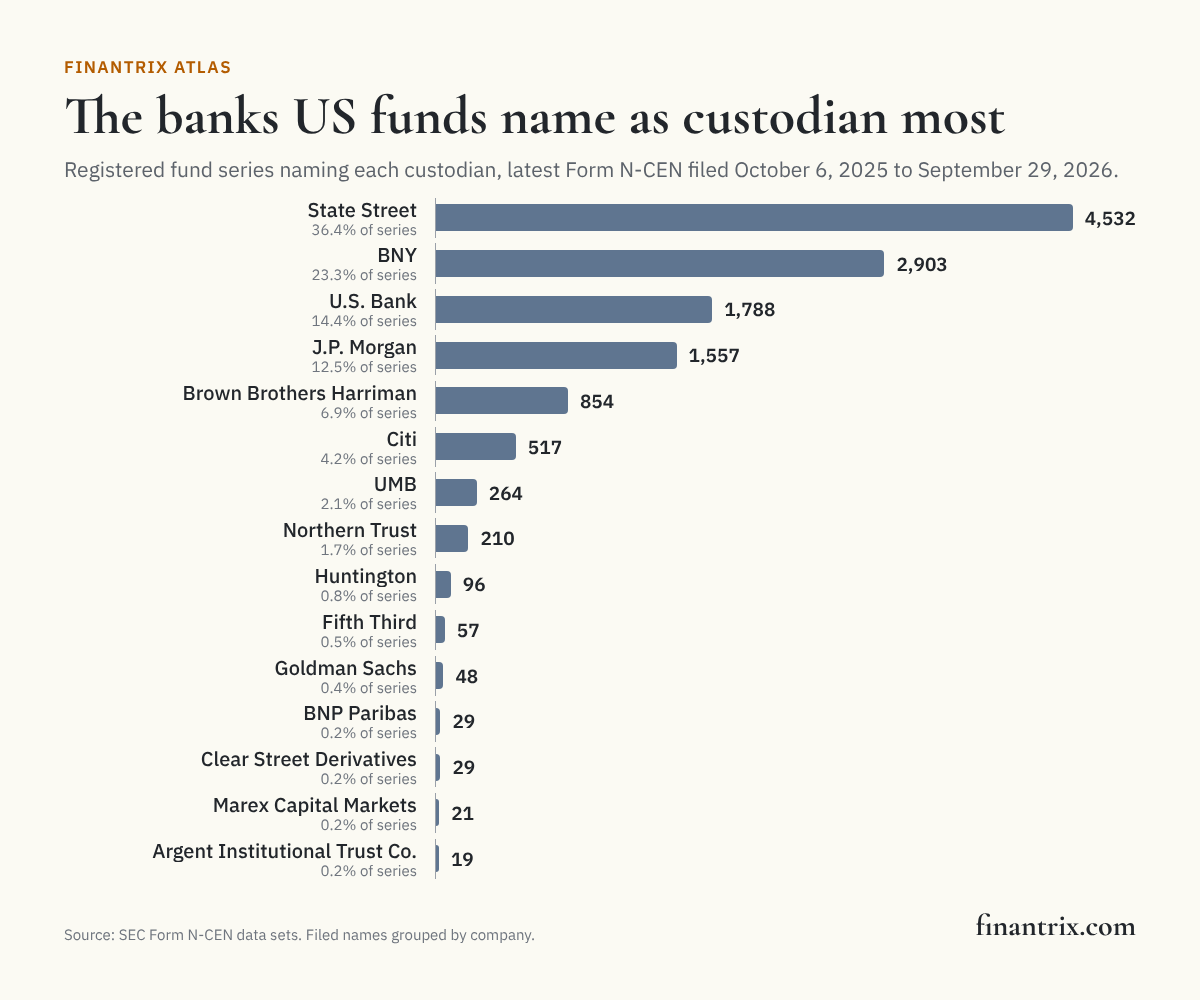
The 20 largest fund custodians
Counted by the fund series that name each bank as custodian under section 17(f)(1) of the Investment Company Act, leaving out sub-custodians, foreign custodians, securities depositories and futures brokers. A series with two bank custodians counts for both.
| Rank | Custodian | Fund series | Share of series with a custodian | Average net assets of those series |
|---|---|---|---|---|
| 1 | State Street | 4,532 | 36.4% | $15.45 trillion |
| 2 | BNY | 2,903 | 23.3% | $8.98 trillion |
| 3 | U.S. Bank | 1,788 | 14.4% | $782 billion |
| 4 | J.P. Morgan | 1,557 | 12.5% | $12.25 trillion |
| 5 | Brown Brothers Harriman | 854 | 6.9% | $1.73 trillion |
| 6 | Citi | 517 | 4.2% | $1.58 trillion |
| 7 | UMB | 264 | 2.1% | $144 billion |
| 8 | Northern Trust | 210 | 1.7% | $648 billion |
| 9 | Huntington | 96 | 0.8% | $9.6 billion |
| 10 | Fifth Third | 57 | 0.5% | $7.3 billion |
| 11 | Goldman Sachs | 48 | 0.4% | $28.2 billion |
| 12 | BNP Paribas | 29 | 0.2% | $35.2 billion |
| 13 | Clear Street Derivatives | 29 | 0.2% | $1.5 billion |
| 14 | Marex Capital Markets | 21 | 0.2% | $1.3 billion |
| 15 | Argent Institutional Trust Company | 19 | 0.2% | $4.3 billion |
| 16 | Cowen Execution Services | 9 | 0.1% | $745 million |
| 17 | Inspira Financial | 8 | 0.1% | $10.2 billion |
| 18 | Bank of America | 8 | 0.1% | $1.5 billion |
| 19 | Interactive Brokers | 7 | 0.1% | $6.4 billion |
| 20 | Computershare Trust Company | 6 | 0.0% | $1.5 billion |
Download this table (CSV), free, with every filed name grouped under each bank. The full dataset, every fund series with its family, assets and custodians, is one email away.
How concentrated fund custody is
- The three largest custodians hold the assets of 73% of series with a bank custodian.
- The 12,445 series counted hold $40.10 trillion in average net assets.
- By assets rather than series, State Street leads with $15.45 trillion.
- The filings name 34 bank custodians in all.
What this means for technology buyers
A fund's custodian holds its assets and settles its trades, so the systems on the manager's side have to fit it:
- Order management systems for asset managers: trades that settle with the custodian.
- Corporate actions processing platforms: the event processing a custodian runs on every holding.
- Securities lending platforms for asset managers: often run through the custodian bank.
- Multi-asset portfolio analytics: reconciled positions across custodians.
Mapping the business? The Asset Management Capability Model and the Asset Management Business Architecture Toolkit show where custody sits in a manager's operating model.
More from Finantrix Atlas
- Largest custodian banks, ranked by assets under custody
- Largest mutual fund and ETF administrators
- Who audits mutual funds and ETFs
How this was counted
The SEC publishes Form N-CEN filings quarterly; the last 4 quarters hold every registered fund's latest annual report. Each fund series is taken from its most recent filing, and every bank custodian it names under section 17(f)(1) is grouped by company. Assets are N-CEN's average net assets over each fund's fiscal year.
Limits
- Average, not current, assets. N-CEN reports a fund's average net assets over its fiscal year.
- As filed. Custody types are counted as each fund reports them; a handful of filings list non-banks under the bank heading.
- Counts of series, not fees. A small fund counts the same as a large one; assets are shown so the difference is visible.
- Registered funds only. Bank-wide custody figures, including pension and institutional clients, are on the custodian banks page.
Cite this
Free to quote, cite and republish, including the chart, with credit to Finantrix Atlas and a link to this page.
73% of US registered fund series with a bank custodian use State Street, BNY or U.S. Bank, according to a Finantrix Atlas analysis of SEC Form N-CEN filings.
Suggested citation: Finantrix Atlas, "Largest Mutual Fund and ETF Custodians," from SEC Form N-CEN filings, October 6, 2025 to September 29, 2026. https://www.finantrix.com/articles/largest-fund-custodians
Embed the chart:
<a href="https://www.finantrix.com/articles/largest-fund-custodians"><img src="https://www.finantrix.com/atlas/largest-fund-custodians.png" alt="Fund custodians by number of fund series, from Finantrix Atlas"></a>
<p>Chart: <a href="https://www.finantrix.com/articles/largest-fund-custodians">Finantrix Atlas</a>, from SEC Form N-CEN data.</p>
Frequently asked questions
Q: Which bank is custodian to the most mutual funds? A: State Street, named by 4,532 US registered fund series on Form N-CEN.
Q: How concentrated is fund custody? A: According to SEC Form N-CEN data, 73% of fund series with a bank custodian use one of the three largest.
Download the data
The 20 rows on this page (CSV), free. The full dataset has all 13,195 rows, as of September 29, 2026; we email you a link.
Frequently Asked Questions
Which bank is custodian to the most mutual funds?
State Street, named by 4,532 US registered fund series on Form N-CEN.
How concentrated is fund custody?
According to SEC Form N-CEN data, 73% of fund series with a bank custodian use one of the three largest.