
Key Takeaways
- Among standalone ETFs, BlackRock (iShares) manages the most assets, $3.39 trillion on average over the latest fiscal year, or 49% of the $6.86 trillion those ETFs hold, according to SEC filings.
- BlackRock (iShares), State Street (SPDR) and Charles Schwab manage 68% of standalone ETF assets across 4,173 ETFs from 256 issuers.
- Vanguard's largest ETFs are a share class of its index mutual funds; SEC filings report $6.99 trillion for those 69 funds across all their classes, so they are shown apart rather than ranked.
- 84% of standalone ETF assets are in index ETFs, and 2,309 of the 4,173 ETFs are not index funds, according to Form N-CEN.
Among standalone ETFs, BlackRock (iShares) manages the most assets: $3.39 trillion on average over the latest fiscal year, 49% of the $6.86 trillion those ETFs hold. State Street (SPDR) and Charles Schwab follow, and the three together manage 68%. The figures cover 4,173 ETFs from 256 issuers, from the annual reports every registered fund files with the SEC.
One issuer cannot be ranked on the same basis, and the reason is below: Vanguard's largest ETFs are a share class of its index mutual funds.
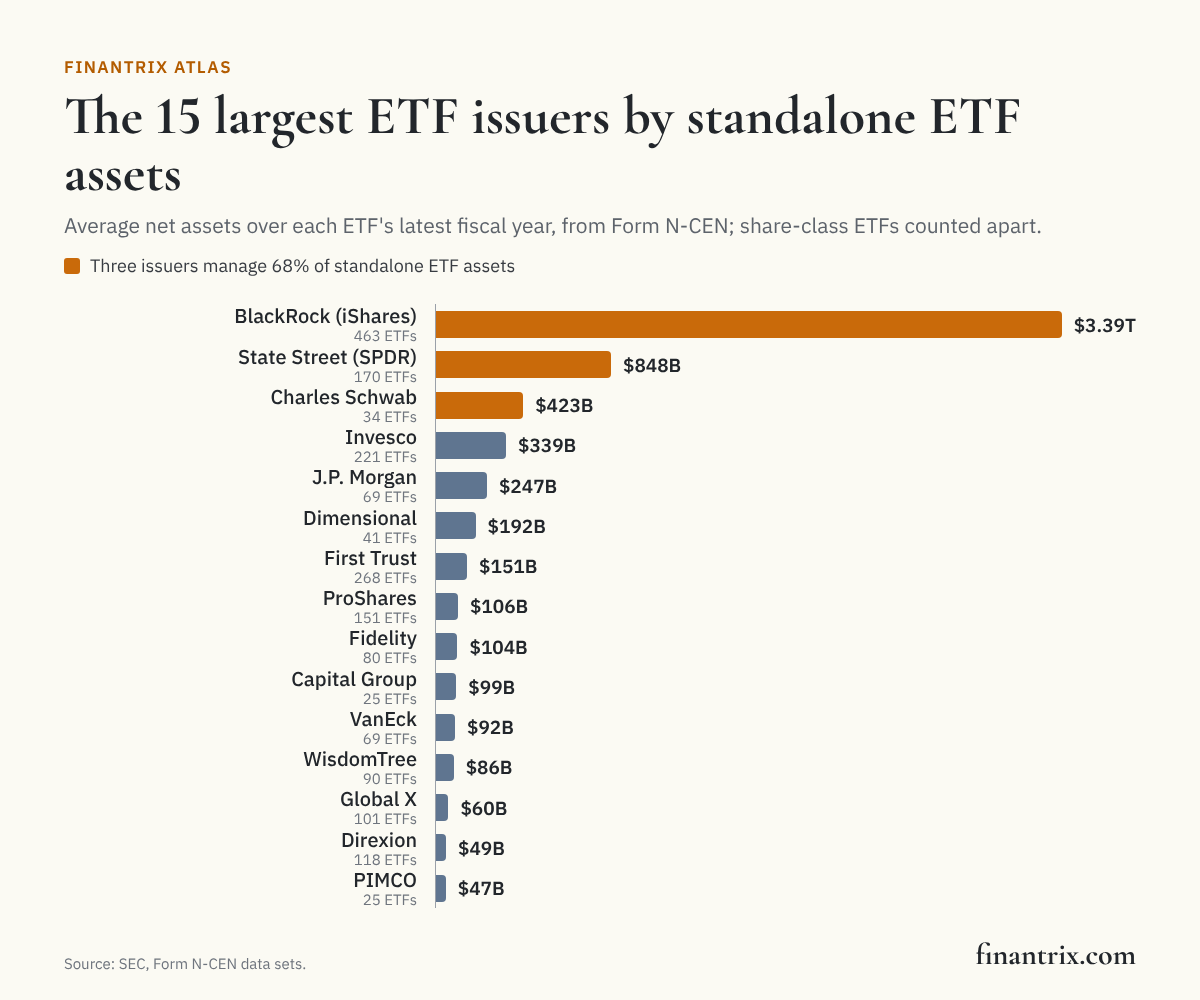
The 25 largest ETF issuers
Ranked by the average net assets of each issuer's standalone ETFs over its latest fiscal year, as reported on Form N-CEN. An issuer is the ETF's investment adviser of record, with advisers that share a firm's name grouped together.
| Rank | Issuer | Standalone ETF assets | Share | ETFs | In index ETFs | Source |
|---|---|---|---|---|---|---|
| 1 | BlackRock (iShares) | $3.39 trillion | 49.5% | 463 | 98% | SEC |
| 2 | State Street (SPDR) | $848 billion | 12.4% | 170 | 98% | SEC |
| 3 | Charles Schwab | $423 billion | 6.2% | 34 | 100% | SEC |
| 4 | Invesco | $339 billion | 4.9% | 221 | 96% | SEC |
| 5 | J.P. Morgan | $247 billion | 3.6% | 69 | 23% | SEC |
| 6 | Dimensional | $192 billion | 2.8% | 41 | 0% | SEC |
| 7 | First Trust | $151 billion | 2.2% | 268 | 44% | SEC |
| 8 | ProShares | $106 billion | 1.6% | 151 | 78% | SEC |
| 9 | Fidelity | $104 billion | 1.5% | 80 | 46% | SEC |
| 10 | Capital Group | $98.8 billion | 1.4% | 25 | 0% | SEC |
| 11 | VanEck | $92.4 billion | 1.3% | 69 | 98% | SEC |
| 12 | WisdomTree | $85.7 billion | 1.2% | 90 | 94% | SEC |
| 13 | Global X | $60.3 billion | 0.9% | 101 | 99% | SEC |
| 14 | Direxion | $48.6 billion | 0.7% | 118 | 99% | SEC |
| 15 | PIMCO | $47.4 billion | 0.7% | 25 | 14% | SEC |
| 16 | Goldman Sachs | $39.8 billion | 0.6% | 43 | 91% | SEC |
| 17 | Pacer | $38.1 billion | 0.6% | 57 | 97% | SEC |
| 18 | Vanguard | $35.9 billion | 0.5% | 29 | 67% | SEC |
| 19 | Janus Henderson | $32.5 billion | 0.5% | 15 | 0% | SEC |
| 20 | Franklin Templeton | $31.0 billion | 0.5% | 68 | 57% | SEC |
| 21 | DWS (Xtrackers) | $26.9 billion | 0.4% | 41 | 100% | SEC |
| 22 | Innovator | $25.5 billion | 0.4% | 158 | 4% | SEC |
| 23 | Tidal Investments | $25.1 billion | 0.4% | 178 | 10% | SEC |
| 24 | Northern Trust | $21.3 billion | 0.3% | 38 | 93% | SEC |
| 25 | Victory Capital | $19.2 billion | 0.3% | 32 | 63% | SEC |
Vanguard is ranked 18 on its standalone ETFs only; most of its ETF assets are in share classes the filings cannot measure, explained below.
Download this table (CSV), free. The full dataset, every ETF with its adviser, subadvisers, share classes and assets, is one email away.
Why Vanguard is counted apart
A fund can issue an ETF as one share class alongside mutual fund classes, and Form N-CEN reports net assets for the fund as a whole. 69 Vanguard funds are built this way; together they report $6.99 trillion to the SEC across all their share classes. The largest, Vanguard Total Stock Market Index Fund, reports $1.90 trillion. No SEC data set separates the ETF class from the others, so counting those funds would credit their mutual fund classes to the ETF ranking, and leaving them out silently would understate Vanguard as an ETF issuer. They are reported here instead, and the table ranks Vanguard on its 29 standalone ETFs alone, $35.9 billion.
What else the filings show
- 84% of standalone ETF assets are in index ETFs. 2,309 of the 4,173 ETFs, 55%, do not report themselves to the SEC as index funds: actively managed ETFs, and rules-based strategies that do not track an index.
- The ten largest issuers manage 86% of standalone ETF assets; the smallest in the table manages $19.2 billion.
- BlackRock (iShares) runs the most ETFs, 463.
What this means for technology buyers
Running ETFs puts the creation and redemption basket, the order flow and the index at the center of operations. These guides compare the options:
- ETF basket trading and creation and redemption platforms: the daily basket process with authorized participants.
- Order management systems for asset managers: orders, compliance checks and allocations.
- Factor investing and smart beta platforms: building the rules-based strategies many ETFs track.
- Transaction cost analysis tools: measuring what rebalancing costs.
Mapping an asset manager before choosing systems? The Asset Management Capability Model sets out what the firm does, and the Asset Management Business Information Model defines the data behind it.
More from Finantrix Atlas
- Largest asset managers by reported equity holdings
- Largest fund custodians
- Compare an institutional manager with its peers
How this list was built
Each series in the SEC's Form N-CEN data sets for 2025q4 to 2026q3 is taken from its latest filing, and counts when it reports itself as an exchange-traded fund. Its size is the average of its monthly net assets over the fiscal year that filing covers, which ends between June 30, 2023 and June 30, 2026. Its issuer is the investment adviser of record the filing names; where a fund names subadvisers, the adviser of record still counts, which is how white-label platforms that host other firms' ETFs appear in the table.
A series is standalone when it has one share class. Funds with an ETF flag and more than one share class are not ranked, and the build fails if any issuer other than Vanguard reports one, so that this page is revisited when share-class ETFs spread.
Limits
- Averages over a fiscal year, not today's assets. Each ETF's figure is its average over its latest fiscal year, so fast-growing ETFs are understated against their current size.
- Registered funds only. Commodity and spot crypto trusts are not registered investment companies, file no N-CEN and are not counted.
- Share-class ETFs are not ranked. See the section above.
- The adviser of record is not always the brand. An ETF hosted on another firm's platform counts under the platform that advises it.
Cite this
Free to quote, cite and republish, including the chart, with credit to Finantrix Atlas and a link to this page.
Among standalone ETFs, BlackRock (iShares) manages the most assets, $3.39 trillion on average over the latest fiscal year, according to a Finantrix Atlas analysis of SEC Form N-CEN data.
Suggested citation: Finantrix Atlas, "ETF Issuers Ranked by Fund Assets," fiscal years ending June 30, 2023 to June 30, 2026, from SEC Form N-CEN. https://www.finantrix.com/articles/etf-issuers-by-assets
Embed the chart:
<a href="https://www.finantrix.com/articles/etf-issuers-by-assets"><img src="https://www.finantrix.com/atlas/etf-issuers-by-assets.png" alt="ETF issuers ranked by standalone ETF assets, from Finantrix Atlas"></a>
<p>Chart: <a href="https://www.finantrix.com/articles/etf-issuers-by-assets">Finantrix Atlas</a>, from SEC Form N-CEN data.</p>
Frequently asked questions
Q: Which company issues the most ETF assets? A: Among standalone ETFs, BlackRock (iShares), with $3.39 trillion on average over the latest fiscal year, 49% of standalone ETF assets.
Q: Why is Vanguard not ranked on all its ETFs? A: Most of Vanguard's ETF assets sit in a share class of funds that also have mutual fund classes, and SEC filings report assets only for the whole fund. Those 69 funds report $6.99 trillion to the SEC across all classes, which overstates their ETF assets, so they are shown separately.
Q: How many ETFs are there? A: 4,173 standalone ETFs filed Form N-CEN for fiscal years ending June 30, 2023 to June 30, 2026, plus 69 funds that offer an ETF share class.
Download the data
The 25 rows on this page (CSV), free. The full dataset has all 4,242 rows, as of June 30, 2026; we email you a link.
Frequently Asked Questions
Which company issues the most ETF assets?
Among standalone ETFs, BlackRock (iShares), with $3.39 trillion on average over the latest fiscal year, 49% of standalone ETF assets.
Why is Vanguard not ranked on all its ETFs?
Most of Vanguard's ETF assets sit in a share class of funds that also have mutual fund classes, and SEC filings report assets only for the whole fund. Those 69 funds report $6.99 trillion to the SEC across all classes, which overstates their ETF assets, so they are shown separately.
How many ETFs are there?
4,173 standalone ETFs filed Form N-CEN for fiscal years ending June 30, 2023 to June 30, 2026, plus 69 funds that offer an ETF share class.