
Key Takeaways
- Blackstone reports the most securitized asset fund assets to the SEC, $51.7 billion in Form ADV filings through October 31, 2026, followed by Redding Ridge and Carlyle, according to SEC data.
- Funds whose names identify them as CLOs hold 69% of the $1.43 trillion in securitized asset fund gross assets reported on Form ADV, according to SEC data.
- The ten largest managers hold 26% of securitized asset fund assets, according to SEC data.
- Counted fund by fund from Schedule D, each fund once, registered and exempt reporting advisers alike.
Blackstone reports the most securitized asset fund assets to the SEC, $51.7 billion, in Form ADV filings through October 31, 2026, followed by Redding Ridge and Carlyle. According to SEC data, 269 advisers report $1.43 trillion in securitized asset funds, and funds whose names identify them as collateralized loan obligations hold 69% of it.
A collateralized loan obligation buys a pool of corporate loans and pays for it by issuing notes in layers, from the most senior, paid first, to the equity, paid last. A manager selects and trades the loans for the life of the deal. Because most of a CLO's investors hold its notes, Form ADV classes it as a securitized asset fund: a private fund whose primary purpose is to issue asset-backed securities and whose investors are primarily debt-holders. This page ranks the managers of those funds, fund by fund, for registered and exempt reporting advisers alike.
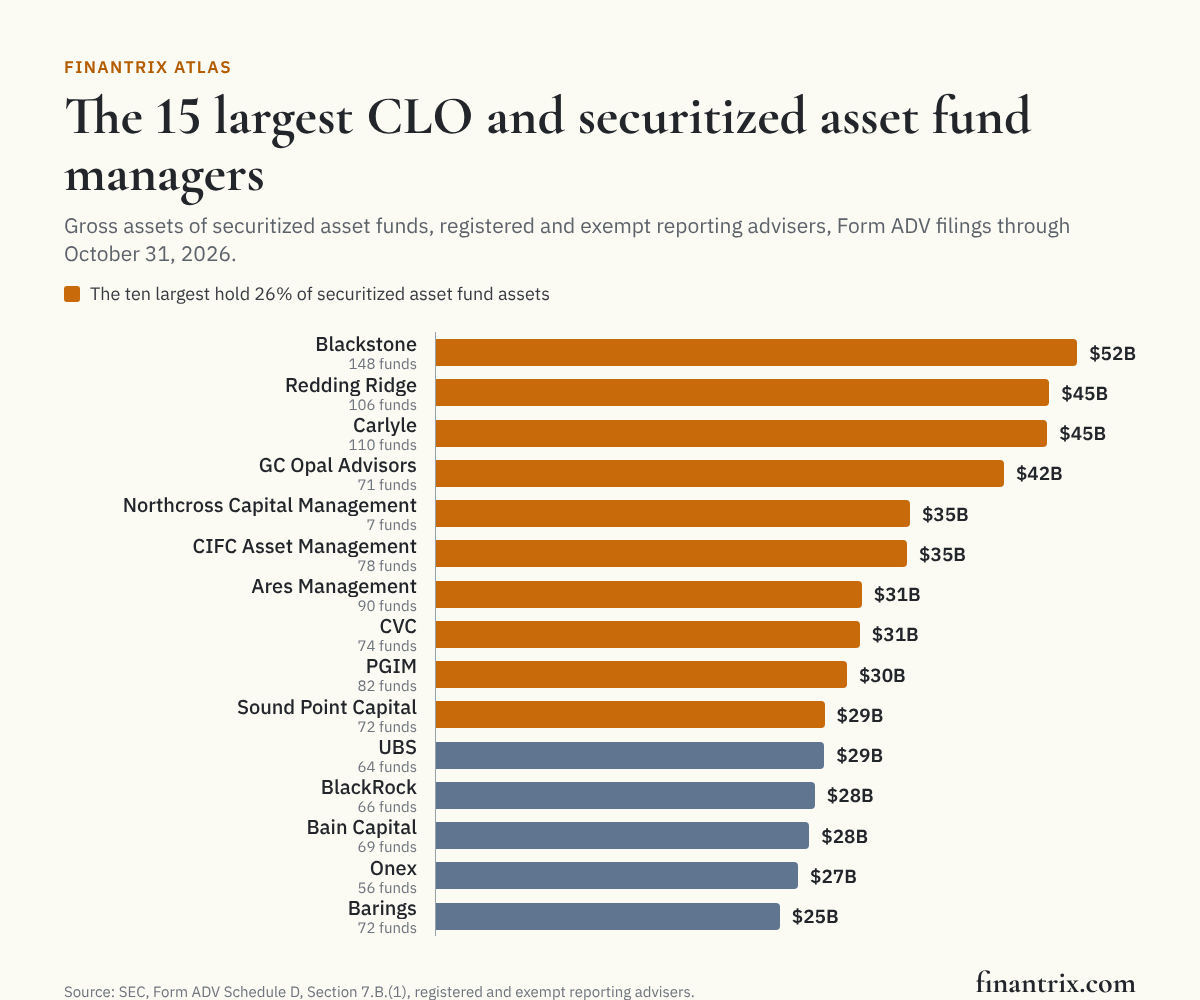
The 25 largest CLO and securitized asset fund managers
Ranked by the gross assets of the securitized asset funds each manager advises, as its advisers reported them on Schedule D. Each CLO is its own fund, so a manager's fund count is close to the number of deals it manages. "Reports as" says whether the manager's advisers are registered with the SEC or report as exempt reporting advisers. A fund reported by two advisers counts once in every total and share.
| Rank | Manager | Securitized asset fund assets | Share | Change over the year | Funds | Reports as | Source |
|---|---|---|---|---|---|---|---|
| 1 | Blackstone (5 advisers) | $51.7 billion | 3.6% | +11% | 148 | Registered | SEC |
| 2 | Redding Ridge (2 advisers) | $45.3 billion | 3.2% | +18% | 106 | Registered | SEC |
| 3 | Carlyle (2 advisers) | $45.1 billion | 3.2% | +0% | 110 | Registered | SEC |
| 4 | GC Opal Advisors | $41.9 billion | 2.9% | +16% | 71 | Registered | SEC |
| 5 | Northcross Capital Management | $35.0 billion | 2.5% | +5% | 7 | Exempt reporting | SEC |
| 6 | CIFC Asset Management | $34.8 billion | 2.4% | +9% | 78 | Registered | SEC |
| 7 | Ares Management (2 advisers) | $31.4 billion | 2.2% | −4% | 90 | Registered | SEC |
| 8 | CVC (2 advisers) | $31.3 billion | 2.2% | +22% | 74 | Registered | SEC |
| 9 | PGIM (2 advisers) | $30.3 billion | 2.1% | −13% | 82 | Registered | SEC |
| 10 | Sound Point Capital (3 advisers) | $28.7 billion | 2.0% | +1% | 72 | Registered | SEC |
| 11 | UBS | $28.7 billion | 2.0% | −1% | 64 | Registered | SEC |
| 12 | BlackRock (2 advisers) | $28.0 billion | 2.0% | +5% | 66 | Registered | SEC |
| 13 | Bain Capital | $27.6 billion | 1.9% | +14% | 69 | Registered | SEC |
| 14 | Onex | $26.7 billion | 1.9% | +30% | 56 | Registered | SEC |
| 15 | Barings (2 advisers) | $25.4 billion | 1.8% | +16% | 72 | Both | SEC |
| 16 | Elmwood Asset Management | $24.3 billion | 1.7% | +14% | 52 | Registered | SEC |
| 17 | AGL Credit Management | $23.5 billion | 1.6% | +39% | 46 | Registered | SEC |
| 18 | Octagon Credit Investors | $23.0 billion | 1.6% | −14% | 50 | Registered | SEC |
| 19 | Oak Hill Advisors | $22.4 billion | 1.6% | +11% | 45 | Registered | SEC |
| 20 | Anchorage Capital Advisors | $20.4 billion | 1.4% | +12% | 61 | Registered | SEC |
| 21 | Trinitas Capital Management | $18.6 billion | 1.3% | +12% | 43 | Registered | SEC |
| 22 | HPS Investment Partners | $18.3 billion | 1.3% | +61% | 49 | Registered | SEC |
| 23 | Palmer Square Capital Management | $18.3 billion | 1.3% | +1% | 46 | Registered | SEC |
| 24 | Voya | $18.0 billion | 1.3% | +4% | 46 | Registered | SEC |
| 25 | Fortress Investment Group | $17.7 billion | 1.2% | +14% | 42 | Registered | SEC |
The change over the year compares each firm's funds with its own filing up to October 31, 2025, like for like, by the rules of the fastest-growing private fund managers: "new" marks a firm that reported none of these funds a year earlier, and "n/a" one whose advisers had not filed again with updated figures.
Download this table (CSV), free. The full dataset, every registered and exempt reporting adviser with securitized asset funds, with how many of each adviser's funds are named as CLOs, is one email away.
What the figures measure
- Gross assets, as Form ADV defines them. An adviser reports each private fund's gross assets on the basis used for regulatory assets under management: the fair value of what the fund holds, without deducting its debt, plus any uncalled capital commitments, according to the SEC's instructions. For a CLO that is broadly the value of its loan portfolio, the assets that its notes finance.
- Not every securitized asset fund is a CLO. The category also takes in funds that issue other asset-backed securities. The share named as CLOs, 69% by assets, counts a fund as a CLO only when its filed name says so, so it is a floor rather than an exact figure.
- The median fund. According to SEC data, the median securitized asset fund counted here reports $407 million in gross assets, and investors outside the US own 22% of the total, weighting each fund's reported share of non-US owners by its size.
What this means for technology buyers
A CLO manager runs many deals at once, each with its own collateral tests, payment waterfall and trustee reports, on top of the loan trading itself. These guides compare the systems involved:
- Private credit loan management and servicing: loan-level records, amendments and payments.
- Counterparty credit risk platforms: exposure to banks, dealers and other counterparties.
- Investor relations and reporting platforms: what noteholders and equity investors receive.
Mapping the firm before choosing systems? The Asset Management Business Information Model defines the information an asset manager runs on.
More from Finantrix Atlas
- Fastest-growing private fund managers by fund type
- Largest private equity firms by fund assets
- Top hedge fund managers by hedge fund assets
- Largest private fund managers
How this list was built
The universe is every private fund that an adviser reported on Schedule D, Section 7.B.(1) of Form ADV, in its latest filing up to October 31, 2026, from both registered and exempt reporting advisers: the SEC's cumulative filing data, then each month it has published since. An adviser counts only if the SEC's own lists of registered and exempt reporting advisers for November 2, 2026 still include it: 34 funds of 8 advisers that the lists no longer include are left out. A fund counts when its adviser classed it as a securitized asset fund. Of those, 5 feeder funds and 70 funds of funds are left out so that no money is counted twice, and 129 funds that report no gross assets are left out rather than counted as zero.
Form ADV gives each private fund one identification number, which every adviser to that fund must use. According to SEC data, 1 securitized asset funds are reported by more than one adviser; each is credited to every manager that reports it and counted once in totals and shares.
The SEC's lists for November 2, 2026 also give each adviser's number of securitized asset funds and the gross assets of all its private funds. For 293 of the 294 advisers counted here, both match this count, the gross assets to within 1%, according to SEC data, and every adviser in the table matches.
Advisers that file separately but share a manager's name are grouped under that manager. The dataset lists every filing adviser with its own figures, so any grouping can be undone.
Limits
- As of each adviser's latest filing. Advisers update the private fund section in their annual amendment, within ninety days of their fiscal year-end, so a fund's figures can be up to a year older than the date above.
- Private funds on Form ADV only. CLOs issued by managers that neither register with the SEC nor report to it as exempt reporting advisers are not in the data, and neither are securitizations that are not private funds.
- Grouping is by name. A manager whose advisers file under unrelated names appears once per adviser.
Cite this
Free to quote, cite and republish, including the chart, with credit to Finantrix Atlas and a link to this page.
Blackstone reports the most securitized asset fund assets to the SEC, $51.7 billion, according to a Finantrix Atlas analysis of Form ADV filings through October 31, 2026.
Suggested citation: Finantrix Atlas, "Largest CLO and Securitized Asset Fund Managers," filings through October 31, 2026, from SEC Form ADV Schedule D. https://www.finantrix.com/articles/largest-securitized-asset-fund-managers
Embed the chart:
<a href="https://www.finantrix.com/articles/largest-securitized-asset-fund-managers"><img src="https://www.finantrix.com/atlas/largest-securitized-asset-fund-managers.png" alt="The largest CLO and securitized asset fund managers, from Finantrix Atlas"></a>
<p>Chart: <a href="https://www.finantrix.com/articles/largest-securitized-asset-fund-managers">Finantrix Atlas</a>, from SEC Form ADV data.</p>
Frequently asked questions
Q: Who is the largest CLO manager? A: By the securitized asset fund assets its advisers report to the SEC, Blackstone, with $51.7 billion in Form ADV filings through October 31, 2026, followed by Redding Ridge and Carlyle. Securitized asset funds include some funds that are not CLOs, and the dataset shows how many of each adviser's funds are named as CLOs.
Q: What is a securitized asset fund on Form ADV? A: A private fund whose primary purpose is to issue asset-backed securities and whose investors are primarily debt-holders. Collateralized loan obligations are the most common kind: funds whose names identify them as CLOs hold 69% of securitized asset fund assets, according to SEC data.
Q: Why do CLO managers report so many funds? A: Each CLO is a separate fund with its own loan portfolio and notes, so a manager that has issued many deals reports each one separately on Form ADV.
Download the data
Two CSV files, free: the 25 rows on this page, and the full dataset of all 269 rows, as of October 31, 2026.
Frequently Asked Questions
Who is the largest CLO manager?
By the securitized asset fund assets its advisers report to the SEC, Blackstone, with $51.7 billion in Form ADV filings through October 31, 2026, followed by Redding Ridge and Carlyle. Securitized asset funds include some funds that are not CLOs, and the dataset shows how many of each adviser's funds are named as CLOs.
What is a securitized asset fund on Form ADV?
A private fund whose primary purpose is to issue asset-backed securities and whose investors are primarily debt-holders. Collateralized loan obligations are the most common kind: funds whose names identify them as CLOs hold 69% of securitized asset fund assets, according to SEC data.
Why do CLO managers report so many funds?
Each CLO is a separate fund with its own loan portfolio and notes, so a manager that has issued many deals reports each one separately on Form ADV.