
Key Takeaways
- 67% of the SEC's 206 new enforcement actions in 2025 cited antifraud provisions, according to the SEC's own releases and orders.
- Investment Advisers Act came second, cited in 58 actions, according to SEC records.
- 47% of the new actions named only individuals, no company, according to the SEC's lists of respondents and defendants.
- Every type is the statute or rule the SEC's own release says was violated, not a label assigned here.
67% of the 206 new enforcement actions the SEC brought in 2025 charged a violation of the antifraud provisions of the securities laws, according to the SEC's own releases and orders. Investment Advisers Act provisions came second, cited in 58 actions, and offering registration provisions third, in 25, according to the same SEC records. 47% of the new actions, 96, named only individuals and no company, according to the SEC's lists of defendants and respondents.
The type of each action is not a label assigned here. It is the section or rule the SEC's own litigation release or order says was violated, read from the sentence that says so. Of the 206 actions, according to SEC records, 122 were civil actions filed in federal court and 84 were administrative proceedings.
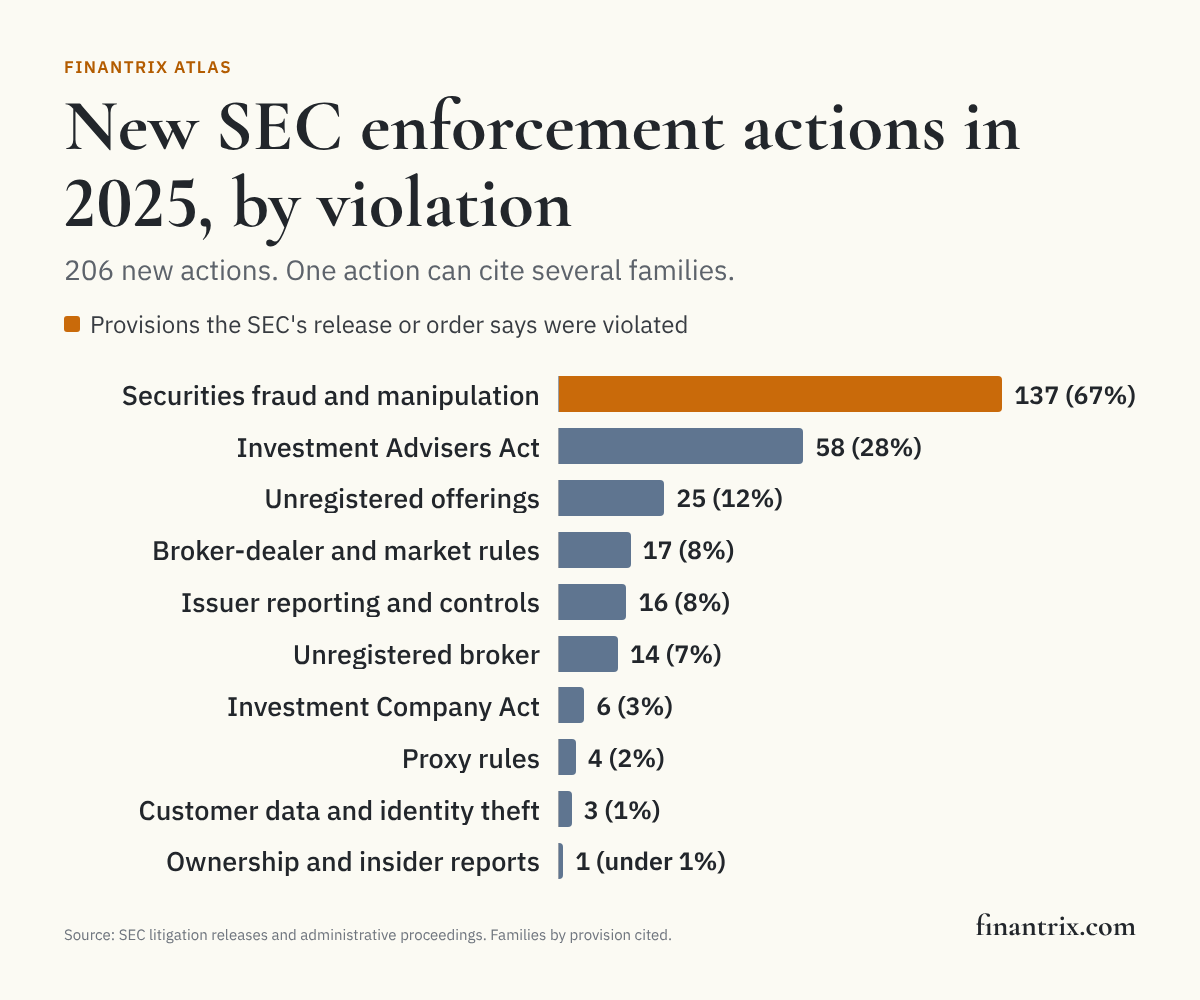
New SEC enforcement actions in 2025, by violation
Each action counts once in every family of provisions it cites, so the shares add to more than the whole. "Most cited" counts actions, not citations.
| Violation family | Provisions in the family | Actions | Share of new actions | In court | Administrative | Naming a company | Most cited (actions) | Source |
|---|---|---|---|---|---|---|---|---|
| Securities fraud and manipulation | Securities Act §17; Exchange Act §§9(a), 10(b), 14(e), 15(c)(1); Rules 10b-5, 14e-3 | 137 | 67% | 111 | 26 | 57 | Rule 10b-5 (116); Exchange Act §10(b) (108); Securities Act §17(a) (104) | SEC, SEC |
| Investment Advisers Act | Advisers Act §§204, 206, 207 and other sections; Rules 204-2, 206(4)-x | 58 | 28% | 28 | 30 | 44 | Advisers Act §206 (51); Rule 206(4)-7 (14); Rule 206(4)-8 (10) | SEC, SEC |
| Unregistered offerings | Securities Act §5 | 25 | 12% | 24 | 1 | 18 | Securities Act §5(a) (24); Securities Act §5(c) (24); Securities Act §5 (1) | SEC, SEC |
| Broker-dealer and market rules | Exchange Act §§5, 15(c)(3), 15(g), 15B, 15F, 17(a); Rules 15c3-x, 15l-1, 17a-x, 18a-x; Regulations Best Interest, ATS, M, SHO | 17 | 8% | 1 | 16 | 16 | Exchange Act §17(a) (9); Rule 17a-4 (5); Rule 17a-8 (5) | SEC, SEC |
| Issuer reporting and accounting controls | Exchange Act §§13(a), 13(b), 15(d); Rules 12b-20, 13a-x, 13b2-x, 15d-x; Sarbanes-Oxley Act; Regulations S-K, S-X (including Rule 2-02), FD, G | 16 | 8% | 5 | 11 | 11 | Exchange Act §13(a) (12); Exchange Act §13(b) (9); Rule 12b-20 (9) | SEC, SEC |
| Acting as an unregistered broker | Exchange Act §15(a) | 14 | 7% | 9 | 5 | 8 | Exchange Act §15(a) (14) | SEC, SEC |
| Investment Company Act | Investment Company Act sections and rules | 6 | 3% | 2 | 4 | 4 | Investment Company Act §30(g) (2); Investment Company Act §34(b) (2); Investment Company Act §15(c) (1) | SEC, SEC |
| Proxy rules | Exchange Act §14(a); Rules 14a-x | 4 | 2% | 2 | 2 | 2 | Exchange Act §14(a) (4); Rule 14a-3 (3); Rule 14a-9 (3) | SEC, SEC |
| Customer data and identity theft | Regulations S-P and S-ID | 3 | 1% | 1 | 2 | 3 | Regulation S-P (3); Regulation S-ID (2) | SEC, SEC |
| Ownership and insider reports | Exchange Act §§13(d), 13(g), 16(a); Rules 13d-x, 16a-x | 1 | under 1% | 1 | 0 | 0 | Exchange Act §13(d) (1); Rule 13d-1 (1) | SEC, SEC |
| Other provisions | Anything not listed above | 3 | 1% | 3 | 0 | 3 | Exchange Act §20(a) (3) | SEC, SEC |
Download this table (CSV), free. The full dataset, every new action with its forum, its respondents, every provision it cites and the sentences they were read from, is one email away.
Where each kind of case is brought
Fraud is mostly a court matter. According to SEC records, 111 of the 137 actions citing the antifraud provisions, 81%, were filed in federal court. The other 26 were administrative proceedings, according to the same records.
Rules for brokers and markets run the other way: 16 of the 17 actions citing broker-dealer and market rules were administrative proceedings, according to SEC records. Investment Advisers Act cases were split, with 30 administrative and 28 in court, according to the same records.
What the SEC lists and this page does not count
The SEC's administrative proceedings list carries many orders that are not new cases. They are counted apart here, according to the SEC's 2025 lists:
| Listed item | Count | Source |
|---|---|---|
| Follow-on proceedings (resting on an injunction or a conviction) | 53 | SEC |
| Section 12(j) proceedings against delinquent filers | 29 | SEC |
| Corrected or amended orders | 6 | SEC |
| Other orders (fair funds, extensions, reinstatements, decisions) | 144 | SEC |
| Litigation releases about cases filed in earlier years or with no filing date | 123 | SEC |
A follow-on proceeding bars a person from the industry after a court has already enjoined or convicted them, so counting it would count the same conduct twice. A Section 12(j) proceeding can suspend or revoke the registration of a company's securities when it has not filed its periodic reports.
What this means for technology buyers
Most new actions cite the antifraud provisions, according to the SEC's records. For a regulated firm, the cases on this list map to three kinds of control: surveillance of what employees trade and say, the records the rules require a firm to keep, and filings that must be complete and on time. These guides compare the systems behind them:
- Compliance monitoring and pre-trade clearance: personal trading, attestations and code-of-ethics controls.
- Regulatory reporting platforms for investment banks: the filings a broker-dealer owes its regulators.
- Risk and compliance advisory platforms for consultants: for the firms that run remediation after an order.
Mapping where these controls sit in a securities firm? The Investment Banking Capability Model places compliance and surveillance among the firm's other capabilities.
More from Finantrix Atlas
- Bank enforcement actions by type: OCC and Federal Reserve
- CFPB enforcement actions
- Bank Secrecy Act enforcement: FinCEN actions and penalties
- OFAC sanctions penalties
How this was built
The universe is every item on the SEC's 2025 lists of litigation releases (249 releases, LR-26207 to LR-26456) and administrative proceedings (316 items), with the text of each release and each order.
- Court actions. A civil action counts when its release caption says it was filed in 2025. Several releases about the same case count once, by court and docket number. Of the 249 releases, 126 were about cases filed in 2025.
- Administrative actions. An order instituting proceedings counts when it is a cease-and-desist proceeding, or another proceeding that does not rest on an injunction or a conviction. A corrected or amended order is the same action.
- Violations. Only sentences that use a form of "violate" are read, and only the sections and rules they print. Where an order states its findings in the SEC's standing form ("as a result of the conduct described above") or orders a respondent to cease and desist, only those sentences are read, so an earlier case recited in the background is not counted. Citations to court opinions are skipped. The sections under which the SEC brings or remedies a case are not violations and are dropped. Each remaining provision belongs to one family, by the list in the table.
- Words, not sections. In 6 actions the release names "the antifraud provisions" without citing a section, and those actions are counted as antifraud on the release's own words. 4 actions cite no provision that could be placed and are counted in no family.
- Against whom. An action names a company when any defendant or respondent in the SEC's list carries a company form in its name, such as Inc., LLC or L.P.
The litigation releases are numbered in sequence. Every number from LR-26207 to LR-26456 is on the SEC's list or has no page, and the numbers on either side are dated in other years, so no release was missed. The reader is also tested on fixed sentences, including one that cites Rule 10b-5, and the build stops if it misreads one.
Limits
- One calendar year, 2025. The SEC reports its own enforcement statistics by fiscal year, which ends in September, and counts actions by its own categories, so these counts will not match the SEC's annual results.
- Announced in the year. A court action filed in 2025 whose first release came later is not counted, and neither is a case the SEC announced only in a press release.
- What a release says is what was charged, not what was proved. A settled order states findings the respondent neither admits nor denies, and a litigated complaint states allegations.
- A count is not a measure of size. A settled order against one adviser and a fraud case against a large issuer each count once. Penalties and disgorgement are not shown.
- Company or individual is read from the name as the SEC lists it. A sole proprietor trading under a company name counts as a company.
- Families are groups of provisions, listed in the table. A different grouping, such as counting insider trading apart from other fraud, would need facts that the sections cited do not record: insider trading is charged under the same antifraud provisions.
Cite this
Free to quote, cite and republish, including the chart, with credit to Finantrix Atlas and a link to this page.
67% of the new enforcement actions the SEC brought in 2025 charged a violation of the antifraud provisions, according to a Finantrix Atlas analysis of the SEC's litigation releases and administrative proceedings.
47% of new SEC enforcement actions in 2025 named only individuals and no company, according to Finantrix Atlas.
Suggested citation: Finantrix Atlas, "SEC Enforcement Actions by Violation Type," 2025, from SEC litigation releases and administrative proceedings. https://www.finantrix.com/articles/sec-enforcement-by-violation
Embed the chart:
<a href="https://www.finantrix.com/articles/sec-enforcement-by-violation"><img src="https://www.finantrix.com/atlas/sec-enforcement-by-violation.png" alt="New SEC enforcement actions by violation type, from Finantrix Atlas"></a>
<p>Chart: <a href="https://www.finantrix.com/articles/sec-enforcement-by-violation">Finantrix Atlas</a>, from SEC litigation releases and administrative proceedings.</p>
Frequently asked questions
Q: What is the most common violation in SEC enforcement actions? A: The antifraud provisions. According to the SEC's releases and orders, 137 of the 206 new actions in 2025, 67%, charged a violation of them.
Q: How many enforcement actions did the SEC bring in 2025? A: 206 new actions announced in 2025, according to the SEC's lists: 122 civil actions in federal court and 84 administrative proceedings, not counting follow-on proceedings and Section 12(j) revocations. This is a calendar-year count and differs from the SEC's fiscal-year statistics.
Q: Does the SEC charge individuals or companies? A: Both. 47% of the new actions in 2025 named only individuals and 110 named at least one company, according to the SEC's lists of defendants and respondents.
Q: Is insider trading counted separately? A: No. Insider trading is charged under the same antifraud provisions as other securities fraud, including Rule 10b-5, so a count by the provision cited cannot separate it.
Download the data
The 11 rows on this page (CSV), free. The full dataset has all 206 rows, as of December 31, 2025; we email you a link.
Frequently Asked Questions
What is the most common violation in SEC enforcement actions?
The antifraud provisions. According to the SEC's releases and orders, 137 of the 206 new actions in 2025, 67%, charged a violation of them.
How many enforcement actions did the SEC bring in 2025?
206 new actions announced in 2025, according to the SEC's lists: 122 civil actions in federal court and 84 administrative proceedings, not counting follow-on proceedings and Section 12(j) revocations. This is a calendar-year count and differs from the SEC's fiscal-year statistics.
Does the SEC charge individuals or companies?
Both. 47% of the new actions in 2025 named only individuals and 110 named at least one company, according to the SEC's lists of defendants and respondents.
Is insider trading counted separately?
No. Insider trading is charged under the same antifraud provisions as other securities fraud, including Rule 10b-5, so a count by the provision cited cannot separate it.