
Key Takeaways
- 64 FDIC-insured US banks with $1 billion or more in assets operated a single office and no branches on June 30, 2026, holding $1.56 trillion in deposits, 7.5% of all bank deposits, according to FDIC data.
- Morgan Stanley Bank is the largest by deposits, $279 billion.
- Of those with at least $500 million in deposits a year earlier, Newtek Bank grew deposits fastest, +91.9%; the median changed by +9.0%.
- A single office is the FDIC's count of a bank's offices, not how a bank describes itself; the group includes card banks and trust companies.
64 FDIC-insured US banks with $1 billion or more in assets operated a single office and no branches on June 30, 2026, according to FDIC data. Together they held $1.56 trillion in deposits, 7.5% of the deposits of all insured banks. Morgan Stanley Bank is the largest of them by deposits, with $279 billion.
Of those that held at least $500 million in deposits a year earlier, Newtek Bank grew deposits fastest, +91.9%, from $1.2 billion on June 30, 2025 to $2.2 billion, followed by Nelnet Bank at +63.5%. The median changed by +9.0%.
A single office here is the FDIC's count, not a bank's description of itself: the bank's domestic offices, offices in US territories and foreign offices add up to one, its headquarters. The group is broader than banks that serve customers online: it includes card banks and trust companies, so each row shows the FDIC's own specialization group for the bank.
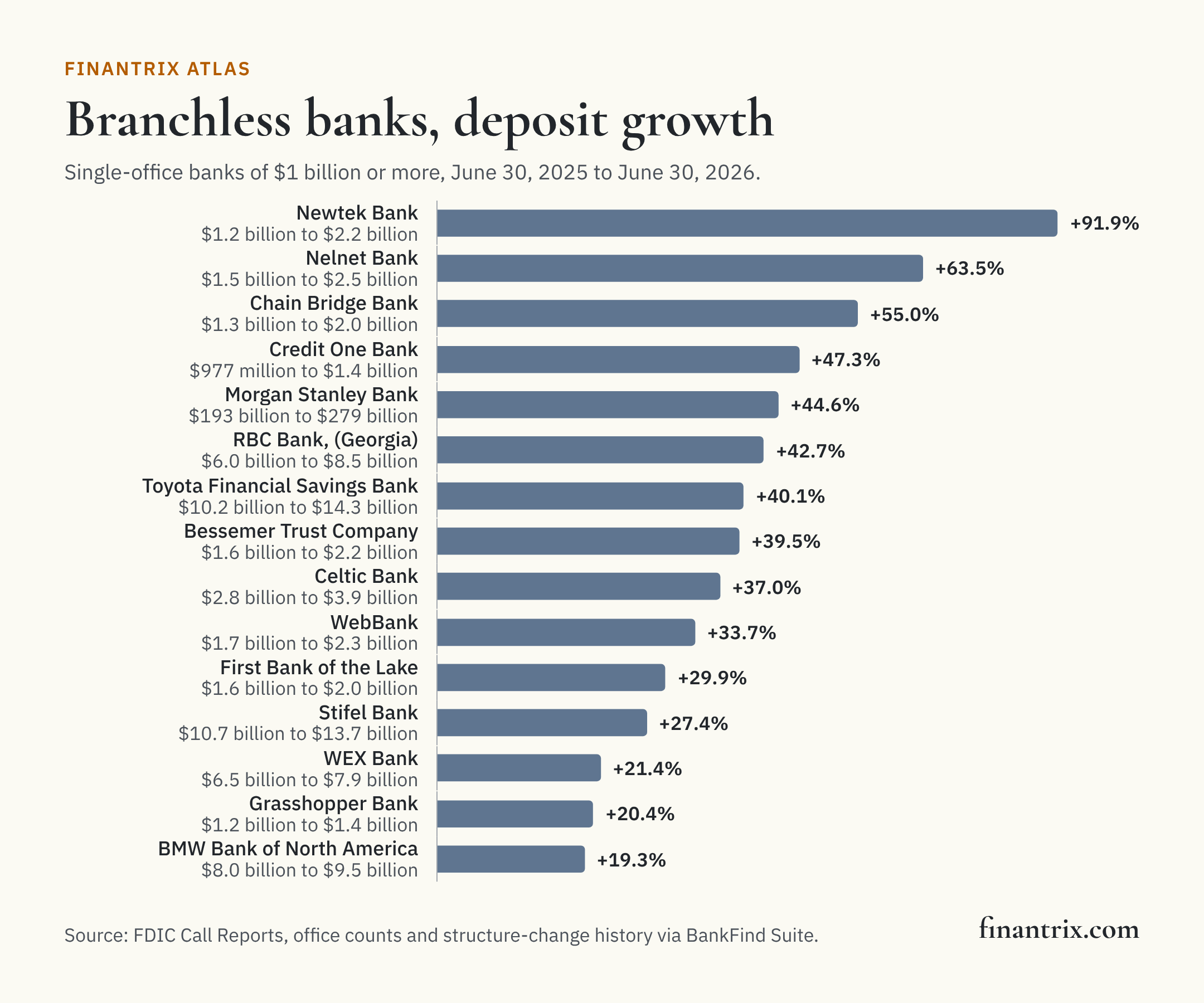
The 25 branchless banks that grew deposits fastest
Ranked by deposit growth from June 30, 2025 to June 30, 2026, among single-office banks with $1 billion or more in assets and at least $500 million in deposits a year earlier. A bank's starting figure includes the deposits of any charter it absorbed during the year, read from the same date.
| Rank | Bank | Headquarters | Deposits | A year earlier, with absorbed charters | Growth | FDIC specialization group | Charters absorbed | Source |
|---|---|---|---|---|---|---|---|---|
| 1 | Newtek Bank | Miami, FL | $2.2 billion | $1.2 billion | +91.9% | Commercial Lending Specialization | None | FDIC |
| 2 | Nelnet Bank | Draper, UT | $2.5 billion | $1.5 billion | +63.5% | Consumer Lending Specialization | None | FDIC |
| 3 | Chain Bridge Bank | McLean, VA | $2.0 billion | $1.3 billion | +55.0% | All Other Over 1 Billion | None | FDIC |
| 4 | Credit One Bank | Las Vegas, NV | $1.4 billion | $977 million | +47.3% | Credit-card Specialization | None | FDIC |
| 5 | Morgan Stanley Bank | Salt Lake City, UT | $279 billion | $193 billion | +44.6% | All Other Over 1 Billion | None | FDIC |
| 6 | RBC Bank, (Georgia) | Atlanta, GA | $8.5 billion | $6.0 billion | +42.7% | All Other Over 1 Billion | None | FDIC |
| 7 | Toyota Financial Savings Bank | Henderson, NV | $14.3 billion | $10.2 billion | +40.1% | All Other Over 1 Billion | None | FDIC |
| 8 | Bessemer Trust Company | Woodbridge, NJ | $2.2 billion | $1.6 billion | +39.5% | All Other Over 1 Billion | None | FDIC |
| 9 | Celtic Bank | Salt Lake City, UT | $3.9 billion | $2.8 billion | +37.0% | Commercial Lending Specialization | None | FDIC |
| 10 | WebBank | Salt Lake City, UT | $2.3 billion | $1.7 billion | +33.7% | Commercial Lending Specialization | None | FDIC |
| 11 | First Bank of the Lake | Osage Beach, MO | $2.0 billion | $1.6 billion | +29.9% | Commercial Lending Specialization | None | FDIC |
| 12 | Stifel Bank | Saint Louis, MO | $13.7 billion | $10.7 billion | +27.4% | All Other Over 1 Billion | None | FDIC |
| 13 | WEX Bank | Sandy, UT | $7.9 billion | $6.5 billion | +21.4% | Commercial Lending Specialization | None | FDIC |
| 14 | Grasshopper Bank | New York, NY | $1.4 billion | $1.2 billion | +20.4% | Commercial Lending Specialization | None | FDIC |
| 15 | BMW Bank of North America | Salt Lake City, UT | $9.5 billion | $8.0 billion | +19.3% | Consumer Lending Specialization | None | FDIC |
| 16 | Bradesco Bank | Coral Gables, FL | $5.0 billion | $4.2 billion | +18.2% | All Other Over 1 Billion | None | FDIC |
| 17 | Comenity Bank ‡ | Wilmington, DE | $4.0 billion | $3.4 billion | +17.7% | Credit-card Specialization | None | FDIC |
| 18 | Solera National Bank | Lakewood, CO | $1.3 billion | $1.1 billion | +16.9% | Commercial Lending Specialization | None | FDIC |
| 19 | Northpointe Bank | Grand Rapids, MI | $5.3 billion | $4.5 billion | +16.8% | All Other Over 1 Billion | None | FDIC |
| 20 | Live Oak Banking Company | Wilmington, NC | $14.7 billion | $12.6 billion | +16.2% | Commercial Lending Specialization | None | FDIC |
| 21 | Medallion Bank | Salt Lake City, UT | $2.3 billion | $2.0 billion | +14.1% | Consumer Lending Specialization | None | FDIC |
| 22 | Jonesboro State Bank | Jonesboro, LA | $1.2 billion | $1.1 billion | +13.5% | All Other Over 1 Billion | None | FDIC |
| 23 | American Bank | Allentown, PA | $915 million | $822 million | +11.3% | Commercial Lending Specialization | None | FDIC |
| 24 | UBS Bank USA | Salt Lake City, UT | $109 billion | $98.4 billion | +11.1% | All Other Over 1 Billion | None | FDIC |
| 25 | Principal Bank | Des Moines, IA | $9.3 billion | $8.4 billion | +10.5% | Mortgage Lending Specialization | None | FDIC |
‡ Closed after June 30, 2026: Comenity Bank (Wilmington, DE) on October 1, 2026. The FDIC records the end of the charter; the figures shown are those it reported for June 30, 2026.
Download this table (CSV), free. The full dataset, all 64 single-office banks with their deposits, office counts and specialization group, is one email away.
The largest branchless banks
The single-office banks with the most deposits on June 30, 2026.
| Rank | Bank | Headquarters | Deposits | Total assets | FDIC specialization group |
|---|---|---|---|---|---|
| 1 | Morgan Stanley Bank | Salt Lake City, UT | $279 billion | $419 billion | All Other Over 1 Billion |
| 2 | Charles Schwab Bank, SSB | Westlake, TX | $225 billion | $251 billion | Mortgage Lending Specialization |
| 3 | Morgan Stanley Private Bank | Purchase, NY | $212 billion | $250 billion | All Other Over 1 Billion |
| 4 | American Express National Bank | Sandy, UT | $172 billion | $214 billion | Credit-card Specialization |
| 5 | Ally Bank | Sandy, UT | $157 billion | $188 billion | Consumer Lending Specialization |
| 6 | UBS Bank USA | Salt Lake City, UT | $109 billion | $124 billion | All Other Over 1 Billion |
| 7 | Raymond James Bank | Saint Petersburg, FL | $41.4 billion | $45.6 billion | All Other Over 1 Billion |
| 8 | Barclays Bank Delaware | Wilmington, DE | $35.3 billion | $43.5 billion | Credit-card Specialization |
| 9 | Deutsche Bank Trust Company Americas | New York, NY | $28.1 billion | $40.5 billion | All Other Over 1 Billion |
| 10 | TD Bank USA | Wilmington, DE | $27.2 billion | $32.1 billion | All Other Over 1 Billion |
| 11 | Charles Schwab Premier Bank, SSB | Westlake, TX | $24.5 billion | $26.6 billion | All Other Over 1 Billion |
| 12 | Sallie Mae Bank | Salt Lake City, UT | $20.3 billion | $28.5 billion | Consumer Lending Specialization |
| 13 | Optum Bank, Inc. | Draper, UT | $16.5 billion | $21.4 billion | Commercial Lending Specialization |
| 14 | Live Oak Banking Company | Wilmington, NC | $14.7 billion | $16.0 billion | Commercial Lending Specialization |
| 15 | Toyota Financial Savings Bank | Henderson, NV | $14.3 billion | $16.8 billion | All Other Over 1 Billion |
What kind of banks they are
The FDIC places every bank in one specialization group by what its assets are concentrated in. The 64 single-office banks fall into these groups.
| FDIC specialization group | Banks |
|---|---|
| All Other Over 1 Billion | 23 |
| Commercial Lending Specialization | 22 |
| Mortgage Lending Specialization | 7 |
| Credit-card Specialization | 6 |
| Consumer Lending Specialization | 5 |
| Agricultural Specialization | 1 |
What this means for technology buyers
A bank without branches gathers and keeps deposits through its own apps and website, through partners that offer its accounts under their brand, or through a parent company's customers. Each route is a set of systems to buy. These guides compare the options side by side:
- Core banking systems for neobanks: the ledger and product engine for a bank that runs online.
- Banking-as-a-service platforms for traditional banks: offering accounts through partners.
- Deposit management platforms for retail banks: product configuration, pricing and the account lifecycle.
Planning the change before choosing the vendor? The Banking and Payments Capability Matrix states what a bank does, from taking deposits to serving customers, so a platform can be placed against the capabilities it supports.
More from Finantrix Atlas
- US banks with the most branches
- US banks that closed the most branches
- Fastest-growing US banks
- US banks by brokered deposits
How this list was built
The universe is every FDIC-insured commercial bank and savings institution that filed a Call Report for June 30, 2026, read from the FDIC's BankFind Suite, including banks whose charter has ended since. Office counts are the FDIC fields OFFDOM (domestic offices, including the headquarters), OFFOA (offices in US territories and freely associated states) and OFFFOR (foreign offices), as of the same date. Deposits are the FDIC field DEP. The specialization group is the FDIC's asset concentration hierarchy as its institution record shows it today.
Growth compares deposits on June 30, 2026 with those on June 30, 2025. Charters absorbed during the year come from the FDIC's structure-change history, and each one's deposits on June 30, 2025 are added to the bank's starting figure, so a merger does not count as growth. 1 single-office banks filed no Call Report a year earlier and have no growth figure.
The FDIC's Quarterly Banking Profile, the edition for the second quarter of 2026, prints the industry's deposits and total assets. Summed across the same 4,238 institutions, the banks' figures equal both lines to the million dollars.
Limits
- Offices, not channels. The office count says nothing about how a bank serves its customers or where its depositors are.
- Deposits that are not retail. Some of these banks hold deposits placed by a parent company, brokers or other institutions rather than by individuals.
- Banks of $1 billion or more. Smaller single-office banks are counted in the dataset only.
- One year. Growth runs from June 30, 2025 to June 30, 2026.
Cite this
Free to quote, cite and republish, including the chart, with credit to Finantrix Atlas and a link to this page.
64 FDIC-insured US banks of $1 billion or more had a single office and no branches on June 30, 2026, holding $1.56 trillion in deposits, according to a Finantrix Atlas analysis of FDIC data.
Suggested citation: Finantrix Atlas, "US Banks Without Branches, by Deposit Growth," June 30, 2025 to June 30, 2026, from FDIC Call Reports. https://www.finantrix.com/articles/branchless-banks-deposit-growth
Embed the chart:
<a href="https://www.finantrix.com/articles/branchless-banks-deposit-growth"><img src="https://www.finantrix.com/atlas/branchless-banks-deposit-growth.png?v=2026-06-30" alt="The branchless US banks that grew deposits fastest, from FDIC data, by Finantrix Atlas"></a>
<p>Chart: <a href="https://www.finantrix.com/articles/branchless-banks-deposit-growth">Finantrix Atlas</a>, from FDIC Call Reports.</p>
Frequently asked questions
Q: How many US banks have no branches? A: 64 FDIC-insured banks with $1 billion or more in assets operated a single office on June 30, 2026, according to FDIC office counts.
Q: Which branchless bank holds the most deposits? A: Morgan Stanley Bank, with $279 billion on June 30, 2026, according to FDIC data.
Q: Are these all online banks? A: No. A single office is the FDIC's count of a bank's offices. The group also includes card banks and trust companies.
Download the data
Two CSV files, free: the 25 rows on this page, and the full dataset of all 64 rows, as of June 30, 2026.
Frequently Asked Questions
How many US banks have no branches?
64 FDIC-insured banks with $1 billion or more in assets operated a single office on June 30, 2026, according to FDIC office counts.
Which branchless bank holds the most deposits?
Morgan Stanley Bank, with $279 billion on June 30, 2026, according to FDIC data.
Are these all online banks?
No. A single office is the FDIC's count of a bank's offices. The group also includes card banks and trust companies.