
Key Takeaways
- JPMorgan Chase Bank runs 5,117 full-service branches, more than any other US bank, followed by Wells Fargo Bank with 4,070 and Bank of America with 3,528.
- According to the FDIC's Summary of Deposits, the ten largest networks hold 32.9% of the 73,461 full-service branches of insured US banks, run by 4,238 institutions.
- One of the ten banks with the most deposits in US offices is not among the 50 largest branch networks: Goldman Sachs Bank USA.
- Every count is from the FDIC's June 30, 2026 Summary of Deposits, and the ten largest networks are the same, in the same order, on the FDIC's Call Report office count.
Ten banks run 32.9% of the 73,461 full-service branches of FDIC-insured US banks. JPMorgan Chase Bank has the largest network, with 5,117 branches and offices in 48 of the fifty states, followed by Wells Fargo Bank with 4,070 and Bank of America with 3,528. The median bank with a branch runs 4 branches.
This ranking counts every office of every FDIC-insured institution in the FDIC's Summary of Deposits for June 30, 2026: 75,859 offices at 4,249 institutions. A branch here is a full-service office a customer can walk into, as the FDIC codes it.
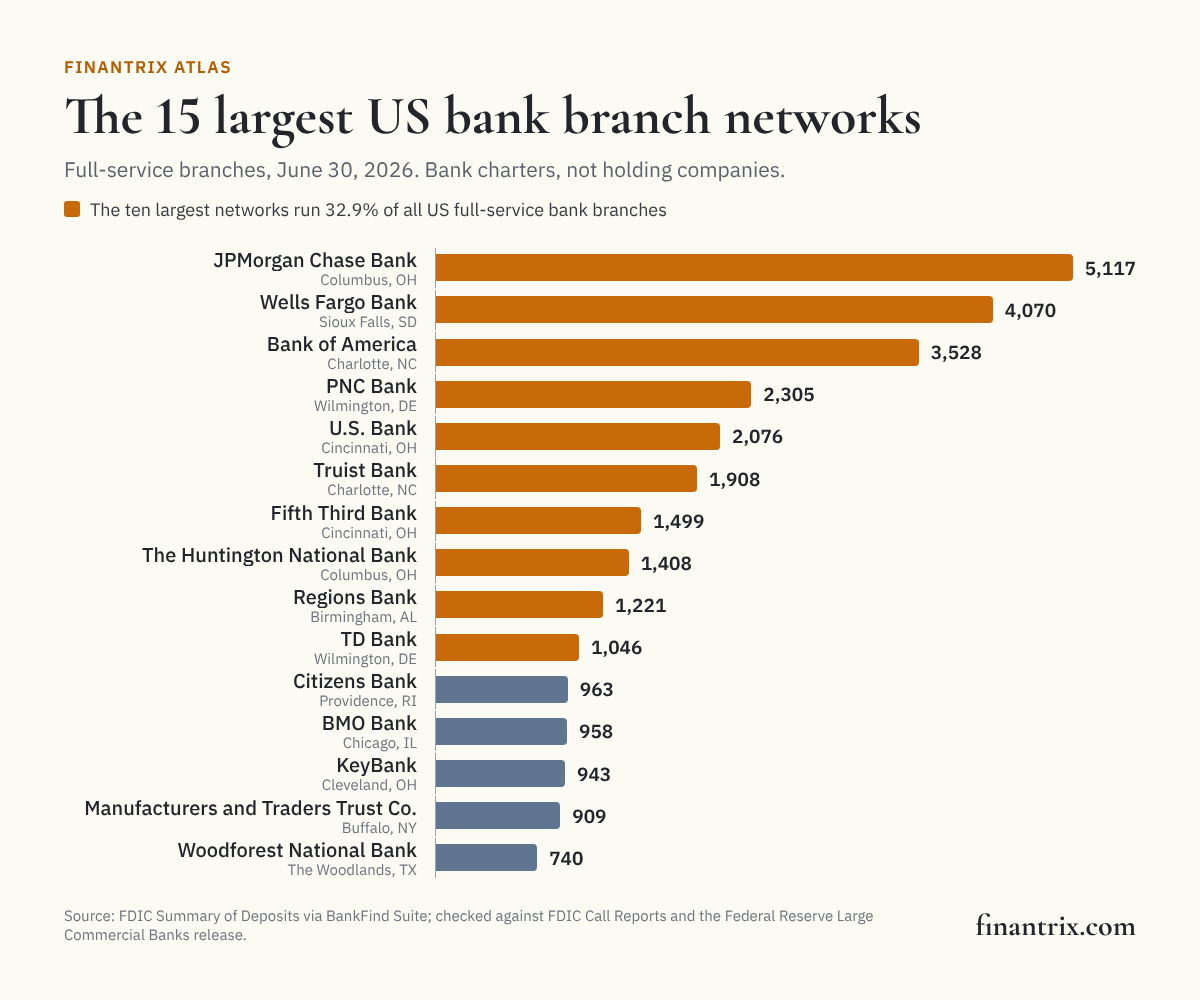
The 50 US banks with the most branches
Ranked by full-service branches on June 30, 2026. Each row is one bank charter; a holding company that owns more than one charter appears once per charter. Banks with the same count share a rank. "All offices" adds drive-through, administrative, trust, loan production and other limited-service offices, and offices that serve customers only online or by phone.
| Rank | Bank | Headquarters | Full-service branches | All offices | States with an office | Deposits in those offices | Source |
|---|---|---|---|---|---|---|---|
| 1 | JPMorgan Chase Bank | Columbus, OH | 5,117 | 5,141 | 48 | $2.23 trillion | FDIC |
| 2 | Wells Fargo Bank | Sioux Falls, SD | 4,070 | 4,157 | 39 | $1.55 trillion | FDIC |
| 3 | Bank of America | Charlotte, NC | 3,528 | 3,598 | 38 | $1.98 trillion | FDIC |
| 4 | PNC Bank | Wilmington, DE | 2,305 | 2,401 | 27 | $457 billion | FDIC |
| 5 | U.S. Bank | Cincinnati, OH | 2,076 | 2,097 | 29 | $533 billion | FDIC |
| 6 | Truist Bank | Charlotte, NC | 1,908 | 1,928 | 17 | $419 billion | FDIC |
| 7 | Fifth Third Bank | Cincinnati, OH | 1,499 | 1,513 | 15 | $240 billion | FDIC |
| 8 | The Huntington National Bank | Columbus, OH | 1,408 | 1,452 | 21 | $227 billion | FDIC |
| 9 | Regions Bank | Birmingham, AL | 1,221 | 1,245 | 16 | $132 billion | FDIC |
| 10 | TD Bank | Wilmington, DE | 1,046 | 1,050 | 15 | $278 billion | FDIC |
| 11 | Citizens Bank | Providence, RI | 963 | 971 | 15 | $189 billion | FDIC |
| 12 | BMO Bank | Chicago, IL | 958 | 988 | 23 | $194 billion | FDIC |
| 13 | KeyBank | Cleveland, OH | 943 | 951 | 16 | $158 billion | FDIC |
| 14 | Manufacturers and Traders Trust Company | Buffalo, NY | 909 | 957 | 13 | $172 billion | FDIC |
| 15 | Woodforest National Bank | The Woodlands, TX | 740 | 742 | 17 | $8.1 billion | FDIC |
| 16 | Citibank | Sioux Falls, SD | 661 | 667 | 12 | $901 billion | FDIC |
| 17 | First-Citizens Bank & Trust Company | Raleigh, NC | 510 | 518 | 23 | $174 billion | FDIC |
| 18 | Zions Bancorporation | Salt Lake City, UT | 407 | 409 | 11 | $76.6 billion | FDIC |
| 19 | First Horizon Bank | Memphis, TN | 402 | 406 | 12 | $68.8 billion | FDIC |
| 20 | Pinnacle Bank | Nashville, TN | 379 | 389 | 9 | $102 billion | FDIC |
| 21 | Santander Bank | Wilmington, DE | 365 | 368 | 9 | $79.1 billion | FDIC |
| 22 | First National Bank Texas | Killeen, TX | 357 | 358 | 4 | $4.1 billion | FDIC |
| 23 | Columbia Bank | Roseburg, OR | 351 | 360 | 8 | $52.2 billion | FDIC |
| 24 | First National Bank of Pennsylvania | Greenville, PA | 347 | 358 | 7 | $39.1 billion | FDIC |
| 25 | Old National Bank | Evansville, IN | 342 | 354 | 10 | $57.0 billion | FDIC |
| 26 | SouthState Bank | Winter Haven, FL | 341 | 349 | 8 | $56.4 billion | FDIC |
| 27 | Flagstar Bank | Hicksville, NY | 340 | 345 | 10 | $67.5 billion | FDIC |
| 28 | Prosperity Bank | El Campo, TX | 321 | 344 | 2 | $32.9 billion | FDIC |
| 29 | First Interstate Bank | Billings, MT | 270 | 274 | 10 | $21.7 billion | FDIC |
| 30 | Bank OZK | Little Rock, AR | 253 | 256 | 6 | $34.0 billion | FDIC |
| 31 | Renasant Bank | Tupelo, MS | 246 | 259 | 6 | $22.2 billion | FDIC |
| 32 | Capital One | McLean, VA | 238 | 245 | 8 | $512 billion | FDIC |
| 33 | Glacier Bank | Kalispell, MT | 236 | 252 | 9 | $24.9 billion | FDIC |
| 34 | United Bank | Fairfax, VA | 232 | 235 | 8 | $27.3 billion | FDIC |
| 35 | Valley National Bank | Passaic, NJ | 228 | 228 | 6 | $54.3 billion | FDIC |
| 36 | Centennial Bank | Conway, AR | 225 | 230 | 6 | $19.6 billion | FDIC |
| 37 | Simmons Bank | Pine Bluff, AR | 219 | 229 | 6 | $19.9 billion | FDIC |
| 37 | Arvest Bank | Fayetteville, AR | 219 | 225 | 4 | $24.6 billion | FDIC |
| 39 | Associated Bank | Green Bay, WI | 212 | 217 | 6 | $40.1 billion | FDIC |
| 40 | Frost Bank | San Antonio, TX | 210 | 222 | 1 | $43.7 billion | FDIC |
| 40 | WesBanco Bank, Inc. | Wheeling, WV | 210 | 217 | 8 | $21.8 billion | FDIC |
| 40 | WaFd Bank | Seattle, WA | 210 | 212 | 9 | $21.1 billion | FDIC |
| 43 | Fulton Bank | Lancaster, PA | 200 | 205 | 5 | $27.4 billion | FDIC |
| 44 | Community Bank | Canton, NY | 198 | 210 | 6 | $14.9 billion | FDIC |
| 45 | Webster Bank ‡ | Stamford, CT | 193 | 194 | 4 | $70.7 billion | FDIC |
| 46 | UMB Bank | Kansas City, MO | 189 | 192 | 14 | $60.2 billion | FDIC |
| 47 | United Community Bank | Greenville, SC | 188 | 190 | 6 | $24.1 billion | FDIC |
| 48 | Hancock Whitney Bank | Gulfport, MS | 180 | 186 | 5 | $29.9 billion | FDIC |
| 49 | Atlantic Union Bank | Richmond City, VA | 175 | 177 | 3 | $30.6 billion | FDIC |
| 50 | NBT Bank | Norwich, NY | 173 | 175 | 7 | $13.7 billion | FDIC |
‡ Closed after the survey date: Webster Bank on August 20, 2026. The FDIC records the end of the charter; the offices shown are those it ran on June 30, 2026.
Download this table (CSV), free. The full dataset, every insured institution with its office count by service type, is one email away.
How concentrated the branch network is
- The largest network holds 7.0% of all full-service branches of insured banks.
- The largest four hold 20.4%, and the largest ten hold 32.9%.
- The 50 banks in the table run 52.4%. The smallest network in the table has 173 branches.
- According to the FDIC, 734 insured institutions operate from a single office.
- Beyond the full-service branches, the survey lists 2,398 other offices.
Branches and deposits are different rankings
A large deposit base does not need a large branch network. One of the ten banks with the most deposits in US offices is not among the 50 largest branch networks: Goldman Sachs Bank USA. Of those ten, Goldman Sachs Bank USA has the fewest branches: 3, against $473 billion in deposits, the 7th largest of any insured bank, according to FDIC data.
The FDIC's codes also show where a network sits. Two of the 50 have most of their branches in what the FDIC codes as full-service retail offices: Woodforest National Bank (701 of 740) and First National Bank Texas (339 of 357).
What this means for technology buyers
A branch count says how a bank reaches its customers, and so which systems it has to run in person as well as online. A bank with a large network needs its branches and its digital channels to work from the same accounts; a bank with a large deposit base and few branches depends on its digital channels to open and serve accounts at all. These guides compare the options side by side:
- Mobile banking apps for regional banks: digital channel platforms for banks below money-center scale.
- Deposit management platforms for retail banks: account opening and servicing, in the branch and online.
- Cloud-based core banking systems: the ledger every branch and channel reads from.
- Financial BI dashboards for bank executives: for measuring how a branch network performs.
Planning the change before choosing the vendor? The Retail Bank Business Capability Model maps what a retail bank does across its branches and channels, and the Bank Value Streams show how that work reaches a customer.
More from Finantrix Atlas
- Largest banks in the US, ranked by total assets
- Largest community banks in the US
- US bank mergers of the past year
- Largest credit unions in the US
How this list was built
The FDIC's Summary of Deposits is an annual survey of every office of every FDIC-insured institution as of June 30, with the deposits each office holds and a service-type code the FDIC assigns. This page counts as a branch every office coded full service, brick and mortar; full service, retail; full service, mobile; or full service, seasonal. Offices coded full service, home banking or home and phone banking are full service in the FDIC's coding but are not a place, so they are in "all offices" and not in the branch count, as are limited-service offices.
Two other counts were compared with the survey:
- The FDIC's Call Report office count. Each bank's Call Report for June 30, 2026 reports its number of domestic offices, including its head office, from a different filing. It does not equal the survey office by office: for the 50 banks in the table it totals 39,542 offices, against 39,246 in the survey. Ranked on that count instead, the ten largest networks are the same banks, in the same order.
- The Federal Reserve's Large Commercial Banks release prints each insured commercial bank's domestic branches for the same quarter. Each of the 50 commercial banks in the table appears there, within 10% of its office count in the survey; the largest difference is 5.8%, and 3 match exactly. The release's own notes say its branch counts can differ for banks owned by foreign banking organizations.
Each bank's surveyed offices were also summed and compared with the domestic deposits in its Call Report for the same date, which shows the survey was read for the whole bank.
Limits
- Banks, not bank holding companies. A group that owns several charters runs more branches than any one of its rows.
- A branch is the FDIC's service type. An office that the FDIC codes as full service counts the same whatever its size, and the count says nothing about opening hours, staffing or what each branch offers.
- Insured institutions only. Credit union branches are not counted; credit unions file with the NCUA, not the FDIC.
- Once a year. The survey describes June 30, 2026. Branches open, close and change hands through the year, and a merger after that date is not reflected until the next survey.
- Branches are not customers. The count shows the size of a physical network, not how many people use it or how much business it does. The deposits column shows the deposits each bank's offices hold.
Cite this
Free to quote, cite and republish, including the chart, with credit to Finantrix Atlas and a link to this page.
Ten banks run 32.9% of the 73,461 full-service branches of FDIC-insured US banks, and JPMorgan Chase Bank alone runs 5,117, according to a Finantrix Atlas analysis of the FDIC's June 30, 2026 Summary of Deposits.
The median US bank with a branch runs 4 full-service branches, according to Finantrix Atlas.
Suggested citation: Finantrix Atlas, "US Banks with the Most Branches," data as of June 30, 2026, from the FDIC Summary of Deposits. https://www.finantrix.com/articles/banks-with-most-branches
Embed the chart:
<a href="https://www.finantrix.com/articles/banks-with-most-branches"><img src="https://www.finantrix.com/atlas/banks-with-most-branches.png" alt="The US banks with the most branches, from Finantrix Atlas"></a>
<p>Chart: <a href="https://www.finantrix.com/articles/banks-with-most-branches">Finantrix Atlas</a>, from the FDIC Summary of Deposits.</p>
Frequently asked questions
Q: Which US bank has the most branches? A: JPMorgan Chase Bank, with 5,117 full-service branches on June 30, 2026, according to the FDIC's Summary of Deposits.
Q: How many bank branches are there in the US? A: 73,461 full-service branches of FDIC-insured institutions on June 30, 2026, according to the FDIC's Summary of Deposits. Counting drive-through, administrative and other limited-service offices too, the survey lists 75,859 offices.
Q: What counts as a branch? A: An office the FDIC codes as full service and that a customer can visit: in the FDIC's coding, a brick-and-mortar, retail, mobile or seasonal office. Drive-through-only facilities, administrative, trust and loan production offices, and online or phone-only offices are counted separately.
Q: How much of the US branch network do the largest banks run? A: The four largest networks run 20.4% of full-service bank branches, and the ten largest run 32.9%.
Q: Why do branch counts differ between sources? A: Each source counts differently. The FDIC's Summary of Deposits lists offices by service type on June 30; the Call Report counts every domestic office, including the head office; the Federal Reserve's release prints its own domestic-branch figure. On June 30, 2026 the ten largest networks were the same banks, in the same order, on the survey and the Call Report count.
Download the data
The 50 rows on this page (CSV), free. The full dataset has all 4,249 rows, as of June 30, 2026; we email you a link.
Frequently Asked Questions
Which US bank has the most branches?
JPMorgan Chase Bank, with 5,117 full-service branches on June 30, 2026, according to the FDIC's Summary of Deposits.
How many bank branches are there in the US?
73,461 full-service branches of FDIC-insured institutions on June 30, 2026, according to the FDIC's Summary of Deposits. Counting drive-through, administrative and other limited-service offices too, the survey lists 75,859 offices.
What counts as a branch?
An office the FDIC codes as full service and that a customer can visit: in the FDIC's coding, a brick-and-mortar, retail, mobile or seasonal office. Drive-through-only facilities, administrative, trust and loan production offices, and online or phone-only offices are counted separately.
How much of the US branch network do the largest banks run?
The four largest networks run 20.4% of full-service bank branches, and the ten largest run 32.9%.
Why do branch counts differ between sources?
Each source counts differently. The FDIC's Summary of Deposits lists offices by service type on June 30; the Call Report counts every domestic office, including the head office; the Federal Reserve's release prints its own domestic-branch figure. On June 30, 2026 the ten largest networks were the same banks, in the same order, on the survey and the Call Report count.