
Key Takeaways
- According to the World Bank's Global Findex 2025, 78.7% of adults worldwide had an account in 2024, up from 50.6% in 2011.
- In the 141 economies surveyed, an estimated 1.27 billion adults had no account, and 8 economies hold half of them, from World Bank data.
- By Finantrix Atlas estimates from World Bank Findex data, 3 economies each have more than 100 million adults without an account, China (124.9 million), India (118.3 million) and Pakistan (113.3 million).
- In the United States, 97.0% of adults had an account in 2024; 23 of the 47 other high-income economies surveyed report a higher share, according to the World Bank.
According to the World Bank's Global Findex 2025, 78.7% of adults worldwide had a financial account in 2024. In the 141 economies it surveyed, that leaves an estimated 1.27 billion adults without one, and 8 economies hold half of them. By these estimates from World Bank data, 3 economies each have more than 100 million adults without an account, China (124.9 million), India (118.3 million) and Pakistan (113.3 million). The lowest share with an account is in Niger, at 14.8%, according to the World Bank.
The shares are the World Bank's survey estimates. The number of adults without an account is a Finantrix Atlas estimate, computed from the adult population and the account share the World Bank publishes for each economy.
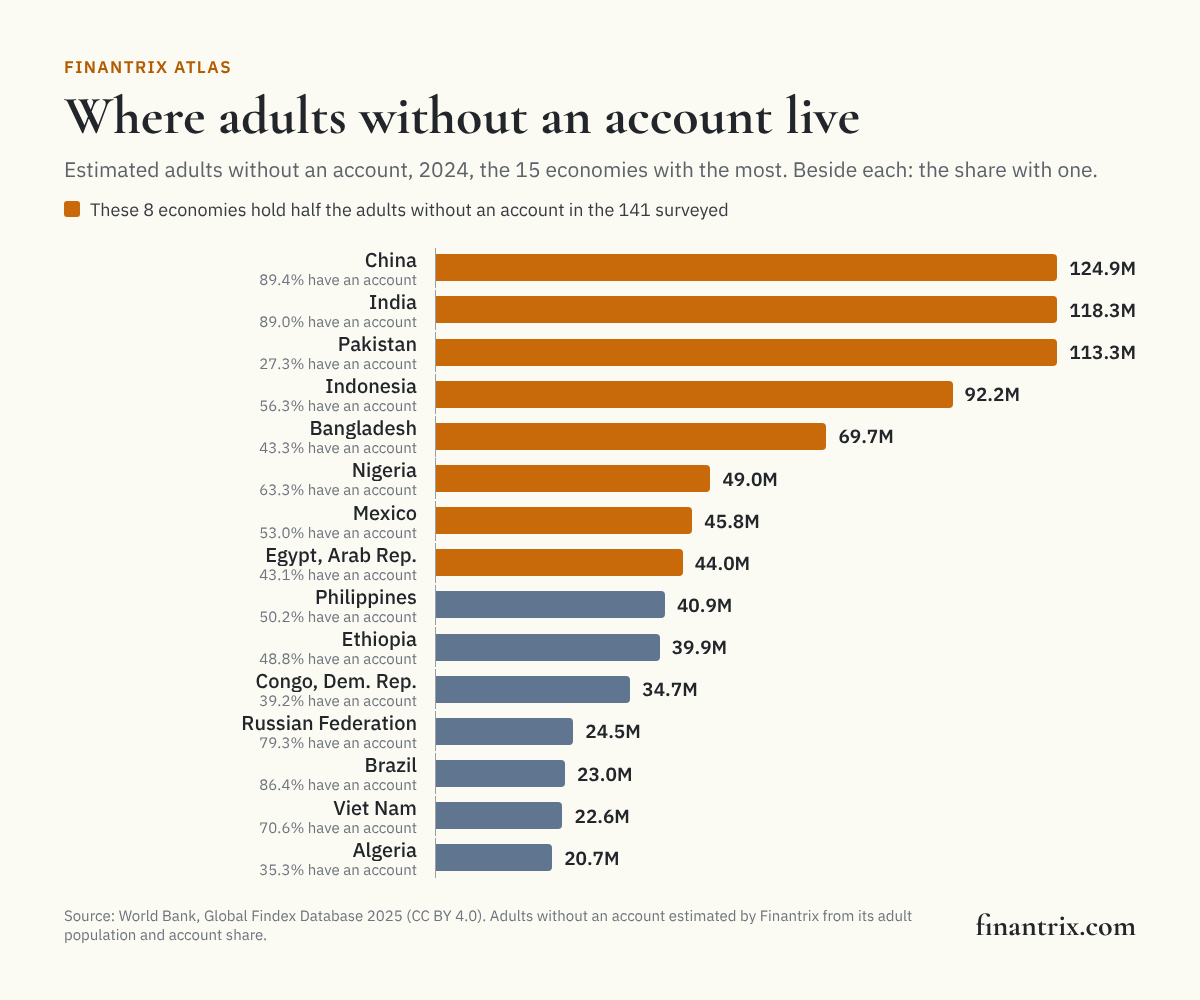
The 20 economies with the most adults without an account
An account is one at a bank or similar financial institution, or a mobile money account, held alone or with someone else, as the World Bank defines it. Digital payments are shown where the 2025 survey asked about them.
| Economy | Region (World Bank) | Income group | Adults without an account (estimate) | Adults with an account | Made or received a digital payment | Source |
|---|---|---|---|---|---|---|
| China | East Asia & Pacific (excluding high income) | Upper middle income | 124.9 million | 89.4% | 88.7% | World Bank |
| India | South Asia (excluding high income) | Lower middle income | 118.3 million | 89.0% | 48.5% | World Bank |
| Pakistan | South Asia (excluding high income) | Lower middle income | 113.3 million | 27.3% | 24.6% | World Bank |
| Indonesia | East Asia & Pacific (excluding high income) | Lower middle income | 92.2 million | 56.3% | 42.7% | World Bank |
| Bangladesh | South Asia (excluding high income) | Lower middle income | 69.7 million | 43.3% | 33.9% | World Bank |
| Nigeria | Sub-Saharan Africa (excluding high income) | Lower middle income | 49.0 million | 63.3% | 54.5% | World Bank |
| Mexico | Latin America & Caribbean (excluding high income) | Upper middle income | 45.8 million | 53.0% | 41.4% | World Bank |
| Egypt, Arab Rep. | Middle East & North Africa (excluding high income) | Lower middle income | 44.0 million | 43.1% | 36.3% | World Bank |
| Philippines | East Asia & Pacific (excluding high income) | Lower middle income | 40.9 million | 50.2% | 40.3% | World Bank |
| Ethiopia | Sub-Saharan Africa (excluding high income) | Low income | 39.9 million | 48.8% | 20.7% | World Bank |
| Congo, Dem. Rep. | Sub-Saharan Africa (excluding high income) | Low income | 34.7 million | 39.2% | 37.1% | World Bank |
| Russian Federation | Europe & Central Asia (excluding high income) | Upper middle income | 24.5 million | 79.3% | not published | World Bank |
| Brazil | Latin America & Caribbean (excluding high income) | Upper middle income | 23.0 million | 86.4% | 77.4% | World Bank |
| Viet Nam | East Asia & Pacific (excluding high income) | Lower middle income | 22.6 million | 70.6% | 62.4% | World Bank |
| Algeria | Middle East & North Africa (excluding high income) | Lower middle income | 20.7 million | 35.3% | 13.1% | World Bank |
| Iraq | Middle East & North Africa (excluding high income) | Upper middle income | 19.8 million | 30.2% | 25.0% | World Bank |
| Colombia | Latin America & Caribbean (excluding high income) | Upper middle income | 17.8 million | 57.1% | 49.2% | World Bank |
| Morocco | Middle East & North Africa (excluding high income) | Lower middle income | 15.5 million | 44.4% | 32.0% | World Bank |
| Tanzania | Sub-Saharan Africa (excluding high income) | Lower middle income | 15.3 million | 59.8% | 57.1% | World Bank |
| Madagascar | Sub-Saharan Africa (excluding high income) | Low income | 14.2 million | 24.5% | 21.7% | World Bank |
Download this table (CSV), free. The full dataset, every economy in the database at its latest survey year with its adult population, account, financial institution, mobile money and digital payment shares, is one email away.
The lowest shares of adults with an account
| Economy | Adults with an account | Adults without an account (estimate) | Source |
|---|---|---|---|
| Niger | 14.8% | 11.8 million | World Bank |
| Chad | 20.9% | 8.1 million | World Bank |
| Lebanon | 23.0% | 3.3 million | World Bank |
| Nicaragua | 23.5% | 3.7 million | World Bank |
| Madagascar | 24.5% | 14.2 million | World Bank |
| Pakistan | 27.3% | 113.3 million | World Bank |
| Mauritania | 27.3% | 2.1 million | World Bank |
| Iraq | 30.2% | 19.8 million | World Bank |
| Libya | 33.1% | 3.5 million | World Bank |
| Algeria | 35.3% | 20.7 million | World Bank |
The United States among high-income economies
According to the World Bank, 97.0% of adults in the United States had an account in 2024, an estimated 8.2 million without one. Of the 47 other high-income economies in the survey, 23 report a higher share. Survey estimates carry sampling error, so economies a few tenths of a point apart cannot be told apart.
According to the World Bank's notes to the database, the 2025 survey asked about the use of accounts, including digital payments, only in low- and middle-income economies. So the digital payment figure for each economy below is from the latest edition that asked it, and 6 economies the database classes as high income do have a 2024 figure. For the United States the latest is 2021: 93.0% of adults made or received a digital payment, according to the World Bank.
| Economy | Adults with an account | Adults without an account (estimate) | Made or received a digital payment (latest year asked) | Source |
|---|---|---|---|---|
| Iceland | 99.9% | 0.0 million | 99.9% (2021) | World Bank |
| Finland | 99.8% | 0.0 million | 98.5% (2021) | World Bank |
| Austria | 99.5% | 0.0 million | 99.3% (2021) | World Bank |
| United Kingdom | 99.3% | 0.4 million | 99.2% (2021) | World Bank |
| France | 99.2% | 0.5 million | 98.4% (2021) | World Bank |
| Netherlands | 99.2% | 0.1 million | 98.8% (2021) | World Bank |
| Lithuania | 99.0% | 0.0 million | 90.8% (2021) | World Bank |
| Estonia | 98.9% | 0.0 million | 98.7% (2021) | World Bank |
| Slovenia | 98.7% | 0.0 million | 97.0% (2021) | World Bank |
| Denmark | 98.7% | 0.1 million | 100.0% (2021) | World Bank |
| Sweden | 98.6% | 0.1 million | 99.1% (2021) | World Bank |
| Norway | 98.6% | 0.1 million | 99.5% (2021) | World Bank |
| Japan | 98.5% | 1.6 million | 95.8% (2021) | World Bank |
| Switzerland | 98.4% | 0.1 million | 98.2% (2021) | World Bank |
| Canada | 98.4% | 0.5 million | 98.3% (2021) | World Bank |
| Spain | 98.4% | 0.7 million | 97.5% (2021) | World Bank |
| Germany | 98.3% | 1.2 million | 99.5% (2021) | World Bank |
| Ireland | 98.3% | 0.1 million | 98.2% (2021) | World Bank |
| Belgium | 98.2% | 0.2 million | 97.4% (2021) | World Bank |
| Australia | 98.0% | 0.4 million | 98.9% (2021) | World Bank |
| Singapore | 98.0% | 0.1 million | 94.8% (2021) | World Bank |
| New Zealand | 97.9% | 0.1 million | 97.6% (2021) | World Bank |
| Hong Kong SAR, China | 97.3% | 0.2 million | 92.8% (2021) | World Bank |
| United States | 97.0% | 8.2 million | 93.0% (2021) | World Bank |
| Korea, Rep. | 96.9% | 1.4 million | 97.9% (2021) | World Bank |
| Malta | 96.6% | 0.0 million | 90.7% (2021) | World Bank |
| Cyprus | 96.1% | 0.0 million | 87.2% (2021) | World Bank |
| Taiwan, China | 95.6% | 0.9 million | 87.7% (2021) | World Bank |
| Latvia | 95.0% | 0.1 million | 95.3% (2021) | World Bank |
| Croatia | 92.6% | 0.2 million | 88.5% (2024) | World Bank |
| Czechia | 92.3% | 0.7 million | 94.1% (2021) | World Bank |
| Slovak Republic | 92.2% | 0.4 million | 94.6% (2021) | World Bank |
| Portugal | 91.4% | 0.8 million | 90.6% (2021) | World Bank |
| Israel | 89.3% | 0.8 million | 91.2% (2021) | World Bank |
| Greece | 88.6% | 1.0 million | 91.4% (2021) | World Bank |
| Hungary | 87.0% | 1.1 million | 86.4% (2021) | World Bank |
| Poland | 86.1% | 4.3 million | 82.1% (2024) | World Bank |
| Italy | 86.0% | 7.2 million | 95.8% (2021) | World Bank |
| Chile | 85.1% | 2.4 million | 84.3% (2021) | World Bank |
| Bahrain | 82.3% | 0.2 million | 77.3% (2017) | World Bank |
| Saudi Arabia | 78.8% | 5.3 million | 75.7% (2024) | World Bank |
| Trinidad and Tobago | 74.6% | 0.3 million | 64.1% (2017) | World Bank |
| Kuwait | 74.5% | 1.0 million | 74.8% (2017) | World Bank |
| Uruguay | 73.7% | 0.7 million | 68.0% (2021) | World Bank |
| United Arab Emirates | 73.1% | 2.4 million | 76.6% (2021) | World Bank |
| Romania | 71.3% | 4.6 million | 63.6% (2024) | World Bank |
| Oman | 69.5% | 1.2 million | 60.4% (2024) | World Bank |
| Panama | 64.1% | 1.2 million | 52.1% (2024) | World Bank |
By region and income group
These are the World Bank's own aggregates.
| Group (World Bank aggregate) | Adults with an account | Source |
|---|---|---|
| World | 78.7% | World Bank |
| High income | 94.9% | World Bank |
| Upper middle income | 84.0% | World Bank |
| East Asia & Pacific (excluding high income) | 83.3% | World Bank |
| Europe & Central Asia (excluding high income) | 77.8% | World Bank |
| South Asia | 77.6% | World Bank |
| Developing economies | 75.4% | World Bank |
| Lower middle income | 70.4% | World Bank |
| Latin America & Caribbean (excluding high income) | 69.7% | World Bank |
| Sub-Saharan Africa (excluding high income) | 58.2% | World Bank |
| Middle East & North Africa (excluding high income) | 52.9% | World Bank |
| Low income | 46.4% | World Bank |
Economies not in the 2024 survey
These economies appear in earlier editions of the database but not in the 2025 edition's survey, so they are not ranked above. Their latest figures are shown with the year.
| Economy | Latest survey year in the database | Adults with an account, that year | Source |
|---|---|---|---|
| Yemen, Rep. | 2022 | 11.9% | World Bank |
| Afghanistan | 2021 | 9.7% | World Bank |
| Jamaica | 2021 | 73.3% | World Bank |
| Myanmar | 2021 | 47.8% | World Bank |
| South Sudan | 2021 | 5.8% | World Bank |
| Belarus | 2017 | 81.2% | World Bank |
| Central African Republic | 2017 | 13.7% | World Bank |
| Haiti | 2017 | 32.6% | World Bank |
| Luxembourg | 2017 | 98.8% | World Bank |
| Maldives | 2017 | 79.5% | World Bank |
| Rwanda | 2017 | 50.0% | World Bank |
| Turkmenistan | 2017 | 40.6% | World Bank |
| Angola | 2014 | 29.3% | World Bank |
| Bhutan | 2014 | 33.7% | World Bank |
| Burundi | 2014 | 7.1% | World Bank |
| Puerto Rico | 2014 | 69.7% | World Bank |
| Somalia | 2014 | 38.7% | World Bank |
| Sudan | 2014 | 15.3% | World Bank |
| Djibouti | 2011 | 12.3% | World Bank |
| Qatar | 2011 | 65.9% | World Bank |
| Syrian Arab Republic | 2011 | 23.3% | World Bank |
What this means for technology buyers
Reaching adults without an account means onboarding customers who may have few records, on core and payment systems that can serve small balances at low cost. These guides compare the options:
- Core banking systems for neobanks and digital-only banks: the ledger under a digital-first account.
- KYC automation platforms: verifying a new customer who may have thin records.
- Real-time payments platforms: the payment rails that make an account useful from the first day.
Mapping the business? The Retail Bank Business Capability Model maps what a retail bank does, from taking deposits to moving money.
More from Finantrix Atlas
How this list was built
The universe is every economy with an all-adult account estimate for 2024 in the World Bank's Global Findex Database 2025, read from the country-level workbook on the Findex download page. Each figure was checked against the same indicator in the World Bank's data API, in the Findex source and in World Development Indicators: every value the API carries matches the workbook, and the economy-years it does not carry are named in the Limits.
Adults without an account are the workbook's adult population multiplied by the share without an account. Added up over the surveyed economies, they give 78.0% with an account, close to but not the same as the World Bank's world figure of 78.7%, which is the World Bank's own aggregate.
Limits
- Survey estimates. Findex figures are estimates from surveys of adults in each economy, and each carries sampling error. Small differences between economies are not meaningful.
- Not every economy. 141 economies were surveyed for 2024; 21 more appear only in earlier editions and are listed apart. Economies never surveyed are not in the database.
- An account is not use. Having an account says nothing about how often it is used, and an account can be held jointly.
- Digital payments by edition. The 2025 edition asked about digital payments only in low- and middle-income economies, according to the World Bank; most high-income figures are from earlier editions, and each says its year.
- The World Bank's two copies. Every figure in the workbook matches the World Bank's data API, except that the API's Findex series does not carry Morocco for 2017 or United Arab Emirates for 2024, and World Development Indicators does not carry Taiwan, China or United Arab Emirates for 2024. The workbook's figures are used.
- The estimate of adults without an account is ours. It multiplies the World Bank's published share by its adult population and inherits the error of both.
- Data date. Survey year 2024, from the Global Findex Database 2025.
Cite this
Free to quote, cite and republish, including the chart, with credit to Finantrix Atlas and a link to this page.
8 economies hold half of the estimated 1.27 billion adults without a financial account, according to a Finantrix Atlas analysis of the World Bank's Global Findex Database 2025.
Suggested citation: Finantrix Atlas, "Account Ownership Around the World," 2024 survey data, from the World Bank, Global Findex Database 2025, licensed under CC BY 4.0. Adults without an account computed by Finantrix Atlas. https://www.finantrix.com/articles/account-ownership-global
Data credit: World Bank, Global Findex Database 2025, used under the Creative Commons Attribution 4.0 International license as the World Bank's data licensing terms set out. Changes: Finantrix Atlas computed the number of adults without an account and ordered the economies; the shares are as published.
Embed the chart:
<a href="https://www.finantrix.com/articles/account-ownership-global"><img src="https://www.finantrix.com/atlas/account-ownership-global.png" alt="Where adults without a financial account live, from Finantrix Atlas"></a>
<p>Chart: <a href="https://www.finantrix.com/articles/account-ownership-global">Finantrix Atlas</a>, from World Bank Global Findex data (CC BY 4.0).</p>
Frequently asked questions
Q: What share of adults in the world have a bank account? A: 78.7% of adults had an account at a financial institution or a mobile money account in 2024, according to the World Bank's Global Findex 2025, up from 50.6% in 2011.
Q: How many adults do not have a bank account? A: An estimated 1.27 billion adults in the 141 economies the Global Findex surveyed for 2024, by Finantrix Atlas's calculation from the World Bank's data.
Q: Which country has the most adults without a bank account? A: China, with an estimated 124.9 million adults without an account, although 89.4% of its adults have one, from World Bank Findex data.
Q: What share of Americans have a bank account? A: 97.0% of adults in the United States had an account in 2024, according to the World Bank's Global Findex 2025.
Download the data
The 20 rows on this page (CSV), free. The full dataset has all 162 rows, as of December 31, 2024; we email you a link.
Frequently Asked Questions
What share of adults in the world have a bank account?
78.7% of adults had an account at a financial institution or a mobile money account in 2024, according to the World Bank's Global Findex 2025, up from 50.6% in 2011.
How many adults do not have a bank account?
An estimated 1.27 billion adults in the 141 economies the Global Findex surveyed for 2024, by Finantrix Atlas's calculation from the World Bank's data.
Which country has the most adults without a bank account?
China, with an estimated 124.9 million adults without an account, although 89.4% of its adults have one, from World Bank Findex data.
What share of Americans have a bank account?
97.0% of adults in the United States had an account in 2024, according to the World Bank's Global Findex 2025.