Key Takeaways
- The eleven Federal Home Loan Banks had 6,297 members on June 30, 2026, according to FHFA: 3,948 banks and savings institutions, 1,641 credit unions and 625 insurance companies.
- 93% of FDIC-insured banks are members, but 2,227 banks had FHLB advances outstanding, $532 billion in all, according to FDIC Call Reports.
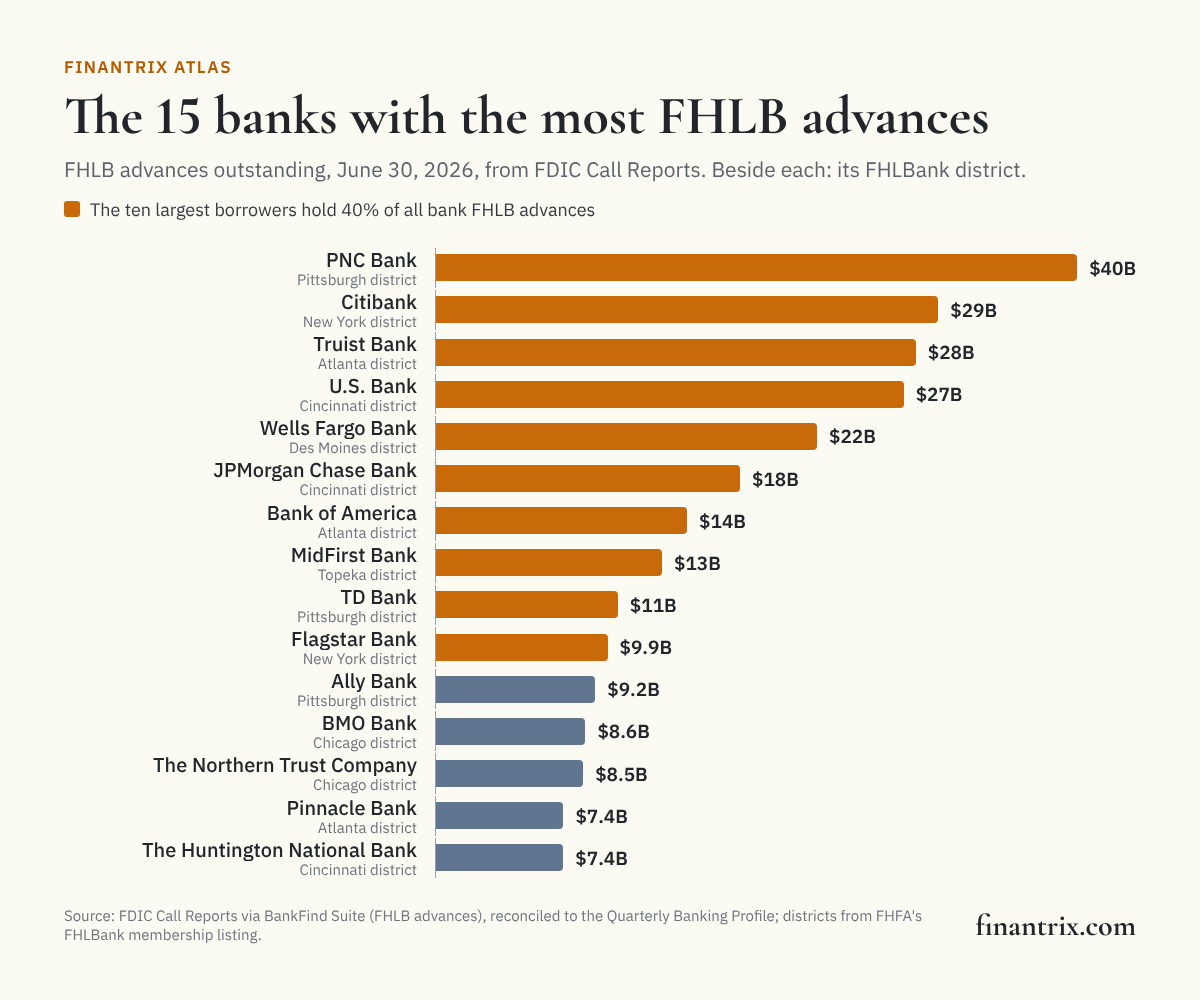
- The ten banks with the most FHLB advances held 40% of all bank advances on June 30, 2026, led by PNC Bank with $40.4 billion, from FDIC data.
- Des Moines is the largest district by members, with 1,205, according to FHFA's listing.
93% of FDIC-insured banks are members of a Federal Home Loan Bank, but only 57% of those members had FHLB advances outstanding on June 30, 2026, according to FHFA and FDIC data. The ten banks with the most owed 40% of the $532 billion in advances on bank balance sheets. The largest single borrower was PNC Bank, with $40.4 billion, according to its Call Report.
The eleven Federal Home Loan Banks had 6,297 members on June 30, 2026, according to FHFA's membership listing: 3,948 banks and savings institutions, 1,641 credit unions, 625 insurance companies and 83 community development financial institutions. FHFA lists members, not borrowers, so the borrowing on this page is the banks' own, from the FDIC.
The 20 banks with the most FHLB advances
FHLB advances outstanding on June 30, 2026, as each bank reported them in its Call Report, with the FHLBank district FHFA lists the bank in. Each row is one bank charter.
| Rank | Bank | Headquarters | FHLBank district (FHFA) | Total assets | FHLB advances | Advances as share of assets | Source |
|---|---|---|---|---|---|---|---|
| 1 | PNC Bank | Wilmington, DE | Pittsburgh | $610 billion | $40.4 billion | 6.6% | FDIC |
| 2 | Citibank | Sioux Falls, SD | New York | $1.98 trillion | $29.0 billion | 1.5% | FDIC |
| 3 | Truist Bank | Charlotte, NC | Atlanta | $548 billion | $27.7 billion | 5.1% | FDIC |
| 4 | U.S. Bank | Cincinnati, OH | Cincinnati | $706 billion | $27.0 billion | 3.8% | FDIC |
| 5 | Wells Fargo Bank | Sioux Falls, SD | Des Moines | $1.91 trillion | $22.0 billion | 1.2% | FDIC |
| 6 | JPMorgan Chase Bank | Columbus, OH | Cincinnati | $4.09 trillion | $17.6 billion | 0.4% | FDIC |
| 7 | Bank of America | Charlotte, NC | Atlanta | $2.65 trillion | $14.5 billion | 0.5% | FDIC |
| 8 | MidFirst Bank | Oklahoma City, OK | Topeka | $42.8 billion | $13.1 billion | 30.5% | FDIC |
| 9 | TD Bank | Wilmington, DE | Pittsburgh | $343 billion | $10.5 billion | 3.1% | FDIC |
| 10 | Flagstar Bank | Hicksville, NY | New York | $87.7 billion | $9.9 billion | 11.3% | FDIC |
| 11 | Ally Bank | Sandy, UT | Pittsburgh | $188 billion | $9.2 billion | 4.9% | FDIC |
| 12 | BMO Bank | Chicago, IL | Chicago | $255 billion | $8.6 billion | 3.4% | FDIC |
| 13 | The Northern Trust Company | Chicago, IL | Chicago | $179 billion | $8.5 billion | 4.8% | FDIC |
| 14 | Pinnacle Bank | Nashville, TN | Atlanta | $129 billion | $7.4 billion | 5.7% | FDIC |
| 15 | The Huntington National Bank | Columbus, OH | Cincinnati | $283 billion | $7.4 billion | 2.6% | FDIC |
| 16 | Old National Bank | Evansville, IN | Indianapolis | $73.9 billion | $6.5 billion | 8.8% | FDIC |
| 17 | Citizens Bank | Providence, RI | Boston | $233 billion | $6.4 billion | 2.7% | FDIC |
| 18 | Fifth Third Bank | Cincinnati, OH | Cincinnati | $299 billion | $6.0 billion | 2.0% | FDIC |
| 19 | Western Alliance Bank | Phoenix, AZ | San Francisco | $98.6 billion | $5.8 billion | 5.9% | FDIC |
| 20 | Third Federal Savings and Loan Association of Cleveland | Cleveland, OH | Cincinnati | $18.1 billion | $5.6 billion | 31.3% | FDIC |
Download this table (CSV), free. The full dataset, every one of the 6,297 members with its district, type, identifiers and, for banks, its total assets and FHLB advances, is one email away.
Members by district
According to FHFA, a member joins the district that serves the state of its home office or principal place of business. The table counts members by type in each district, according to FHFA's listing, and adds the FHLB advances that member banks in the district reported to the FDIC. Des Moines has the most members, with 1,205, and Pittsburgh the fewest, with 277, according to FHFA. By the advances on member banks' balance sheets, Cincinnati is the largest district, with $77.3 billion, from FDIC data.
| District | Members | Banks and savings institutions | Credit unions | Insurance companies | CDFIs | Change in a year | Advances at member banks | Source |
|---|---|---|---|---|---|---|---|---|
| Des Moines | 1,205 | 850 | 271 | 77 | 7 | −33 | $57.1 billion | FHFA, FDIC |
| Atlanta | 769 | 442 | 249 | 61 | 17 | −18 | $76.0 billion | FHFA, FDIC |
| Dallas | 768 | 553 | 138 | 68 | 9 | −24 | $27.2 billion | FHFA, FDIC |
| Topeka | 641 | 516 | 91 | 30 | 4 | −19 | $28.6 billion | FHFA, FDIC |
| Chicago | 629 | 444 | 103 | 73 | 9 | −6 | $40.3 billion | FHFA, FDIC |
| Cincinnati | 588 | 376 | 148 | 57 | 7 | −15 | $77.3 billion | FHFA, FDIC |
| Boston | 417 | 173 | 155 | 87 | 2 | −9 | $35.3 billion | FHFA, FDIC |
| Indianapolis | 350 | 157 | 145 | 43 | 5 | −5 | $20.4 billion | FHFA, FDIC |
| New York | 329 | 152 | 111 | 57 | 9 | +4 | $76.6 billion | FHFA, FDIC |
| San Francisco | 324 | 129 | 160 | 24 | 11 | −4 | $18.9 billion | FHFA, FDIC |
| Pittsburgh | 277 | 156 | 70 | 48 | 3 | −8 | $74.7 billion | FHFA, FDIC |
Who the members are
Membership fell from 6,434 on June 30, 2025 to 6,297 on June 30, 2026, according to FHFA: by FHFA's member ID, 75 institutions joined the listing and 212 left it.
| Member type (FHFA) | Members, June 30, 2026 | A year earlier | Change | Source |
|---|---|---|---|---|
| Commercial banks | 3,471 | 3,560 | −89 | FHFA |
| Savings banks | 243 | 273 | −30 | FHFA |
| Savings associations | 234 | 272 | −38 | FHFA |
| Credit unions | 1,641 | 1,643 | −2 | FHFA |
| Insurance companies | 625 | 604 | +21 | FHFA |
| Community development financial institutions | 83 | 82 | +1 | FHFA |
Which banks borrow
According to the FDIC, 3,941 of the 4,238 FDIC-insured banks that filed a Call Report for June 30, 2026 are on FHFA's membership listing, and together they hold 98% of insured bank assets. 2,227 banks reported FHLB advances, and every one of them is on the listing, according to FHFA and FDIC data. Across all insured banks, advances were 2.0% of total assets; at the median borrowing bank they were 3.6%, according to FDIC Call Reports.
| Bank size (FDIC QBP group) | Insured banks | FHLBank members | Share that are members | Banks with advances | Advances | Source |
|---|---|---|---|---|---|---|
| Less than $100 million | 543 | 400 | 74% | 135 | $537 million | FDIC, FHFA |
| $100 million to $1 billion | 2,647 | 2,521 | 95% | 1,374 | $27.3 billion | FDIC, FHFA |
| $1 billion to $10 billion | 890 | 869 | 98% | 605 | $91.9 billion | FDIC, FHFA |
| $10 billion to $250 billion | 140 | 133 | 95% | 97 | $187 billion | FDIC, FHFA |
| More than $250 billion | 18 | 18 | 100% | 16 | $225 billion | FDIC, FHFA |
Credit unions
According to NCUA and FHFA data, 1,582 of the 4,214 federally insured credit unions that filed a Call Report for the quarter are FHLBank members, 38% of them, and they hold 94% of federally insured credit union assets. The NCUA's own Call Report asks each credit union whether it is a member: 1,591 of the 1,622 on FHFA's listing say yes, according to the NCUA.
19 credit union members on FHFA's listing are not in the NCUA's quarterly file of credit union Call Reports; 10 of them are corporate credit unions by name, and two have no NCUA charter number. In the NCUA's file for this quarter, the account for each credit union's total borrowing from FHLBanks is zero for every credit union while a narrower account for line-of-credit draws is not, so credit union borrowing is not totaled here.
What this means for technology buyers
Membership is a source of funding a bank can draw on, not only a loan it has taken: 43% of member banks owed nothing on June 30, 2026, according to FDIC data. Drawing on it depends on the collateral a bank has pledged and on how well its treasury team can see its liquidity, which is where these systems come in. These guides compare the options side by side:
- Treasury and liquidity management solutions: cash, funding and liquidity positions in one place.
- Deposit management platforms for retail banks: the other side of a bank's funding.
- Mortgage loan origination systems: the mortgage side of a member bank's lending.
- Financial BI and dashboards for bank executives: seeing funding, collateral and liquidity together.
Mapping the business? The Retail Bank Business Capability Model maps what a bank does, including treasury and funding.
More from Finantrix Atlas
- Largest banks in the US
- US banks by size: how many in each asset tier
- Largest credit unions
- CDFI banks
- Largest mortgage lenders
How this list was built
Members are every row of FHFA's FHLBank membership listing for June 30, 2026, the newest FHFA publishes, compared with the listing for June 30, 2025 by FHFA's member ID. Each bank member is joined to its FDIC Call Report for the same date by its FDIC certificate number, and each credit union to its NCUA Call Report by its charter number; nothing is matched by name.
Advances are each bank's "FHLB advances" as the FDIC defines the field: borrowings from Federal Home Loan Banks, from the Call Report. Summed over every FDIC-insured commercial bank and savings institution, they equal the FDIC's own Quarterly Banking Profile line for FHLB advances, $532 billion, to the million dollars. Bank sizes are the Quarterly Banking Profile's asset groups.
Limits
- Members are not borrowers. FHFA's listing names members. Borrowing is shown only for banks, from their Call Reports; credit unions, insurance companies and CDFIs are counted as members only, because no government source used here publishes their FHLB borrowing per institution in a usable form. Insurance company borrowing is therefore not on this page.
- One day's balance. Advances are outstanding on June 30, 2026. A bank that borrows and repays within the quarter can show none.
- Banks, not holding companies. A holding company with several bank charters appears once per charter, and each charter is a member on its own.
- District is where the member is, not where it borrowed. The district column is the one FHFA lists the bank in; the Call Report does not say which FHLBank lent the advances.
- A few members match nothing. 7 of FHFA's bank members have no FDIC Call Report for the date, according to FHFA and FDIC data, and 19 credit union members are not in the NCUA's file; they are counted as members and left out of the rates.
- Data date. FHFA's listing and the Call Reports are both as of June 30, 2026.
Cite this
Free to quote, cite and republish, including the chart, with credit to Finantrix Atlas and a link to this page.
93% of FDIC-insured banks are Federal Home Loan Bank members, but 57% of them had advances outstanding on June 30, 2026, according to a Finantrix Atlas analysis of FHFA and FDIC data.
The ten US banks with the most FHLB advances owed 40% of the $532 billion on bank balance sheets on June 30, 2026, according to Finantrix Atlas, from FDIC Call Reports.
Suggested citation: Finantrix Atlas, "Federal Home Loan Bank Membership by District," data as of June 30, 2026, from FHFA FHLBank membership data and FDIC Call Reports. https://www.finantrix.com/articles/fhlbank-members
Embed the chart:
<a href="https://www.finantrix.com/articles/fhlbank-members"><img src="https://www.finantrix.com/atlas/fhlbank-members.png" alt="US banks with the most Federal Home Loan Bank advances, from FDIC data, by Finantrix Atlas"></a>
<p>Chart: <a href="https://www.finantrix.com/articles/fhlbank-members">Finantrix Atlas</a>, from FDIC Call Reports and FHFA membership data.</p>
Frequently asked questions
Q: How many members do the Federal Home Loan Banks have? A: 6,297 on June 30, 2026, according to FHFA, across eleven FHLBanks. Des Moines has the most, with 1,205.
Q: Which bank borrows the most from the Federal Home Loan Banks? A: PNC Bank, with $40.4 billion in FHLB advances outstanding on June 30, 2026, according to its Call Report filed with the FDIC.
Q: How much do banks owe the Federal Home Loan Banks? A: $532 billion in FHLB advances on June 30, 2026, across 2,227 FDIC-insured banks, according to FDIC Call Reports. The figure equals the FDIC's Quarterly Banking Profile total.
Q: Can credit unions join a Federal Home Loan Bank? A: Yes. 1,641 credit unions were members on June 30, 2026, according to FHFA, and 38% of federally insured credit unions are on its listing, according to FHFA and NCUA data.
Download the data
The 20 rows on this page (CSV), free. The full dataset has all 6,297 rows, as of June 30, 2026; we email you a link.
Frequently Asked Questions
How many members do the Federal Home Loan Banks have?
6,297 on June 30, 2026, according to FHFA, across eleven FHLBanks. Des Moines has the most, with 1,205.
Which bank borrows the most from the Federal Home Loan Banks?
PNC Bank, with $40.4 billion in FHLB advances outstanding on June 30, 2026, according to its Call Report filed with the FDIC.
How much do banks owe the Federal Home Loan Banks?
$532 billion in FHLB advances on June 30, 2026, across 2,227 FDIC-insured banks, according to FDIC Call Reports. The figure equals the FDIC's Quarterly Banking Profile total.
Can credit unions join a Federal Home Loan Bank?
Yes. 1,641 credit unions were members on June 30, 2026, according to FHFA, and 38% of federally insured credit unions are on its listing, according to FHFA and NCUA data.