
Key Takeaways
- Three banks hold 54.0% of the $1.19 trillion in credit card loans on the books of FDIC-insured US banks, according to FDIC Call Report data for June 30, 2026.
- Capital One holds the most, $251 billion, followed by JPMorgan Chase Bank with $216 billion, according to the FDIC.
- The ten largest card lenders hold 91.8% of bank card loans, while 668 banks report card loans above zero, according to FDIC data.
- The banks' card loans add up to the FDIC's own Quarterly Banking Profile total for the quarter, to the million dollars.
Three banks hold 54.0% of the credit card loans on the books of FDIC-insured US banks, according to FDIC Call Report data for June 30, 2026. Capital One holds the most, $251 billion, followed by JPMorgan Chase Bank with $216 billion and Citibank with $176 billion. Capital One's total includes the card loans of Discover Bank, which the FDIC records as merged into it on May 18, 2025: $98.9 billion at that bank's last Call Report, more than the $34.3 billion by which Capital One now leads JPMorgan Chase Bank, according to FDIC data.
This ranking covers all 4,238 FDIC-insured commercial banks and savings institutions that filed a Call Report for June 30, 2026, including 38 that have closed since. 668 of them report credit card loans above zero, $1.19 trillion between them, according to FDIC data.
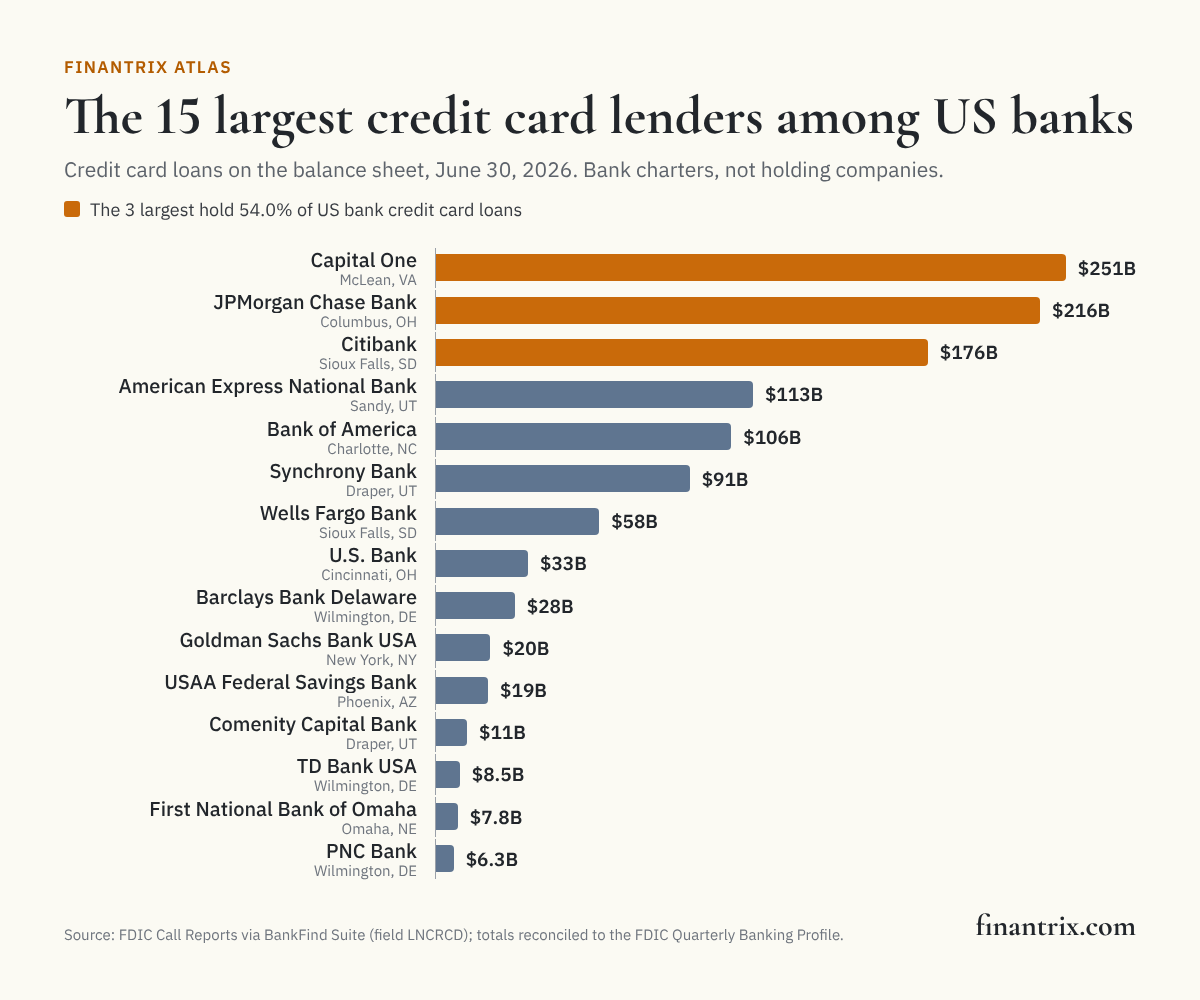
The 25 largest credit card lenders among US banks
Ranked by credit card loans on June 30, 2026. Each row is one bank charter; a holding company that owns more than one charter appears once per charter. The share of each bank's own loans that are card loans is shown beside it.
| Rank | Bank | Headquarters | Credit card loans | Share of bank card loans | Cards as share of the bank's loans | Total assets | Source |
|---|---|---|---|---|---|---|---|
| 1 | Capital One ◊ | McLean, VA | $251 billion | 21.1% | 55% | $662 billion | FDIC |
| 2 | JPMorgan Chase Bank | Columbus, OH | $216 billion | 18.2% | 14% | $4.09 trillion | FDIC |
| 3 | Citibank | Sioux Falls, SD | $176 billion | 14.8% | 23% | $1.98 trillion | FDIC |
| 4 | American Express National Bank | Sandy, UT | $113 billion | 9.5% | 66% | $214 billion | FDIC |
| 5 | Bank of America | Charlotte, NC | $106 billion | 8.9% | 9% | $2.65 trillion | FDIC |
| 6 | Synchrony Bank | Draper, UT | $90.8 billion | 7.6% | 92% | $115 billion | FDIC |
| 7 | Wells Fargo Bank | Sioux Falls, SD | $58.4 billion | 4.9% | 6% | $1.91 trillion | FDIC |
| 8 | U.S. Bank | Cincinnati, OH | $32.9 billion | 2.8% | 8% | $706 billion | FDIC |
| 9 | Barclays Bank Delaware | Wilmington, DE | $28.2 billion | 2.4% | 95% | $43.5 billion | FDIC |
| 10 | Goldman Sachs Bank USA | New York, NY | $19.5 billion | 1.6% | 8% | $759 billion | FDIC |
| 11 | USAA Federal Savings Bank | Phoenix, AZ | $18.6 billion | 1.6% | 40% | $106 billion | FDIC |
| 12 | Comenity Capital Bank | Draper, UT | $11.1 billion | 0.9% | 94% | $13.9 billion | FDIC |
| 13 | TD Bank USA | Wilmington, DE | $8.5 billion | 0.7% | 98% | $32.1 billion | FDIC |
| 14 | First National Bank of Omaha | Omaha, NE | $7.8 billion | 0.7% | 32% | $34.2 billion | FDIC |
| 15 | PNC Bank | Wilmington, DE | $6.3 billion | 0.5% | 2% | $610 billion | FDIC |
| 16 | Comenity Bank ‡ | Wilmington, DE | $6.3 billion | 0.5% | 100% | $7.4 billion | FDIC |
| 17 | Merrick Bank | South Jordan, UT | $6.3 billion | 0.5% | 72% | $9.1 billion | FDIC |
| 18 | TD Bank | Wilmington, DE | $4.8 billion | 0.4% | 3% | $343 billion | FDIC |
| 19 | Truist Bank | Charlotte, NC | $3.2 billion | 0.3% | 1% | $548 billion | FDIC |
| 20 | Stride Bank | Enid, OK | $2.9 billion | 0.2% | 58% | $5.4 billion | FDIC |
| 21 | Credit One Bank | Las Vegas, NV | $2.0 billion | 0.2% | 100% | $2.4 billion | FDIC |
| 22 | Citizens Bank | Providence, RI | $1.9 billion | 0.2% | 1% | $233 billion | FDIC |
| 23 | Fifth Third Bank | Cincinnati, OH | $1.7 billion | 0.1% | 1% | $299 billion | FDIC |
| 24 | Regions Bank | Birmingham, AL | $1.5 billion | 0.1% | 2% | $160 billion | FDIC |
| 25 | Banco Popular de Puerto Rico | San Juan, PR | $1.2 billion | 0.1% | 4% | $63.3 billion | FDIC |
‡ Closed after June 30, 2026: Comenity Bank on October 1, 2026. The FDIC records the end of the charter; the card loans shown are those it reported for June 30, 2026.
◊ A quarter or more of this figure was held by a bank the FDIC records as absorbed into it in the three years to June 30, 2026: Capital One absorbed Discover Bank on May 18, 2025, $98.9 billion of card loans at the last report, according to FDIC data.
Download this table (CSV), free. The full dataset, every insured bank that reports card loans with its identifiers, is one email away.
How concentrated bank card lending is
- The largest card lender holds 21.1% of credit card loans at FDIC-insured banks, according to FDIC data.
- The largest ten hold 91.8%, and the 25 in the table hold 98.8%, according to FDIC data. The smallest of them, Banco Popular de Puerto Rico, holds $1.2 billion, by FDIC figures.
- The other 643 banks that report card loans share the remaining 1.2%, according to FDIC data.
Card specialists and diversified banks
The table mixes two kinds of lender. For 10 of the 25 banks in it, credit card loans are more than half of everything the bank lends, according to FDIC data. For the others, card loans are less than half of what the bank lends. The column on each bank's own loan mix tells the two apart, because a bank's place in the ranking says how large its card book is, not how much of its business that book is.
What this means for technology buyers
A card book is a high-volume, revolving consumer loan: the issuer decides credit line by line, services balances every month and collects on the accounts that fall behind. For a bank whose lending is mostly cards, those systems carry most of its business. These guides compare the options side by side:
- Credit decision engines for consumer lending: card approvals, limits and the reasons behind them.
- Collections and recovery software for banks: the collection side of a card program.
- Predictive analytics platforms for credit risk: models for scoring and monitoring a revolving portfolio.
- Payment gateway solutions for banks: the transaction side of a card program.
Mapping the business behind the card program? The Payments Industry Capability Model sets out what a payments business does, from authorization and settlement to disputes, so a technology decision can be placed against the capabilities it supports.
More from Finantrix Atlas
- Credit card issuers by consumer complaints
- Largest banks in the US, ranked by total assets
- Largest US banks by deposits
- Consumer complaints by company
How this list was built
The universe is every FDIC-insured commercial bank and savings institution that filed a Call Report for June 30, 2026, read from the FDIC's BankFind Suite, including banks whose charter has ended since. Banks are ranked by the FDIC field LNCRCD, which the FDIC's field definitions describe as consumer loans extended through credit card plans. Amounts are balances on the bank's own balance sheet at quarter-end. Total loans and leases (LNLSGR) and total assets (ASSET) are from the same report.
The FDIC publishes the same quarter's industry totals in its Quarterly Banking Profile, the edition for the second quarter of 2026. Its population is the one used here: 4,238 institutions. Summed across them, the banks' credit card loans and total assets equal the Quarterly Banking Profile's figures to the million dollars it prints, a test that a dropped or double-counted bank would fail. BankFind also reports 66 uninsured filers, such as trust companies, and 9 insured US branches of foreign banks; the Quarterly Banking Profile leaves both out, and none of them reports card loans.
The Federal Reserve's Large Commercial Banks release, which the asset rankings are checked against, publishes assets and branch counts but not loans by type, so it cannot confirm this ranking. The check here is the FDIC's two products against each other. The same FDIC field supplies the card loans on the card complaints page, and the build requires the two pages to agree bank by bank when they describe the same quarter.
Limits
- Banks, not holding companies or brands. A group that issues cards through several charters appears once per charter, and card programs run by a company that is not an FDIC-insured bank are not counted.
- Credit unions are not included. They are insured by the NCUA and file a different report.
- Balances, not activity. Card loans are what cardholders owed on one day. They do not show accounts, cardholders, purchase volume or credit lines, and they leave out receivables a bank has sold.
- One quarter. The date of the data is June 30, 2026. A merger can move a bank up or down the list between filings.
Cite this
Free to quote, cite and republish, including the chart, with credit to Finantrix Atlas and a link to this page.
Three banks hold 54.0% of the credit card loans on the books of FDIC-insured US banks, and Capital One alone holds 21.1%, according to a Finantrix Atlas analysis of June 30, 2026 FDIC Call Report data.
FDIC-insured US banks held $1.19 trillion in credit card loans on June 30, 2026, according to Finantrix Atlas, from FDIC data.
Suggested citation: Finantrix Atlas, "Largest Credit Card Lenders Among US Banks," data as of June 30, 2026, from FDIC Call Reports and the FDIC Quarterly Banking Profile. https://www.finantrix.com/articles/largest-card-issuing-banks
Embed the chart:
<a href="https://www.finantrix.com/articles/largest-card-issuing-banks"><img src="https://www.finantrix.com/atlas/largest-card-issuing-banks.png" alt="The largest credit card lenders among US banks, from FDIC data, by Finantrix Atlas"></a>
<p>Chart: <a href="https://www.finantrix.com/articles/largest-card-issuing-banks">Finantrix Atlas</a>, from FDIC Call Reports.</p>
Frequently asked questions
Q: Which US bank holds the most credit card loans? A: Capital One, with $251 billion in credit card loans on June 30, 2026, according to its Call Report filed with the FDIC.
Q: How much credit card debt do US banks hold? A: $1.19 trillion in credit card loans at FDIC-insured banks on June 30, 2026, according to FDIC data. That is a balance on bank balance sheets; card debt owed to credit unions and other lenders is not included.
Q: How concentrated is credit card lending among banks? A: Three banks hold 54.0% of bank credit card loans, and the ten largest hold 91.8%, according to FDIC data for June 30, 2026.
Q: How many US banks make credit card loans? A: 668 of the 4,238 FDIC-insured banks report credit card loans above zero, according to FDIC data for June 30, 2026.
Q: Does this list include credit unions? A: No. Credit unions are insured by the NCUA, not the FDIC, and file a different report, so they are not ranked here.
Download the data
The 25 rows on this page (CSV), free. The full dataset has all 668 rows, as of June 30, 2026; we email you a link.
Frequently Asked Questions
Which US bank holds the most credit card loans?
Capital One, with $251 billion in credit card loans on June 30, 2026, according to its Call Report filed with the FDIC.
How much credit card debt do US banks hold?
$1.19 trillion in credit card loans at FDIC-insured banks on June 30, 2026, according to FDIC data. That is a balance on bank balance sheets; card debt owed to credit unions and other lenders is not included.
How concentrated is credit card lending among banks?
Three banks hold 54.0% of bank credit card loans, and the ten largest hold 91.8%, according to FDIC data for June 30, 2026.
How many US banks make credit card loans?
668 of the 4,238 FDIC-insured banks report credit card loans above zero, according to FDIC data for June 30, 2026.
Does this list include credit unions?
No. Credit unions are insured by the NCUA, not the FDIC, and file a different report, so they are not ranked here.